
In the 1920s, Latin American artists sought for new languages in the international arena. But in the particular atmosphere after World War I, these languages were adopted and distilled to suit a new continental American reality. Just as in the 19th and 20th centuries, an exhausted European modernism (like that of the Impressionists, Gauguin, Matisse, Picasso and Henry Moore) sought new forms in the Third World (Persia, Japan, Egypt, Tahiti, Algeria, sub Saharan Africa and Mexico itself), Latin American countries in this century appropiated European models for their nations as they achieved new dimensions of independence from the old colonizers. European models were absorbed and fused with what was local and regional. This was particularly true for Mexico, which had the first revolution of the 20th century in this hemiphere.
Not only did Mexico reject its mimetic academy as early as 1911, but after the, under the impetus of an educational policy that undertook to modernize the nation, it refurbished a project that included not only public murals, but a literacy program for masses of newly enfranchised people, an indigenous focus that recognized the modern political presence and the historical legacy of its numerous Indian peoples, and populist research that highlighted the rich tradition of indigenous/mestizo folk art and popular culture stretching into the present. In depth studies of these art forms were conducted as early as 1921 by Roberto Montenegro and Dr. Atl (pseudonym for Gerardo Murillo).
Preceding the Mexican Mural School of 1921 /1922, was the establishment in 1913 of the «Open Air» Schools and the Popular Painting and Sculpture Centers - despite the fact that the revolution was already underway. (1) This followed a now-famous 1911 student strike at the San Carlos Academy demanding up-to-date curriculum. The new director of San Carlos, painter Alfredo Ramos Martinez (appointed as a result of the strike) was convinced of the importace of French Impressionism, and the first «Open Air» Schools were his idea. Among its teachers, and those of the Centers, were artists like Fernando Castillo and Gabriel Fernandez Ledesma who were part of both the «nationalist» and «antinationalist» movements of the mid-1920s. In their early work, in addition to landscapes, which were the focus of the Open Air process,can already be seen the decorative and fantastic influence of folk arts. Not only did the Schools and Centers ventilate stuffy academic teaching practices until their demise in 1934, but they opened public instruction in the arts to young people who showed interest and promise, and marked an important moment in the democratization of mexican culture.
I would like to urgue —considering that internationalism has existed since the Renaissance when Europeans began to explore and conquer Africa, Asia and the Americas— that the nationalist / internationalist dichotomy— so visible in the literature of Mexican elite culture— is a false one. What was really at stake was not an internationalist vs. a nationalist (by which was meant a «provincial») art language, but the question of political vs. apolitical content. Practically all of the artists to be considered on both sides of the controversy studied and worked abroad. What produced the schism was the existence of two revolutions before the emergence of the Mexican School: the just-ended Mexican Revolution (1910-1920), and the Russian Revolution (1917). The latter introduced a working class and socialist political consciousness, some of which emerged in the most advanced and progressive Articles of the 1917 Mexican constitution which, in its time, was as radical as the U.S. constitution in the 18th century. Such issues were addressed as agrarian reform, protection for labor unions and the right to organize, rules for prohibing the outright sale of Mexican lands and their mineral wealth to foreign investors, etc. These concepts were as subversive to the landed Mexican aristocracy and the emerging laissez-faire industrialists, as the Bill of Rights constitutional amendments were to conservatives in the United States.
In what follows, I will not be discussing particular works of art, but illustrating the above thesis by the presentation of several groupings of artists in the 1920s and 1930s: the Mexican muralist and graphic movements; the Estridentistas (or Stridentists) of 1922-1927 who where also pro-revolutionary and political; the Contempora- neos (or Contemporaries) of 1928-1931 who articulated the anti-nationalist and apolitical position; and, finally, some of the North Americans who played an important role in Mexico during the same decades.
The International Nationalists
It is well known that Diego Rivera studied in Europe from 1906 until his departure in 1921 when he was recalled to Mexico, with a brief visit in 1910. His paintings demostrated his knowledge of Cezanne, and his skill with the Cubist vocabulary learned in Paris, although he was already modifying Synthetic Cubism not only with narrative aspects, but introducing the metaphysical elements inspired by the Italian painter Giorgio de Chirico. In two works from 1914 and 1915, he introduced Mexican references (the sarape, and characteristic objects from the Mexican Revolution) to further nationalize his work while still engaging Cubism.
Before leaving Europe (1921), he spent time in Italy studying early Renaissance murals and paintings, which he later applied to his own murals for spatial composition and relations between background and foreground. Rivera's earliest mural (1922) at the Preparatoria Nacional in Mexico City is still based on an Italian model: the Byzantine murals at Ravenna, including the use of gold leaf and a pompous mysticism. Only the central portion shows the impact of a trip to southern Mexico, which began to foreshadow his mature murals in a new fused style between European and Mexican sources. By 1929, with his magnum opus at the National Palace (completed in 1935 when he returned from the United States after his contorversy at Rockefeller Center), the spatial solutions of Cubism and Renaissance murals fused with a new iconography of domestic insurrection and the struggle against foreign invasions, along with the prediction of a Marxist future for Mexico. At both the Ministry of Education and the Agricultural School at Chapingo, Rivera addressed agrarian reform—a central (and never resolved) demand of the revolution.
Siqueiros, the youngest of the tres grandes, spent a much-shorter time in Europe: from 1919-1921 he was sent as an attache, but the studied European art, and published a short-lived magazine in Barcelona in which appeared the first writting that market him as a major theoretician of the Mexican School and muralism. He also sough out Rivera, whom he admired, and persuaded him to study Renaissance murals, while he himself was certainly aware of the Italian Futurists. After studying in the San Carlos Academy (and actively participating in the student strike), he had served in a military capacity during the revolution. An early self-portrait (c.1917) indicates his temporary use of the enervated styles of European Symbolism that penetrated Mexico at the end of the 19th century. By the 1930s, his portrait of a black woman illustrates the influence of Cubism, but with a three-dimensional realism.
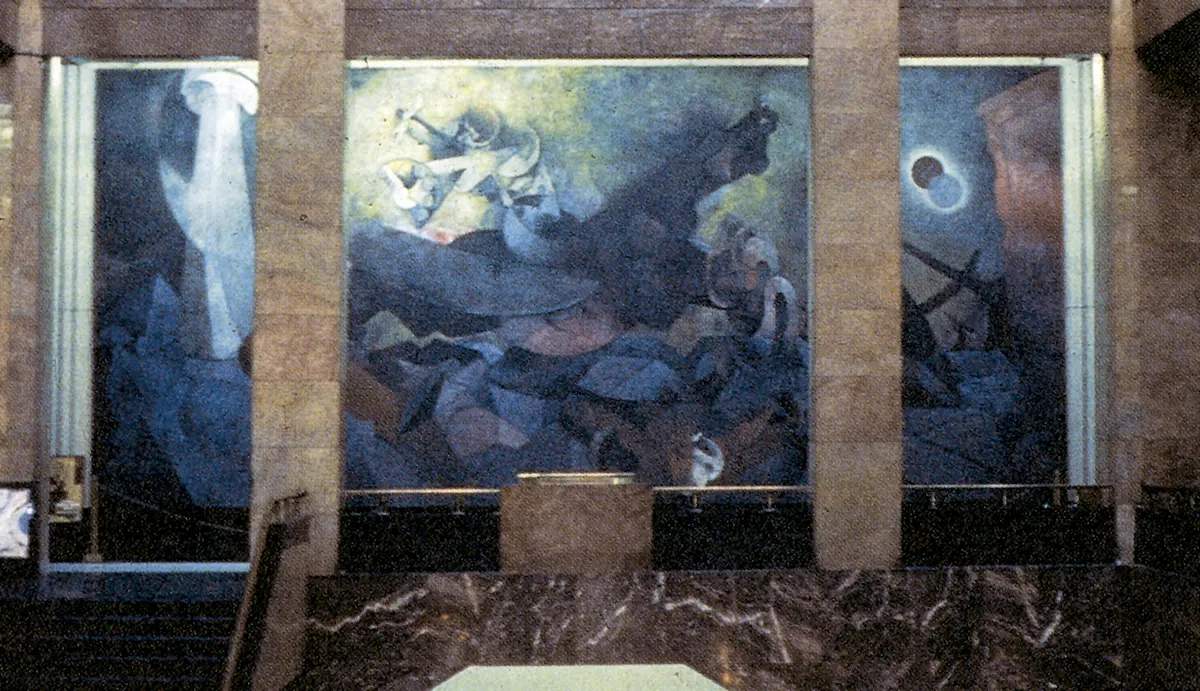
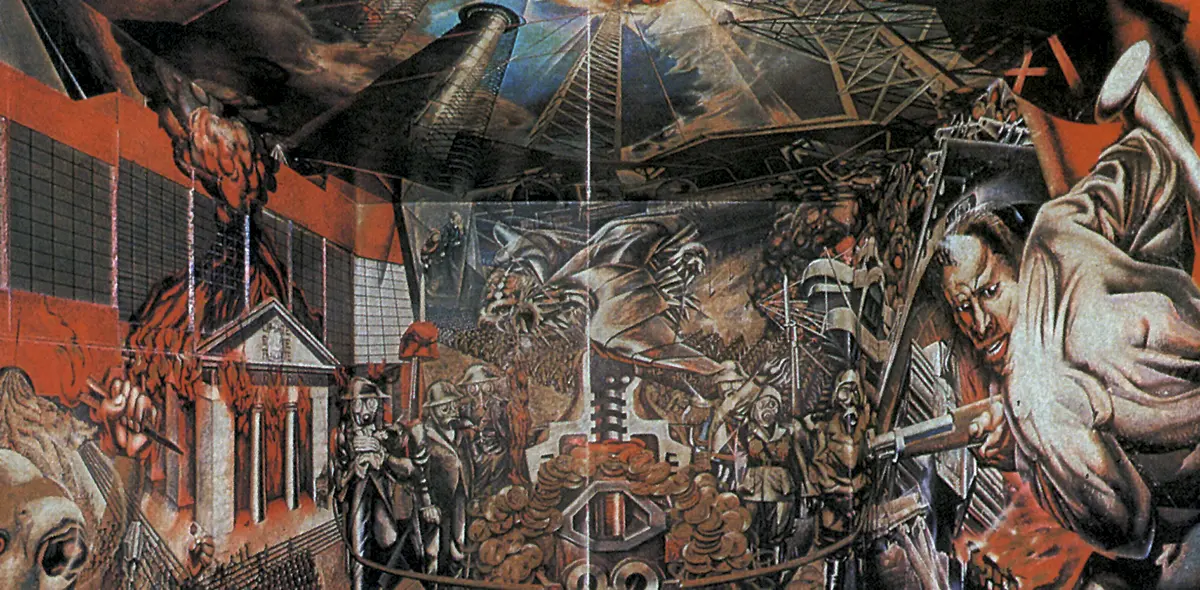
Siqueiros's mature realistic style registered the impact of both documentary photography and a fascination with filmic thecniques. Eisenstein's pioneering film montages (used in his 1925 film Battleship Potemkin), in addition to Futurist experiments with the representation of motion, became one nexus of Siqueiros's Style. He later combined this formal means with his pioneering adaptation of synthetic paints (which can be applied with an airbrush) in a Buenos Aires mural of 1933, a year after painting Tropical America in Los Angeles where he first explored new technologies and theories in the creation of a mural. The powerful resolution of these many ideas appeared in his mural at the headquarters of the Electricians' Syndicate of Mexico City in 1939. The demagogue (Hitler) with his arms and head in motion, as he is screwed up and down by Germany's social machinery (shown on a lower level), is surrounded by images taken from war photographs. In 1960-1965 (interrupted by still another jail term for his political activity), Siqueiros once again used the photograph as a source for his mural about the Mexican Revolution in the National History of Mexico City.
Of the three, Orozco was the only one who formed his style before traveling to Europe. His sources for figures painted in the United States in the 1930s show the influence of the late Italian and German Renaissance —encountered in reproductions in Mexico. Possibly Michelangelo or Tintoretto were the inspiration for the Prometheus in Pomona, California, and El Greco or the Isenheim Atarpiece of Grunewald provided a source for his Christ Destroying His Cross at Dartmouth College. However, Orozco's expressionism derived as well from the long history of Mexican caricature,, including that of Jose Guadalupe Posada, which he developed during his non-combatant experiences during the revolution.
Working against the grain of the current Frida cult —the frida-mama as it is called in Mexico— I would like to propose that, without the nationalist Mexican School, Frida Kahlo would have been a totally different artist. Her marriage to Diego Rivera was more than a whim; her political posture on the left was determined before she was introduced to him by Tina Modotti (as some people claim). She certainly knew his work as early as 1922 when he was painting in her high school. La Adelita, Pancho Villa and Frida of 1927, before she married Rivera, was her own way of referring to the Mexican Revolution and its women soldiers, in a style that approximates modernist flattening. One of her 1932 self-portraits situates her at the boderline between her rich ancient culture, and the mechanical one of the United states. A year later, in New York, her critique of U.S. society became more pronounced: below visions of neoclassical banks, Wall Street, May West, and the mechanical culture of wealth, hangs her own Tehuana dress which offers another contrast between the U.S. and Mexico. Below the dress there is a rare use of collaged newspapers that pictured the destitution of working people during the Depression.
Celebrating her ancient Indian roots is a work in which a wet nurse wears a pre-Columbian Olmec mask in a landscape filled with drops of milk. It was painted three years after Rivera began collecting preColumbian artifacts from the newly-discovered site of Tlatilco in Mexico City. Kahlo's famous doubleportrait of 1939, when Rivera temporarily divorced her, separates the Frida of the white upper-class gown from the Porfiriato (which Rivera rejected), from the regional Indian Gown of Tehuantepec which emphasized the glorification of the folk tradition. Finally, a singular mural-like painting by Kahlo (1945) established a history of great personalities —including the baby Moses, who provided the central theme, Karl Marx, Gandhi, Lenin and Stalin, in addition to Nefretiti, Christ, Napoleon and Hitler.
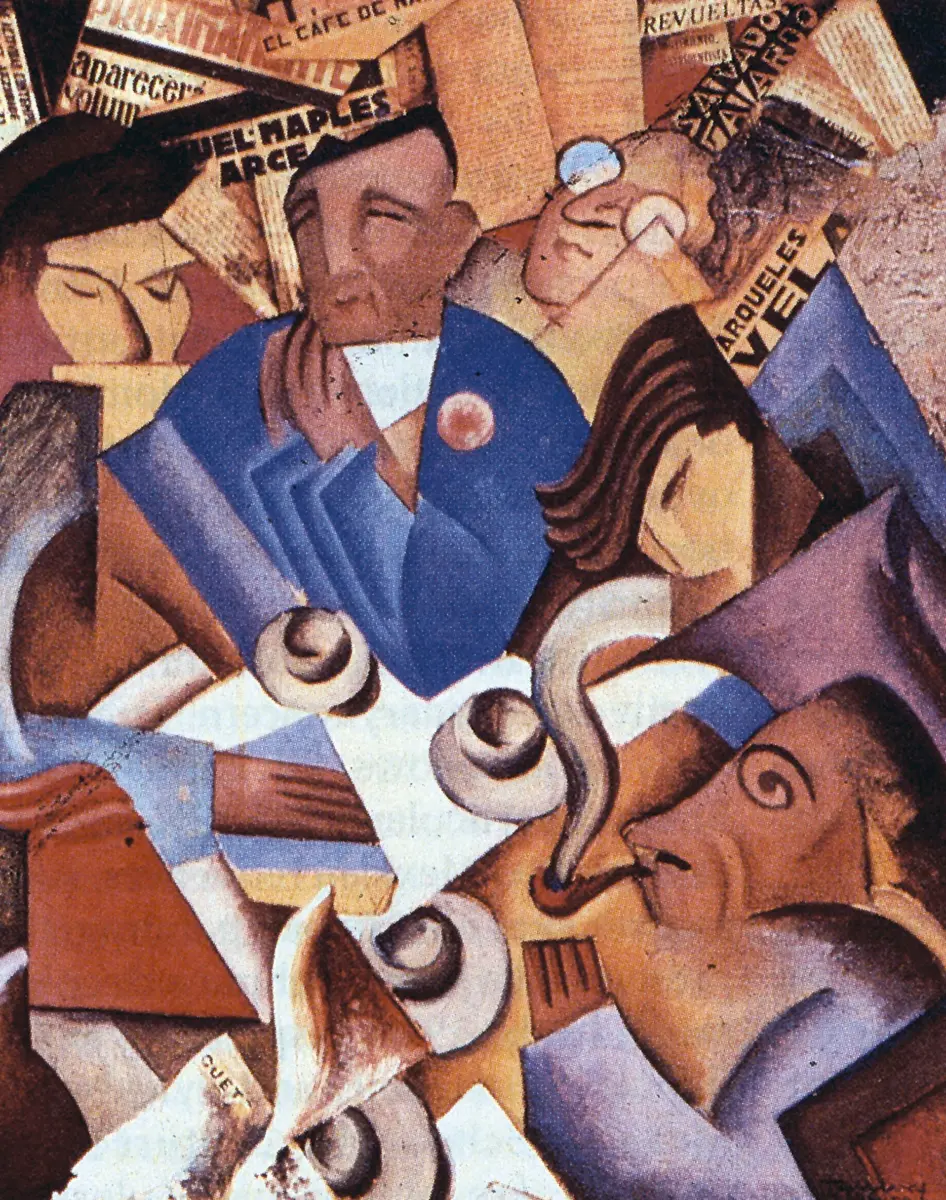
Of an absolutely internationalist disposition, with aspects of Dada and a commitment to Futurism and the glorification of machinery by the Italian writer Marinetti (a commitment which persisted until the Futurists became to fascist-oriented), was a little-known group of writers and artists called the «Estridentistas» (2) . Its earliest manifiesto appeared in 1921 and it dissolved in 1927, three years after the Mexican government withdrew its support to the mural movement. (Only Diego Rivera continued to paint until he went to San Francisco in 1930, while Orozco could only finish up his original commi- sion before he left to New York in 1927). The Dada element includes the group's name —the process of deliberately being «strident» in order to call attention to a language of provocation. The Stridentists attacked the academy, outdated and irrelevant actions and institutions, and even sacred figures like Father Hidalgo. They shouted outrageous slogans in the street, and in their publications: «Death to Father Hidalgo», «Chopin to the electric chair», «Long live turkey stew in mole», Their philosophy proclaimed that old edifices had to be destroyed before building new ones. In this they much resembled the international Dada group in Europe which attacked a failed society because of the unspeakable destructions of World War I. The Stridentists considered themselves «integral Mexican revolutionaries*, were pro- the Russian Revolution (artists like Mayakowsky and Eisenstein visited them in Mexico); had ecxellent relationships with Rivera and Siqueiros. Among the artists involved were printmakers Jean Chariot, Leopoldo Mendez, and Ramon Alva de la Canal, all of whom painted murals as well. The Stridentist magazines also published the photographs of Edward Weston and Tina Modotti. Ramon Alva del Canal painted the writers and artists of the group in their «Cafe de Nadie» —similar to Dada's Cafe Voltaire in Europe— where the original founder, writer Manuel Maples Arce, can be identified as the main figure in blue with his arm in Futurist motion, while other writers, and the artists Leopoldo Mendez and German Cueto, surround the Cubist table. Alva de la Canal also designed book covers and illustrations stressing the Stridentist presence, while German Cueto produced modernist sculptures in iron wire and bronze. In the style Parisian poet Apollonaire, calligrams were produced in the magazines (one by Diego Rivera carries his initials, salutes the stridentists, and appeared in the Irradiador). Leopoldo Mendez (co-founder of the Popular Graphics Art Workshop ten years later) designed many covers for Horizonte magazine, while Jean Chariot (who probably produced the earliest true fresco in modern Mexico in 1923) focused on graphics.
The point, of course, is that internationalist formal and philosophical ideas were never in conflict with radical political ideas. In fact, political utopianism was fundamental to the European avant-garde from the late * 19th century forward. Between the Mexican School and the Stridentist Movement, an international vocabulary fused with what was specifically Mexican.
The International Internationalists
In 1924, the Obregon administration, whose education Minister Jose Vasconcelos established literacy programs, built schools throughout the nation, and commissioned the muralist, left office. With the election of President Plutarco Elias calles —who maintained control of the Mexican presidency until 1934 though he only served one term— Mexican politics moved to the right, and the promises of the revolution were derailed after Calles abandoned his early socialist posture. A certain mood of disillusionment with the revolution obtained in this period and, for all practical purposes between 1924 and 1934, Mexican social realist muralism —except for that of Diego Rivera— came to a halt.
Orozco was in New York by 1927; Rivera and Siqueiros followed by 1930 and 1932. Younger artists like Rufino Tamayo increasingly turned to easel painting (for which there was not much of a marked) in the name of «internationalism» and against political pamphleteering in art, as Tamayo stated it. According to the testimony, younger artists were opposed to «nationalist» art and in favor of art for art's sake. Loosely organized in 1928, again by young, rising writers, was the group named the «Contem- poraneos» which, until 1931, published 43 issues of a literary magazine by the same name. Each issue featured one artist, both European and Latin American. (3) Like the Stridentists, the literary and artistic personalities presented readings like a «who's-who» of modernism. Neither included women, however, with the exception of Tina Modotti for the Stridentists. The list of artists published by the magazine included Julio Castellanos, Agustm Lazo, Roberto Montenegro, Jose Clemente Orozco, Manuel Rodriguez Lozano, Diego Rivera (despite a confrontation between the group and the artist), Georges Braque, Jean Chariot, Giorgio de Chirico, Salvador Dali, Pablo Picasso, Man Ray, and Rufino Tamayo.
Manuel Rodriguez Lozano was one of the painters and personalities who clustered around the Contemporaneos. In 1913, during the revolution, he was a cadet in a military college, then married the daugther of a Porfirian general who intrigued to topple Francisco Madero, the popular president who replaced dictator Porfirio Diaz as War Secretary, the genral sent Rodriguez and his wife to Madrid and Paris to sit out the revolution; they returned in 1921 and found all doors closed to them. With a job as a drawing teacher, Rodriguez Lozano painted what one Mexican critic has called «descriptive» rather «precious» impressions of urban life, and portraits. He established a Mexican Bohemia similar to that sustained by Cocteau in Paris, attended by elegant ladies and flappers; and attacked the Mexican School. In later years Rodriguez Lozano, basing himself on popular sculpted altars, moved into a mystical rendition of strange landscapes and people; even later he adopted the 1920s neoclassicism of France, Italy and Germany which swept Latin America. (4) Carlos Orozco Romero also explored a refined neo- classicism, then experimented with the new Surrealist currents of the 1940s. Agustm Lazo translated for Mexican themes the simplifications and large forms of neoclassicism, then moved in the direction of Italian proto-surrealism based on the metaphysical style of the Chirico, whose empty arcaded plazas earlier appeared in Cubist works by Diego Rivera. Julio Castellanos was one of the most poetic of the group. His neoclassicism played suggestively with reality, while a fresco mural of children's games painted in a school, portrayed Maya children without any folklorisms. (5)
Diego Rivera never forgave Contemporaneos magazine for publishing a critical article about his work in its first issue. By 1928, in a fresco mural at the Ministry of Education, he lampooned the Contemporaneos and their associates with a donkey-eared figure (whose glasses have fallen off), presiding over music, painting and literature, while copies of the magazines Ulises (6) and Contemporaneos (dated 1928) are shown on the ground. One of the flappers surrounding the group is handed a broom by a robust woman revolutionary to make herself useful by sweeping away this trash. The battle lines were definitely drawn.
By far the most ambitious and talented of the artists clustered around the Contemporaneos was the painter Rufino Tamayo who, at an early date articulated his opposition to «anecdotal» art, or art with a message. In various ways over the years, Tamayo took the position that the main function of art was to purify and refine its aesthetic characteristics; that subject matter was distinctly of secondary concern. Tamayo's early work shows the influence of Braque, particularly in still-lifes. He also injected Mexican references, such as dark skin and, in one painting, the presence of a jaguar behind a sleeping muse. In the 1930s responding to the popularity of themes and styles by the Mexican School, he captured the rhythms of revolution and of workers in a choreographed rather than tragic way. He even emulated Orozco in mural projects of 1938; but the strongest and most lasting influence in later years was Picasso, whose Guernica of 1937 was displayed in New York when Tamayo went there to study and work in the 1940s. Picasso's great horse screaming at the sky is quoted in Tamayo's dogs. However he combined this influence with that of pre-Columbian ceramics of West Mexico —employing the same combination of nationalist/indigenist roots with European formal languages that was earlier achieved by Rivera and Siqueiros.
The Picasso horse appears again in Tamayo's 1952 mural in the Palace of Fine Arts in Mexico, where his murals joined company with those of Rivera, Orozco and Siqueiros already enshrined there in the 1930s and 1940s. The Birth of Our Nationality, showing the Indian and Spanish roots of Mexican mestizaje, is, I would argue, just as nationalistic as the work of Diego Rivera. In fact, Tamayo's alliance with Maria Izquierdo in the late 1920s — even reinforced Tamayos'appreciation for folk and popular art, drawing him even closer to nationalist positions.
Izquierdo, who was one of only two women among artists, writers and a musician in a contemporary photograph, contributed visually to a history of the Contemporaneos with her painting Marina of 1936, a work tha commemorated the sea voyage returning from Havana to Mexico in 1927. It was this trip that triggered the establishment of Contemporaneos magazine, whose literary promoters were inspired by the vanguard Cuban magazine Revista de Avance.
While Izquierdo learned compositional devices from Tamayo, his color palette grew lighter and more intense after sharing a studio with her. Iz- quierdo's subject matter, however, remained thoroughly grounded in provicial artifacts, and she dismissed the Parisian School as a source for her work. Like Frida Kahlo, she and other women artists and patrons adopted regional clothing as their nationalist symbol.
The North Americans
The schism (or the supposed schism) between the political and the apolitical also spelled itself out in the imagery of Italian-born photographer Tina Modotti, who first came to Mexico in 1922 and returned again with Edward Weston, whom she met in Los Angeles, in 1924. (7) I will not spend time on Modotti's biographical details. Suffice it to say that the radical tendencies she inherited from her San Francisco family, dating back to their Italian roots, flourished in the Mexican post-revolutionary environment. Beginning as an apprentice to Weston, who was invested in a Cubist- derived formalist modernism. Modotti soon displayed the excellent composition and formal control she learned from him. Within a few years, during which she met the artists of the Mexican School (particularly, but not limited to, Rivera), those of the Stridentists, and other North Americans involved in various cultural projects, she was immersed in Mexican left- wing politics. Her changing consciousness became apparent by 1927 and 1928 as she fused a documentary interest with her superb compositional abilities. An industrial working class orientation is counterparted by a new synthesis of object and symbol. Such is the titled partial view of the typewriter upon which her lover, Cuban exile Julio Mella, expanded his philosophy and political campaign against the Machado dictatorship that eventually caused him to be assassinated in Mexico City. (Mella was an early prototype of Fidel Castro, also a student but one who launched a successful revolutionary invasion of Cuba from Mexico).
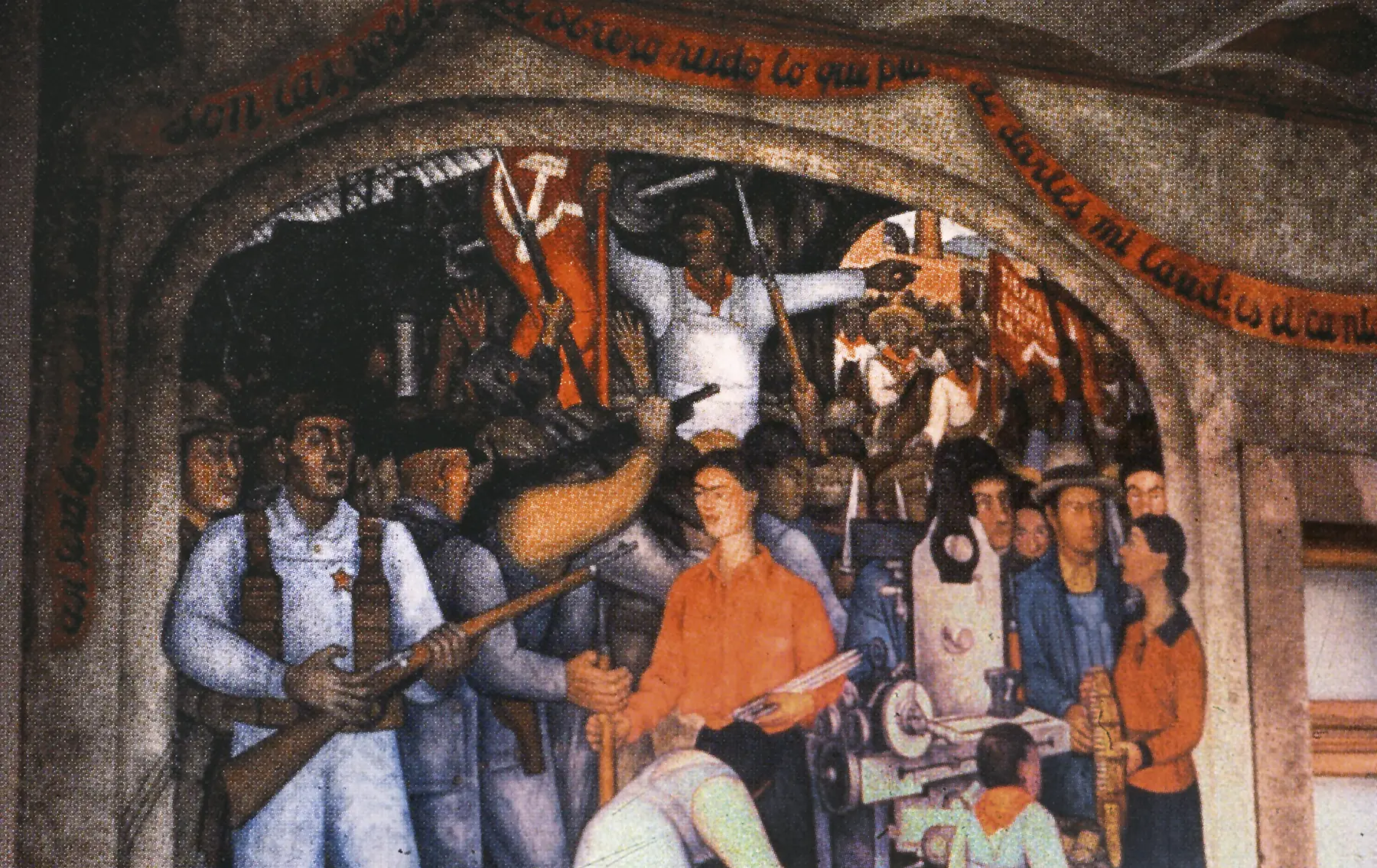
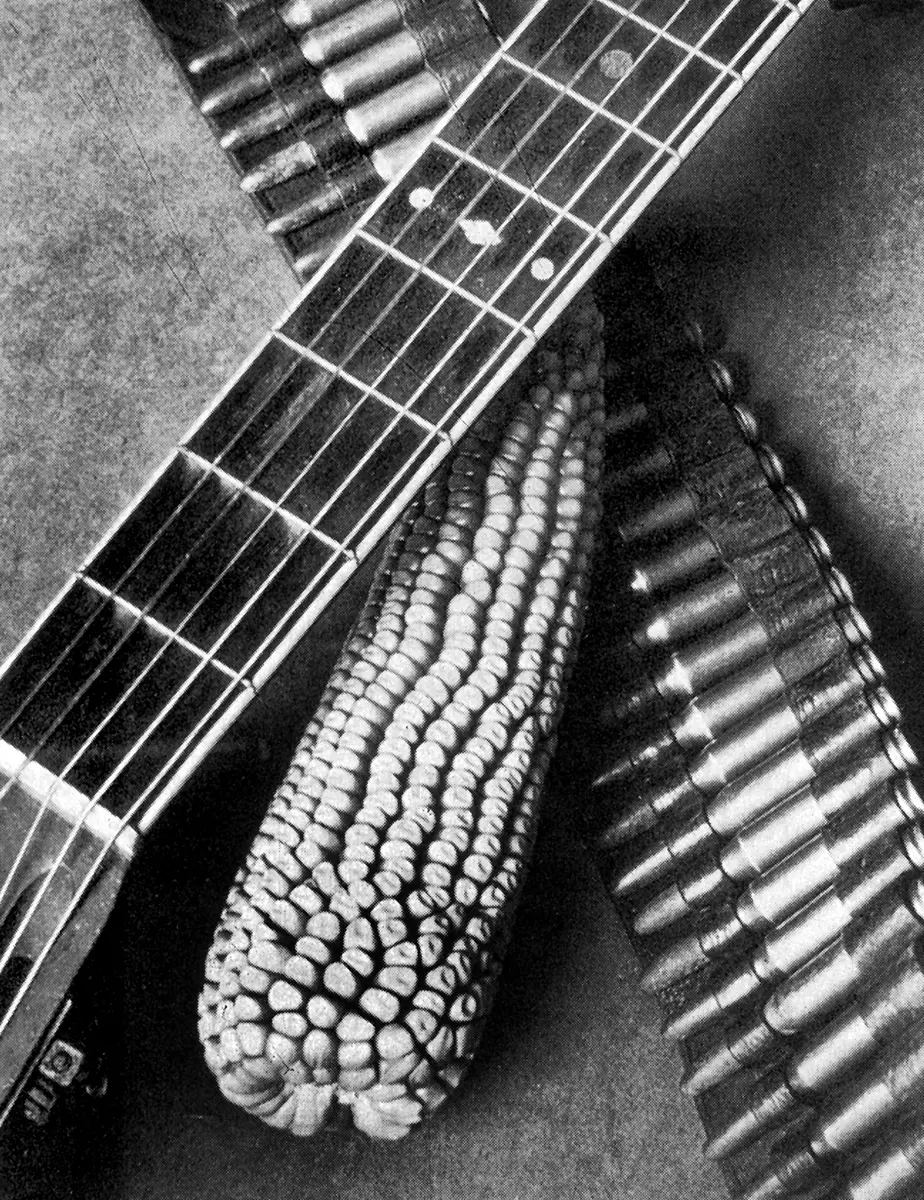
Modotti's synthesizing produced the most poetic rendering of revolutionary symbolism available in photography when she combined an ear of corn, a guitar, and a bandolier for ammunition. Similarly, a straw sombrero with a crossed hammer and sickle curved around the crown, expressed a highly aesthetic rendering of Mexican communism, rooted in rural realities. Modotti not only photographed Mexico, but was employed as a model by Diego Rivera in several murals. At the ministry of Education, not far from the mural criticizing the Contemporaneos, Rivera laid out a panorama of arms distribution for the coming socialist revolution. On the extreme left is Siqueiros with a star on his hat; Frida Kahlo distributes the rifles, while Vittorio Vidali (an Italian who later served as the famous Comandante Carlos during the Spanish Civil War when Siqueiros also went to Spain) as well as Mella and Modotti occupy the extreme right. Modotti's photograph of this mural points up another of her roles: as photographer of choice for the murals of Diego Rivera and those of Orozco. Orozco's 1928 letters form New York to Jean Chariot (who supervised the project) is filled with instructions to Modotti on what shots to take of his earliest mural cycle in mexico, later published in Alma Reed's 1932 book on Orozco's paintings. (8)
Tina Modotti's photograph of Anita Brenner is an introduction to the Mexican-born North American who, in 1929, published Idols Behinf Altars, a compilation of ancient, folk, and post-revolutionary history and culture. It was not traslated into Spanish until the 1980s, which makes clear that its audience was North Americans living in Mexico and in the United States.
There is no doubt that Idols served inadvertently to promote tourism. Brenner employed Weston and Modotti as a team to provide the illustrations for her book.
While Modotti frequently photographed the life and activities of the people, Weston particularly relished the series of the popular saloons known as pe- luquerias with their piquant names and decorations, as well as the broad display of folk arts produced by the village cottage industries of the time.
Two other North American played a significant role in the Mexico of the 1920s and 1930s: Frances Toor who for many years published the magazine Folk-Ways, and for which Jean Chariot, and Diego Rivera, served as editors; and George Biddle, a friend of Franklin Delano Roosevelt. Tremendously impressed with Mexican muralism, Biddle made paintings and murals of his own obviously influenced by Diego Rivera. During the Depression it was he who suggested to Roosevelt that the government sponsor a mural program for indigent artists in the United States. The suggestion was adopted under the New Deal programs, and the rest is part of U.S. art history.
I would like to close by returning to semantics. I have used, throughout, the opposition of «nationalist» vs. internationalist to clarify the discourse. However, there is another term in common modernism parlance that plays a more insidious role: that of «universalism». It is always invoked as an argument for comparative «quality», and I think it is time we disrobe this linguistic practice. Webster's dictionary defines «uni- versal» as «a behavior pattern or institution existing in all cultures.» The Oxford dictionary expands this to including, affecting or involving all people or things; applicable in all cases.» Since modernism art historical
terminology provided a system of codification based on masterworks of European art, it stands to reason that what is «universal» is based on Eurocentric cannons, expanded to define what is best for the whole world. That which is «natinalist» therefore, is regional or provincial; it cannot be «universal». My presentation was intended to disprove this contention. I offer another term, therefore, that will fit the case of Latin America and the Third World: the word «cosmopolitan» - defined as «having a worldwide rather than a limited to provincial scope,» if referring to «persons, constituens, or elements from all or many parts of the world.» Under this definition, one can be «cosmopolitan» and nationalist at the same time.
NOTES
1. See Homenaje al movimiento de Escuela al Aire Libre, catalogue, Mexico City: Instituto Nacional de Bellas Artes, 1981.
2. See «EI Movimiento estridentista,» La Palabra y el Hombre, Revista de la Universidad Veracruzana, October-December 1981; Serge Fauchereau, «The Stridentists,» Artforum International, 24, No. 6 (Frevruary 1986): 84 - 89.
3. See Manuel Duran, Antologia de la Revista Contemporaneos, Mexico City: Fondo de Cultura Economica, 1973, and Guillermo Sheridan, Homenaje Nacional de los Contemporaneos: Monologos en Espiral, Mexico City: Instituto Nacional de Bellas Artes, 1982.
4. Neoclasiscism in the interwar years appeared in the work of Picasso, Braque and Leger in France, and Severini, Carra and De Chirico in Italy. Bernad Myers referred to this style as«monumentalising and gave its source as Franz Roh’s book Nach Expressionismus (1925) which treats the New Objectivity group of Germany, and was translated into Spanish as Realismo magico: Post-expresionismo (1927). He referred to a second group in Guadalajara consisting of former governor Jose Guadalupe Zuno, Raul Anguiano and Jesus Guerrero Galvan. Bernad S. Myers, Mexican Painting in Our Time, New York: Oxford University Press, 1981, Passim. 7. For concise thumb-nail biographies of the artists I am indebted to Olivier Debroise, Figuras en el tropico, Plastica mexicana, 1920-1940, Barcelona: Oceano, 1984.
6. Duran, Antologia, p. 19.
7. See Christiane Barckhausen-Canale’s outstanding biography, Verdad y leyenda de Tina Modotti, Havana: Casa de las Americas, 1985; Amy Conger, Edward Weston in Mexico, 1923 - 1926, Albuquerque: University of New Mexico Press, 1983; Sarah M. Lowe, Tina Modotti: Photographs, catalogue, new York: Harry N. Abrams, Inc., 1995.
8. Jean Chariot (ed.) , Jose Clemente Orozco: El artista en Nueva York (cartas a Jean Chariot y textos ineditos), 1925 - 1929, Mexico City: Siglo Veintiuna Editores, 1971.