In a kind of «manifesto» of this female presence, 340 works by women were recently presented at the Recoleta Cultural Center to make up an installation'entitled Spirit of the Beehive. The event also had a second objective: beyond the plastic nature of the installation, efforts should aim at the organization of a database in the Espigas Foundation, for the collection of documentary material on Argentinian art.
The event, which was held in the months of June and July, included the participation of not only plastic artists but female art critics, writers, photographers, video and film artists, composers and architects. The «methodology» of the beehive - collective and cooperative work - was adopted throughout.
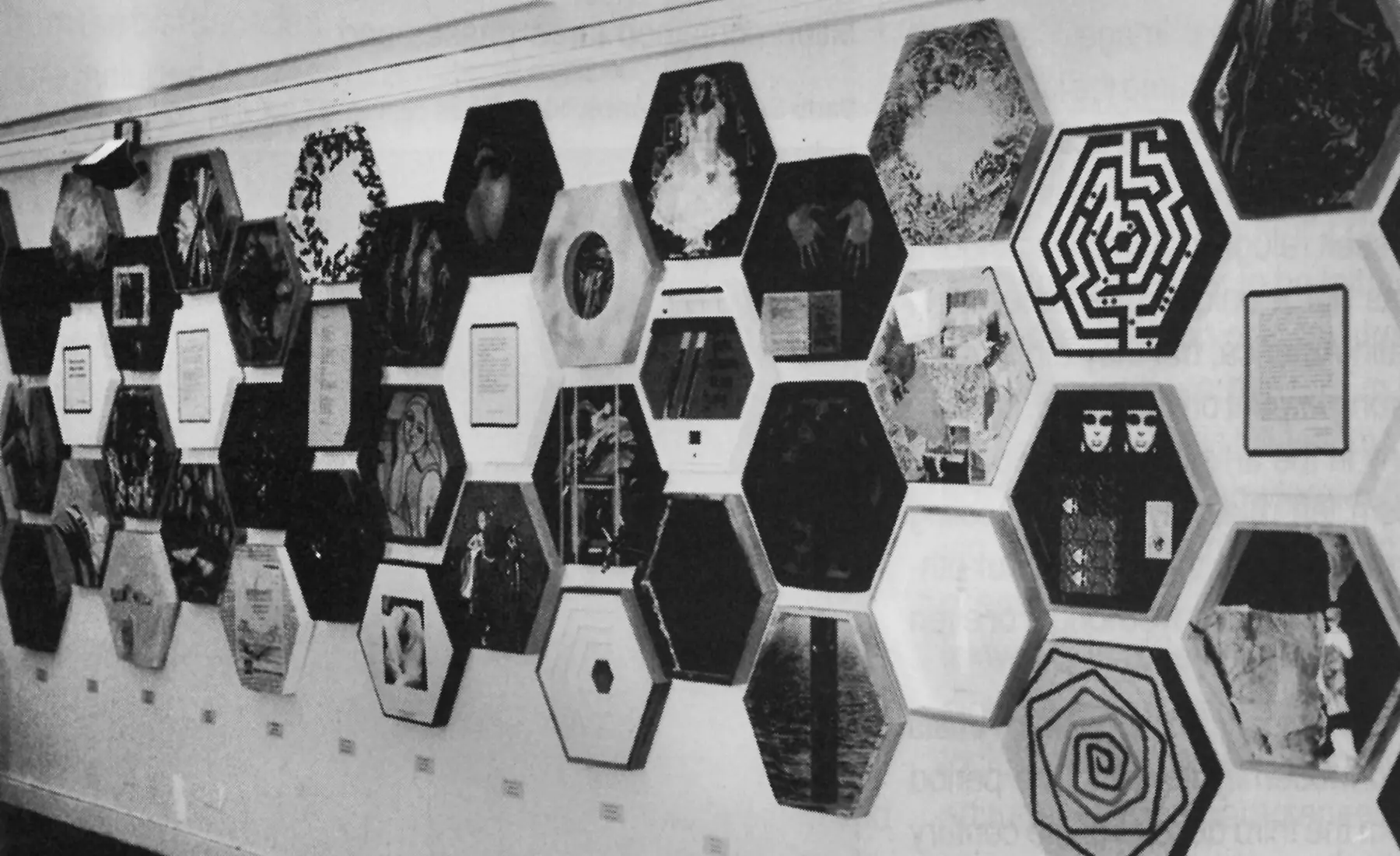
The analogy with the animal kingdom was also carried through into the montage of the works since with the overall product ought to give the idea of a beehive. Each participant was allocated a hexagon of 50cm. in diametre as a support for the collective work, which was to fill the four walls of the exhibition space.
The excessively small size of the cells and their hexagonal shape - with obvious reference to the image of a honeycomb - meant that the works presented by the female artists could be considered as of a «minor kind». But this was not important, since each participant seemed to have abandoned her own individuality from the outset in favor of the idea of the irreversible protagonism of women as a whole.
The broad, almost «encyclo- paedic» and historical nature of the show included the names of Norah Borges (with her long career since the 1920s), Lidy Prati (a member of the Arte Concreto Invention group from the 1940s), Noemi Di Benedetto (an informalist of the 1950s), Josefina Robirosa and Noemi Escandell (both of whom participated in the neo-avant-garde move-ments of the 1960s) and Maria Juana Heras Velasco (a sculptress from the 1970s). Most of the artists, numerically speaking, were from the last two decades, and included: Matilde Marin, Alicia Diaz Rinaldi, Cristina Ghetti, Maria Luz Gil, Raquel Bigio, Julie Weisz, Correas, Zulema Maza, Gachi Hasper, Marta Ares, Dolores Zorreguieta, Carolina Antoniadis, Luz Zorraquin, Fa- biana Barreda, amongst many others.
Outstanding figures, such as Annemarie Heinrich in the field of photography, Maria Kodama, Luisa Valenzuela and Alina Diaconu in the field of literature, as well as Lita Stantic in film-making, reflected from different angles the same phenomenon of the role of women.
Spirit of the Beehive also achieved another of its objectives, namely to act as a cultural «impetus» in updating the debate on gender art. Is there a «female gender» in art? Can we find today any exclusively feminine themes? What are the main characteristics of female identity in art? These were some of the themes discussed and debated in the round-tables accompanying the event.
Beyond the debate, each work spoke for itself, indicating, without exception, a different kind of attitude from the combative and militant approach of the 1960s. Like their contemporaries at the international level, the Argentinian participants showed that today there is no frontal campaign to be waged with the male sex. It would be difficult to classify their works as «feminist», effacing therefore the limits of a «gender-based art».
Spirit of the Beehive confirmed that women are interested in subjects which also affect men, such as for example self-determination and expansion in the physical, mental and spiritual space of all human beings. However, despite the general nature of these themes, it does remain true that there are certain starting points to which “female sculpture* gives preference - such as the world of the individual and the private sphere, which are frequent motivations, although they are in no way exclusive in the art made by women.
In conclusion, the Beehive Spirit highlighted the need to go beyond common simplifications and to carry out a critical inquiry into the problem of female expression beyond the now out-of-date stereotypes. Women and men today seem to play inter-changeable roles. Both may alternately, and contrary to what was thought in the 1960s, be the victim or the victimizer.
The curators and organizers of the show were the artists Maggie Atienza, Delia Banchik, Amalia Perez Molek and Liliana Trotta.
ELENA OLIVERAS