
In her first one-person show in New York, Teresita Fernandez configurated the space of the gallery in a radical way. Indeed, it is space and its relationship to the spectator that we find at the core of Fernandez recent work. Her installations have an architectural quality that forces the audience to inhabit the artist works and it is on this physical mental inhabiting that the meaning of the work depends. The piece presented at Deitch Projects creates a very theatrical space evocative of a swimming pool. Once inside the gallery the spectator has to step up onto a rectangular platform that surrounds a big recessed area, essentially the whole floor of the main gallery. The walls surrounding the recessed space and the platform are painted blue, the cement floor has been left with its natural gray color. Two lines of regular squares were drawn in pencil on the top part of the «inside of the pool», while the walls above were painted blue fading to white towards the upper part of the walls. The effect was serie and poetic but at the same time prosaic and staged. The obligatory art historical reference was definitely minimalism, a visual language that in the nineties has reemerged with new force to give us some of the best pieces in contemporary art. But the reference to minimalism is tangential since Fernandez is not interested in exploring a trascendental phenomenological space devoid of references. Nor does the artist seems interested in deploying an institutional critique a la Hans Haacke and company; rather her reference is the vernacular space of the pool, a mere suggestion that speaks of those generic spaces where our subjectivity is constituted.
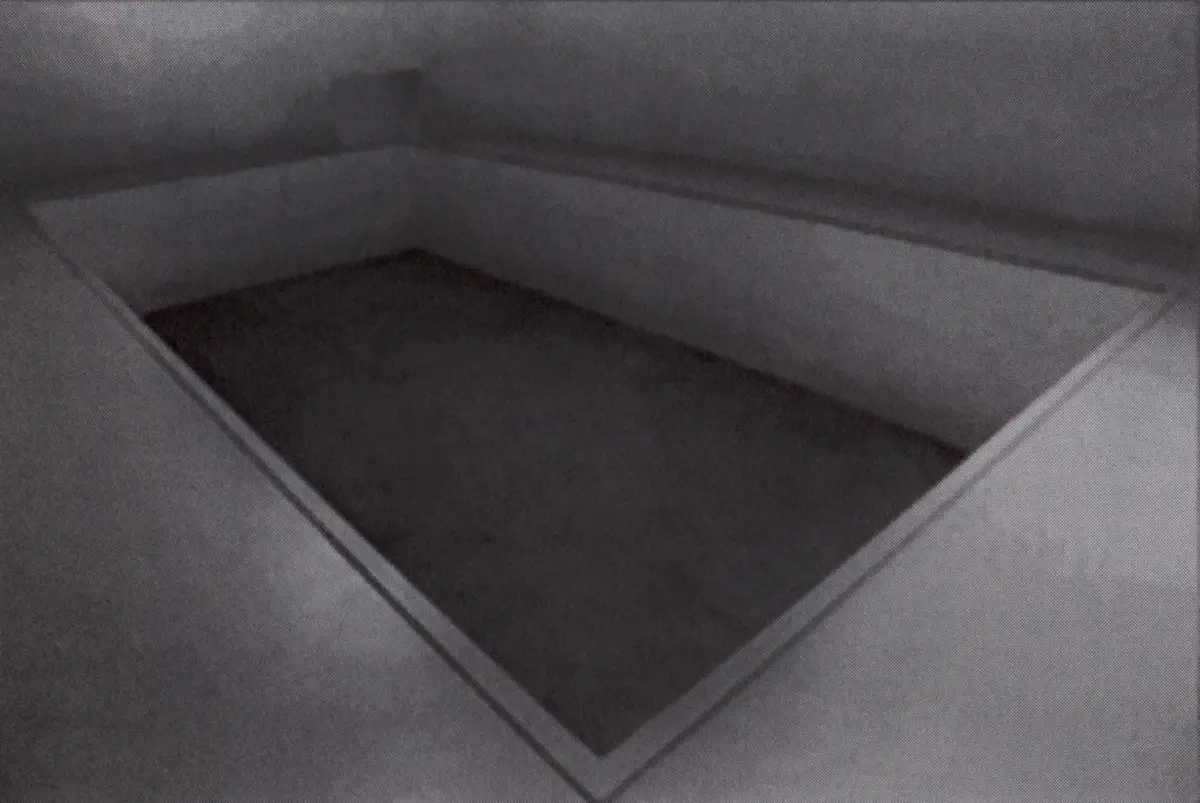
Fernandez has eloquently spoken about the importance of the memories brought to the space of the piece by the observer. Among her interests is that of evoking through the physical interaction with the piece, recollections of past experiences and of past bodily situations. The interesting thing is that the artist hopes that these recollections will be triggered by a device as standard and functional as a pool. In this sense this piece seems to be addressing the paradoxical quality of the personal articulated through the generic, the standardized, the common, the popular. Leaving behind the heroic rhetoric of authenticity that has informed so much «identity art», Fernandez seems to be exploring the possibility of a middle term, one-in which we can conceive a subjectivity predicated on the experiences lived in these common sites of our midde class culture.
It may be for this reason that «the pool» seems a little bit clumsy, deliberate, theatrical and unfinished. The piece doesn't seem to be interested in creating an illusionistic space where sign and reference, memory and subject coincidE. INSTEAD the space posits a collective ground where we may be aware of our sensations and recollections while realizing at the same time, that we are not alone, that we are watching others walking on and off the platform while we ourselves are being watched. So subjectivity is articulated in this piece, in relation to others, in the passage from one place to the other. There is thus an unstable quality that pervades Fernandez’ work. Here, the out summer time connotations of the pool have been brought into the gallery, and the inner recollection of those warm days at the pool has been exposed through the public dimension of the collective imaginary that inhabit in all of us.
MONICA AMOR