
Museum of Modern Art; Juan Martin and Ramon Lopez Galleries This note on the «revision» of the work of Vicente Rojo at the Museum of Modern Art and at two simultaneous gallery exhibitions can be summarized in the following words: the artist is growing with each new show. Born in Barcelona in 1932, and exiled in Mexico 17 years later as a result of the Spanish Civil War, Rojo has always been a very discrete person, passionate about his work in drawing, painting, printmaking, sculpture, as well as in graphic design.
His best-known and extensive series are Negation and Mexico in the Rain, although in Signs, he begins to leave his deep marks in oil. The selection of works extends from 1954 down to the present, with medium-size and large format pieces, some excellent gouaches and mixed media, as well as sculptures in ceramic, metal and wood - making a total of 108 pieces which at every turn reflect the endlessly creative impetus behind his work. The show could have been limited perhaps to a dozen or so less two- dimensional pieces, which would have heightened further the overall impression, since in the density of his work, less is certainly more. The museography was good, although there is a certain sense of haste towards the end, because of the need for more space for the sculptures.
At the entrance of the Museum, there is a mural polyptych work measuring 3 x 7.2 metres, entitled Large Primitive Scene (1996), a mixed media on canvas. The treatment and title of the work may not be more coherent, as will be seen below.
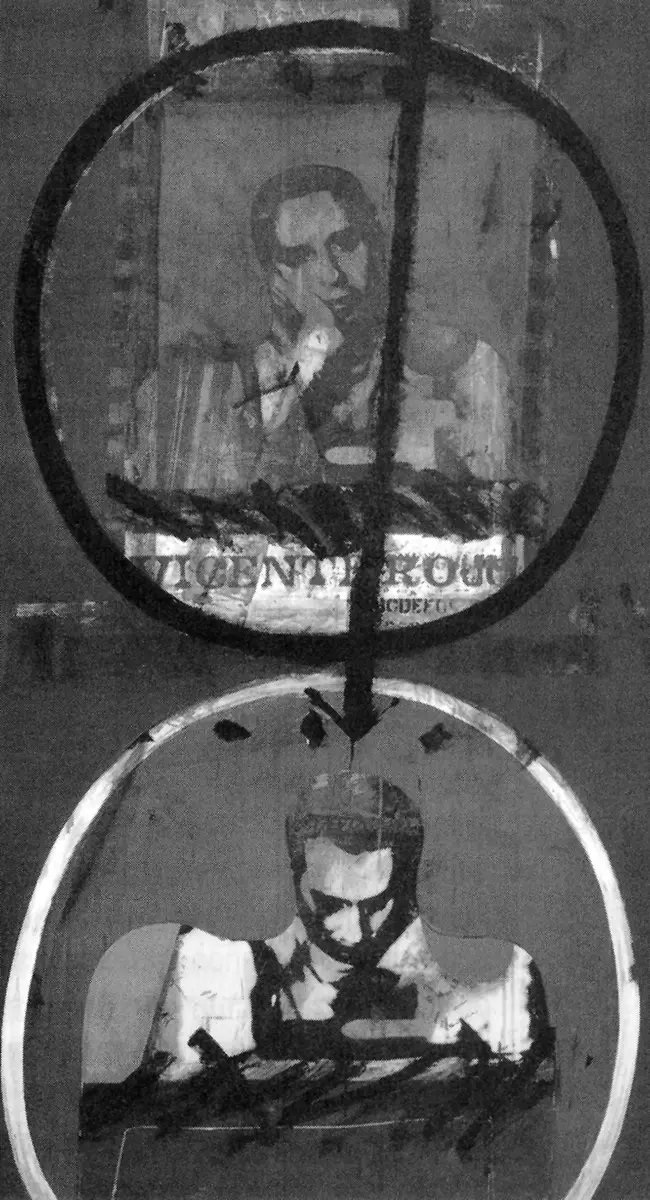
There is a subtle primitive character in all Rojo’s production, a primitive order which involves aspects of expressive force and synthesis, as can be seen in the dark areas of his Signs, in the lower part of his Double Portrait (1966) and in the torrid pieces of Mexico in the Rain, as well as in the above- mentioned polyptych. This refined brutality of Altamira and the Mayas, the Spanish women of the countryside, of Lorca and Maria Casares, is also a captivating feature of Les Demoiselles d'Avignon,although the sense of presence is different. Registers, Greek women and guards are part of this neo-primitive experience which will be linked to the contemporary and industrial version known as the module.
There is also a correlation between the past and the present which links, as in a family tree, the Indian’s arrow with the technological dimension. With the passing of the twentieth century, with all its electronic advances, the primitive elements have gradually acquired increasing respect.
b. A master builder skilled in the elegant use of impasto, a geometrician of oil and of mixed media, gouache and acrylic, Vicente Rojo constantly rebels against what is static. Triangle on Red(1964), Destruction of an Order and Double Self-Portrait (both from 1966), all anticipate his later work in construction and the creation of texture, the use of free forms, the present and the past. The bipolarity of his pictures at that time can still be seen in large sections, although they would increasingly become baroque and motleyed. I reflect on the elements and densities which Rojo would gradually incorporate into his work. Mexico is without doubt in each and every one: the bands which he places in his pictures and bathes in acrylic to enhance the third dimension are reminiscent of the braids to be found in indigenous dress; the triangles drawn, painted, raised or evoked are all brothers of the pyramids. In this entirely characteristic work Vicente Rojo evokes the two territories, with their roughness and dances, their words and their wounds.
As regards color and tone, what does the author use?: flesh-colored vermilion, ruby bathed in blue, purple, indigo, the color of coffee and the earth, sometimes seas of green and stone, flecked whites and urban greys, a bit of sky and hints of sweet Mexican roses— and his desire to construct and to make the picture, to create its texture, to do sculpture, make objects, patriotic symbols and even books. In this conceptualizing process, Rojo creates his own ritual: transparencies on surfaces roughly covered with matter, dreams of a phagocyte world. There is no canvas or impasto or three-dimensional piece which does not reflect this sense of light, transparency and brio.
Rojo is an informed artist who escapes from information with this I mean, that he is not submitted to the avant-garde fluctuations and does not cling to them. His work is an affirmation of his own full personality, a work which reflects what he is himself. All this was evident in the show at the Museum of Modern Art. The simultaneous gallery exhibitions focused on his extremely subtle drawings, without stridency and full of exquisite sensitivity.
The Museum exhibition offers a possible «revision» of the essences of the work of an artist who has no status commitments and who is a stronghold of his generation (he belongs to a generation younger than that of Tamayo, Goeritz and Merida, who offered resistence to the already exhausted and demagogic muralism, without embracing successive waves of fashion, but rather anticipating them).
Rojo presents urban aspects with their motley inhabitants, in a kind of aesthetic intellectualization, inducing a mood of relaxation but also surprising us with "flashes of truth», like the dobladitasand gorditas (names of typical Mexican aperitifs, similar to Spanish tapas), in the textures created on the surface of the pictures. The city, with its multicolor grey hues, seemed to have entered into the Museum itself in fragments of asphalt with thick and hot graphic marks which pushed one another into ordered diagonal lines. In 1984 Rojo presented an excellent series of sculptures at the Museum of the Palace of Fine Arts. One of the ceramic works, Mexico under the Rain D2, seems to have foreshadowed the tragic earthquake in Mexico City of the following year. Other pieces recalled and will continue to recall the myths of the pyramids. The theme of the horizon is a constant, non-verbalized aspect of Latin American art: the reference to the unmeasurable and the unknown and its relationship with the fatalist destiny of the indigenous tribes... the Indian, the gaucho, the mestizo are all here, with the many points, knots and textures of Rojo’s painting and sculptures covering the horizon, sometimes in aT-form painted onto the canvas, reflected in the ascending-descending volume of his sculpture, the crossing of countless different inter-sections and crossroads. In a period of little faith and even less morality, Vicente Rojo has come to take our eyes up from the earth to the sky.
GRACIELA KARTOFEL