Although Antonio Segui's engagement with the mass media link him to other artists of the “pop” movement, he has never rested on a single approach to visual communication. He has, instead embraced a wide range of devices to convey his often satirical social commentary.
The broadly painted figures in the exhibit’s earliest work Box Gentlemen from 1963, verge in the expressionism. Nude from the waist down, this mass of masculinity is so throughly confused that it is impossible to determine where one individual begins and another ends. To compound their untenable situation, they find themselves jumbled together in a space whose interior denies the perspective established by the box that contains them.
Segui addresses the contradictions between exterior presentation and interior reality from a different angle in a series of painted wooden sculptures, populated with stylized figures that would come to characterize his most recent paints, from the late 1960s. Marcas en la nieve (Marks in the Snow), for example, portrays a man walking a dog through the snow. The shape of the man’s tracks, however, correspond to the dosg’s paws. The dog has left the unmistakable mark of a shoe.
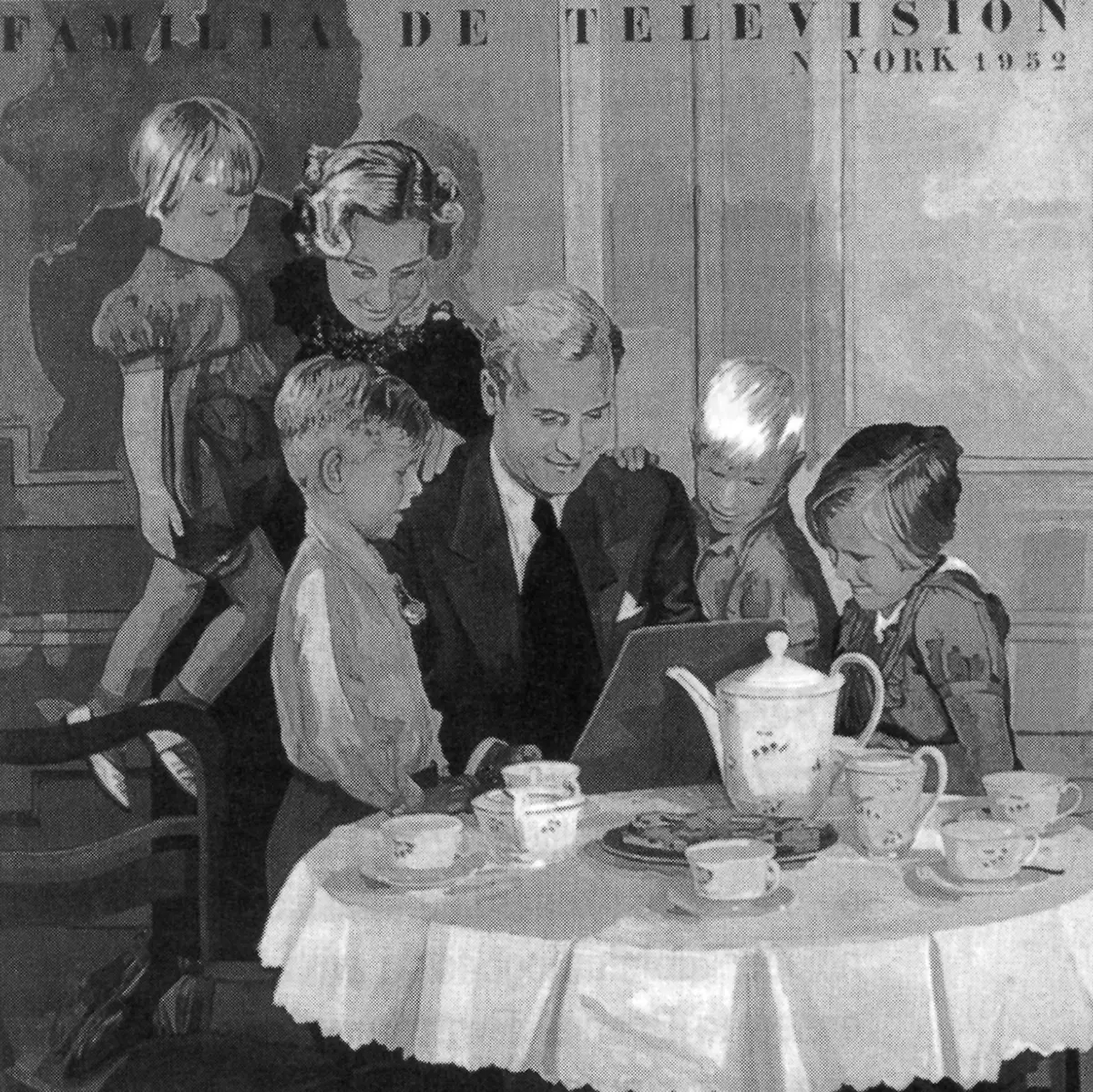
By the early 1970s, Segui has made another major leap, toying with photo- •graphic realism and the flat graphic Style of popular magazines. In a series of family portraits that suggest a straightforward reality, the way that individuals choose themselves to call attention to the divisions between men and women, most notable in the rigid separation of Prague 1942. The settings they select for their portraits are also telling. Both the state gardens of Udine 1904and the confortable middle class living room of Familia de Television, Nueva York, 1952 (Television family, New York, 1952) suggest that we paradoxically, define ourselves by our possessions.
Later in the 1970s, Segui appropriated Rembrandt’s The Anatomy Lesson of Dr. Tulp, using elements of the painting in a series of large pastels on canvas. Appropriately enough, Segui also used the chalks to transform Rembrandt’s antique figures into contemporary humans through the adittion of crude graffiti. Segui did not limit his parodies to the icons of art history or popular culture. In Voyager, a small acrylic on paper from 1982, he deconstructs one of his own rigid characters, imposing cubist form and equally modern man with humorously disconcerting results.
These constructed figures dominate Segui’s most recent, and most sardonic, works. The figures that pack the spaces of Lectura para todos (Reading for Everyone) are imaginary beings, not real people. The nude women, in particular, are little more than misplaced fantasies projected by the men who rule the space.
Perversely, by denying the females their own reality, they themselves remain less than fully realized. The writting on these “chalkboard compositions” is no less comforting, filled with references to Bosnia, Rwanda and other contemporary political tragedies. Nonetheless, Segui is no pessimistic, since the incongruously outsized figures of Gente de techo (People of the Roof) from 1992 remind us, of the fact that we have created our urbanity, however oppressive it may be, and we have the power to ominate our creations.
K. MITCHELL SNOW