«l believe in «reason» and not in the «hand» of the artist», Carlos Arias has written. Yet his recent work is of an artisanal kind that requires much care and patience. If at first sight these pieces raise a series of questions of a conceptual kind about the artistic status of embroidery and the criterion of authorship, a more careful examination shows the painter’s eye which which Carlos Arias looks at an activity associated with popular art. Whether based on commercial models for subsequent decoration, and on which he intervenes with previously worked embroidery, or using his own designs as models, Arias believes that «the construction of a plastic space stitch by stitch with the to and fro movement of the needle means that everything has to be thought out and justified in advance*. And indeed, these works raise a number of questions about the analysis and disarticulation of the creative process, and the different implications of embroidery as a medium of artistic expression.
The diptych entitled Blind Appointment (I995-I996), created with two identical woollen cloths, shows how, using the same image, diametrically opposed results can be achieved: whereas one of them, conceived and hand-worked by Francisca Arenas, literally shows a fifteen year old girl and reflects the directions imposed by the drawing, the second, freely intervened by the artist, shows an almost abstract image which reflects Arias’ indications as regards form, color and stitching. The objective here is to reveal the gap which exists in the perception of the artistic phenomenon between different social and cultural milieux, and to highlight the random and circumstantial nature of any formal resolution.
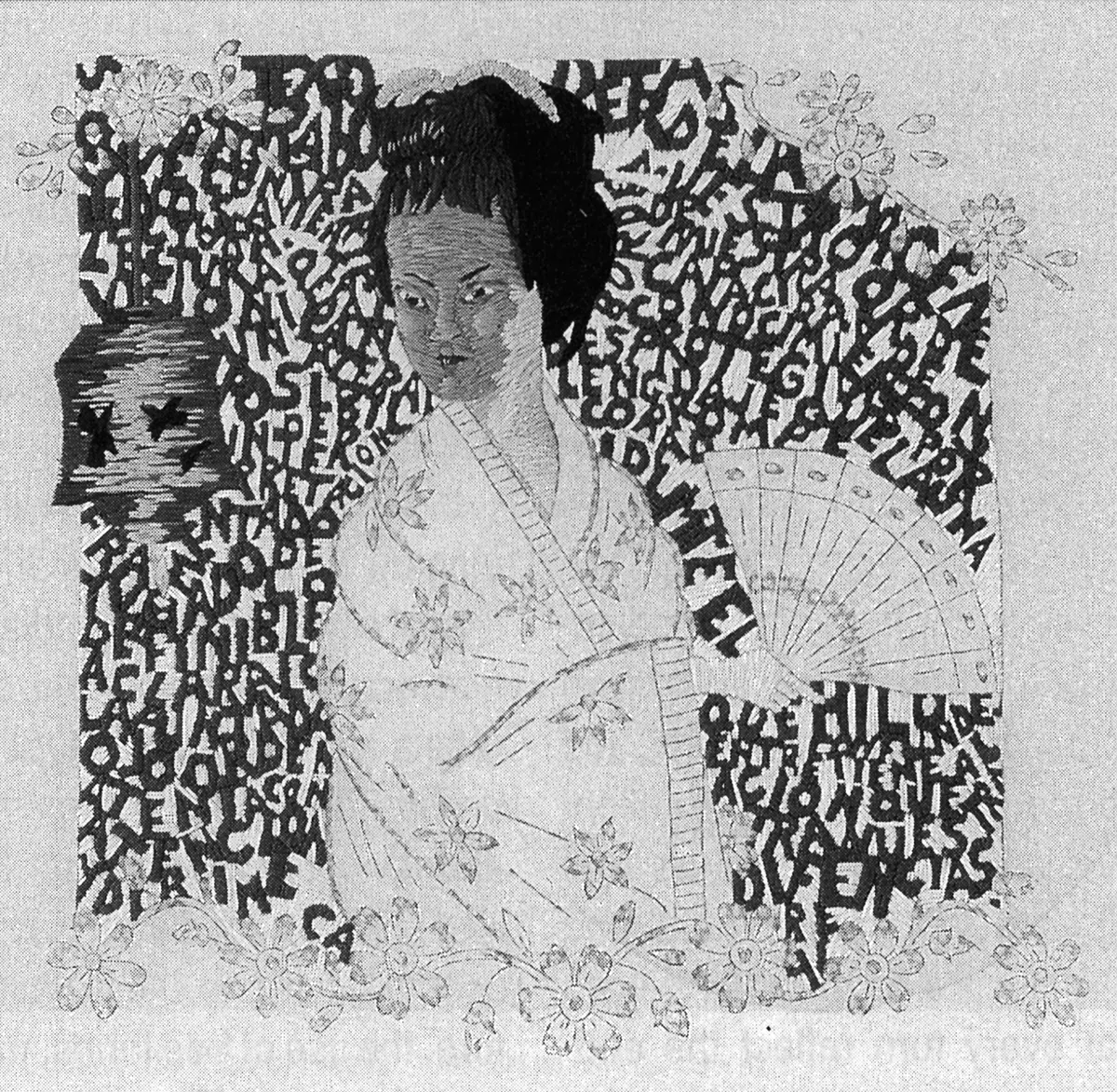
The deliberate alteration in the relationship established between the figure, color and material frees the artisanal work from its popular connotations, suggesting that the creative potential of embroidery —at first sight limited to the mechanical act of "filling*— is similar to that of pictorial techniques. When Arias presents his work in a gallery, he not only transgresses the frontiers between art and handicrafts, but inverts the hierarchy of established criteria, since by choosing embroidery as his means of expression, he is breaking with the traditional codes which associate it with women’s activities, thus Feminine Language (I995), a self-referential piece worked by Arias' himself, encompasses a total of 63 actions, from tacking to openwork and modifies the concept of identity imposed by society. In the same way, a work such as Difference (I996) illustrates the difficult drawing close to the meaning of «otherness» (in this case Oriental culture), not only through recourse to iconographical cliches but by surrounding the figure with an unintelligble mass of woven words. By exposing the central image of the pattern, the background gains in relief, while the figure itself passes to a secondary level, suggesting that the to and fromovement of the thread on the fabric •is constructing the space which gives body to the forms. In this sense, most of Arias’ works based on popular patterns become incisive social commentaries. In Don’t come into my garden (1996), the girl who intially appeared accompanied by a goose is now carrying a basket full of penises and, in the words of the artist, «becomes a victim of the plastic space» constructed by the chromatic tones and interplay of light, dissimulating the "threatening* adult world from which she is protecting herself. As in many of his works, the actual embroidery technique and the plastic solutions adopted help consolidate the meaning of the image and broaden the impact of the iconography. Felatio (1995), a monochromatic work, explores the full range of visual possibilities of stitching and color, since the scene appears only behind the actual finish, the pictorial view which Carlos Arias proposes of embroidery seems to be consolidated in his Self-Portrait (1996), in which, interweaving the lines of the drawing and those of the embroidery, he sketches out a face which once again disrupts the meanings of art and handicraft, repeating the question:«... making culture, for whom?»
MAGALÍ ARRIOLA