
Between the months of October and December, the Museum
of Modern Art of Bogota presented the Fifth Bogota Biennial, which this time
took the form of a follow-up, i.e. with work by artists who had already
distinguished themselves in previous editions, in an attempt to provide a
diagnosis of the current situation of national art. At the same time, the
edition also included work by five specially invited young artists. The
sensation created by a visit to the show was similar to that felt in an empty
theater: it was disconcerting to see so many proposals based on poor ideas and
treatment. Even outstanding artists at the national level, who have done
important work in the past, this time presented works which were vacuous and
repetitive that seemed to have been made just to comply with an obligation.
This was a Biennial which therefore raises a number of questions, but above all, that concerning the term «process». The word is usually used to refer to the evolution of something or the treatment of information. But the analysis of such an evolution necessarily means that we must select something which is meaningful. Colombian art cannot continue to devote all its efforts to making proposals which in the end are of no consequence, because this will only create a sense of void in the end, work which contents itself with presenting magnificent ideas from the past without further development or review. This cannot continue, because we live in a country which needs art, an art which proposes ideas which can compete with all the discord and stupidity which surround us. The development of processes without ideas, or ideas which are abandoned in favor of facile solutions, are contrary to the concept of art and make a mockery of its true content. The spectator feels increasingly isolated from what he sees, and ends up preferring the more interesting proposals of film, literature, theater and television. We have an increasingly greater need for the innocence and spontaneity of children to tell us that the emperor is not wearing any clothes.
It is worth recalling in this connection the dramatic paradox raised by Foucault: despite the visual power of the twentieth century, words will end up by replacing things. Was Foucault right?
The word «process» implies the selection of a phenomenon, its careful examination, its development in space, its successes and failures, so that the artist can, at the end of the examination, make a judgement about what has happened and allow the idea to develop. No different or original idea is required for each exhibition: the only requirements for a genuine analysis are a series of proposals which have been refined over time, so that in each exhibition the artist can express them and the spectator can recognize them and share something of his own thoughts. In this edition of the Biennial, however, there were four artists who did distinguish themselves in their works and analytical processes: Jose Alejandro Restrepo, Luis Roldan, Juan Fernando Herran and Oscar Munoz.
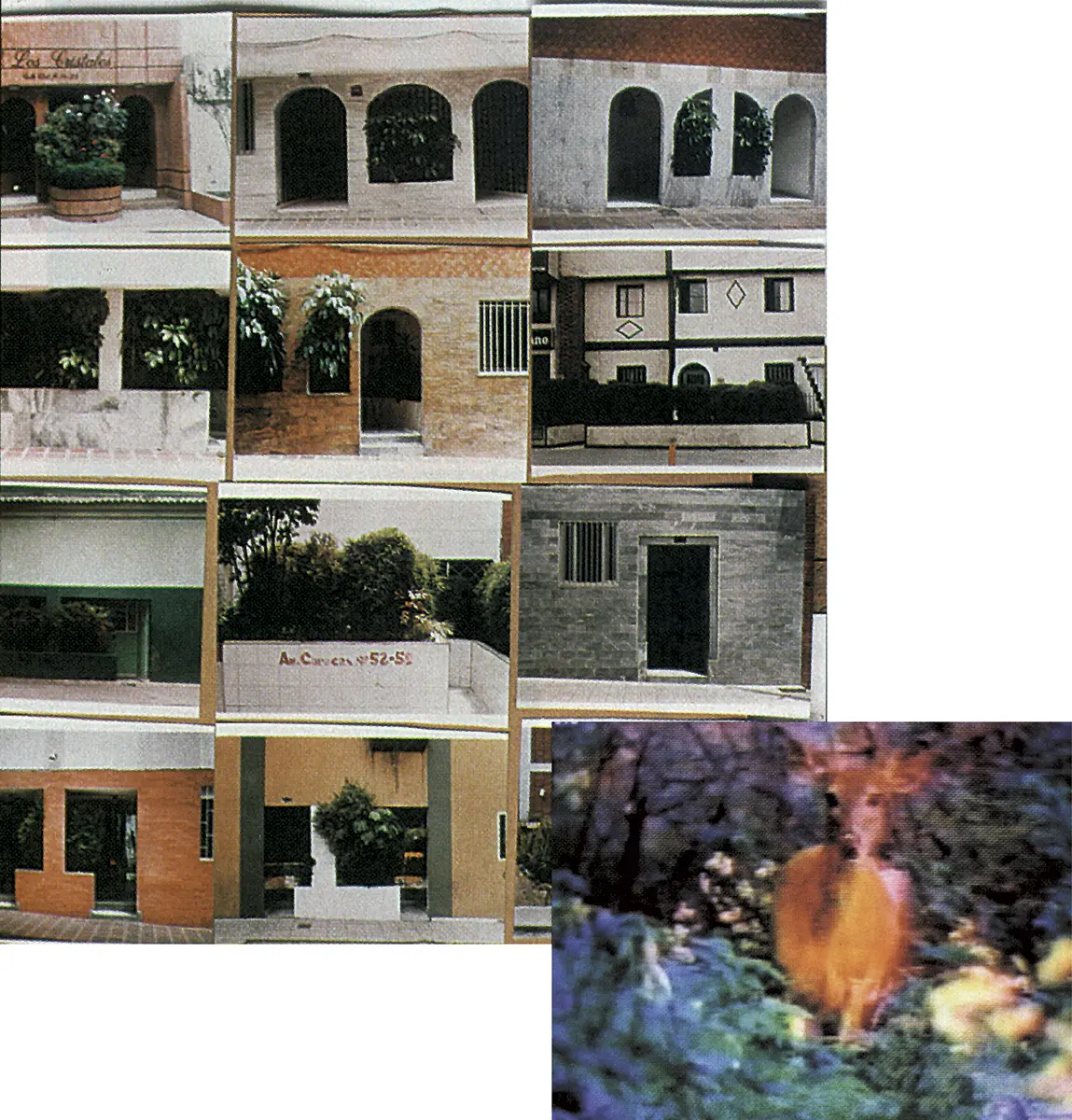
Jose Alejandro Restrepo won the prize at the Biennial,
with a work entitled Atrium and Central Nave. The spectator found himself in
front of a series of television screens placed on the floor, with images of
small hotels in the Chapinero district of Bogota, strategically located and
fitted out for amorous encounters, along with all the spacial paraphernalia of
the pavement with its potted plants, allowing the visitor to disappear
discretely - veritable passageways towards another dimension. With these explicitly
literal references, the spectator was invited to enter «secret- ly» and to find
himself, with surprise, in a place without time, the myth of space. The
spectator moved from the atrium, the profane area, to the central nave, i.e.
towards metaphor, allegory, the reinvention of reality.
In this case he was before the myth of Diana and Acteon and the relationship between Diana, the beautiful and inaccessible Huntress and Acteon, the Conqueror. The artist explains: «With this work I want to recreate the moment in which Diana is bathing and Acteon devises a strategy to change himself into a deer. His disguise enables him to observe her at close quarters, but not to touch her. His pleasure lies in running his eyes over her naked body. But Acteon, in his mystical and sexual ecstasy, forgets something important, namely that Diana is accompanied by her dogs, which see.the deer and devour it.» Indeed, the spectator sees two screens, one on the floor with water running over the female pubis, and the other, placed vertically, showing a nervous deer, synchronized, like the spectator, with a series of sound impulses, which fix him to the spot, seducing him and completing the experience with his own dreams.
The work is part of Restrepo's reflection on the reinterpretation of history and myth.
From early on in his career he has been asking basic questions which, in his own words, can be summarized as follows: «Who makes history? Who writes it? How is it written? How is it depicted?... and the most important question...How do you represent it?» The representation of events and feelings which are vital to human beings, as in this case the relationship between man and woman and what in historical terms lovers have imagined... and then to tell the story, to illustrate it, not literally, but by evoking all the suggestion and ambivalence of seduction.
The work by Juan Fernando Herran, entitled Annex 273, was an' effective reference to the annex of a judicial file. It consisted of a photograph of some suggestive boxes wrapped up as a present in pink paper with gold-colored stars, which some archetypal bodyguards take out of a car in a darkened parking lot. Already the photograph seems to tell the beginning of some mystery story. On the wall, there is the following sentence taken from a newspaper: «...the affair involved banknotes of 5,000 and 10,000 pesos in cardboard boxes in fuchsia colored gift wrapper paper with brilliant stars». On the floor, there was a pile of boxes in polyester resin, matching the description.
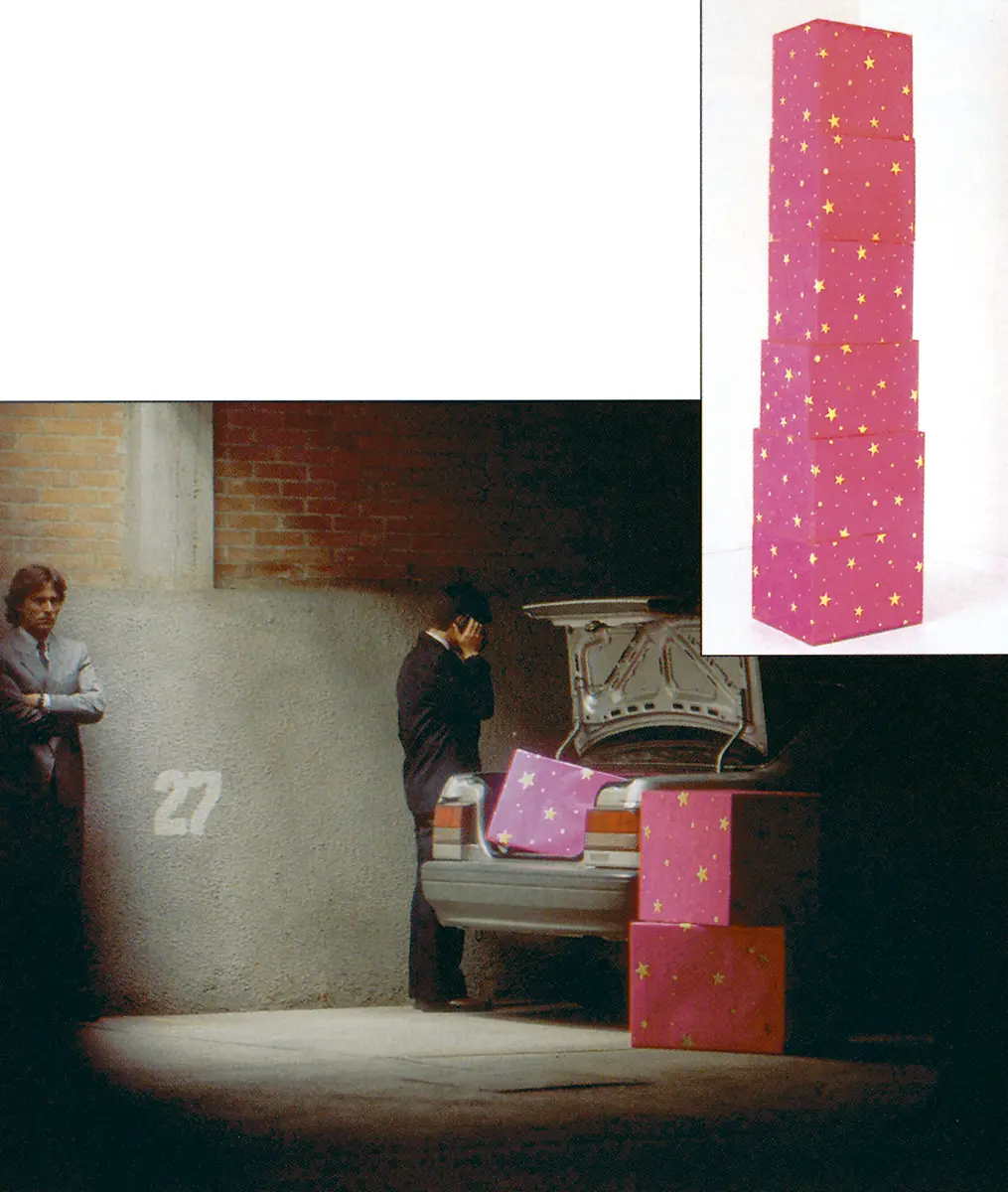
Here it is worth looking at the word «archeology», which many artists misunderstand when a series of apparently unrelated objects are selected and presented for the spectator's own interpretation. Herran understands the term correctly as the recovery of the meaning of certain objects for a society. In this case it is a question of transferring to the visual medium an historical event which is impossible to describe correctly, because we do not know if it was something painful, merely stupid or as one contemporary Colombian writer has said, an undeniable symptom of deviation. What is undeniable is that corruption, wrapped up in fuchsia colored paper and studded with stars, is a symbol of our recent history.
Oscar Munoz, a draughtsman with a long career behind him, has for some time now left behind the problems of self- expression and become a «communicator» of certain processes which show the fragility and fragmentation of the world in which we live. It is important here to recall his earlier works, such as his Narcissi, which in fact consist of charcoal dust falling onto water through a sieve, gradually disappearing and at the same time creating his own face on a newspaper with the latest news, and Ambulatory, a map of Cali, his native city, covered with protective glass broken into small pieces. Violence is the prime cause of fragmentation, and it makes it almost impossible to recover any sense of the whole.
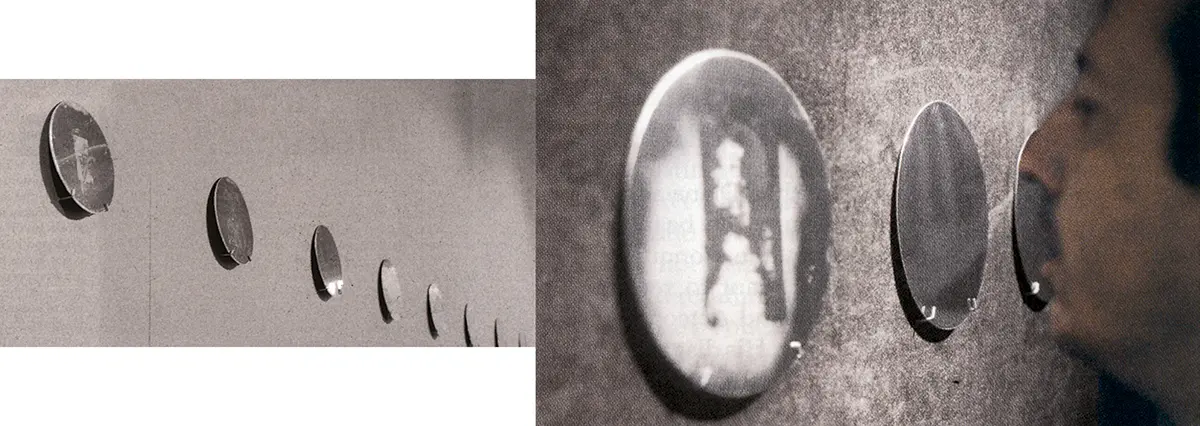
His work at the Biennial, entitled Breath, consisted
of 15 plates of stainless steel, each with a photographic impression of rites
of passage, such as births and birthdays of ordinary people which could be seen
through steam. The work, as in the case of old photographs, seems to be a trap
for the breath and light: a unique moment, which is almost unrepeatable, more a
matter of chemistry than physics, underscoring the fleeting nature not only of
the world in which we live, but also creation itself.
For Luis Roldan, the winner of the previous edition of the National Salon, abstraction is a way of turning an idea over in his head. Thus we have seen his work evolve, beginning with the classical reflection on form, space, synthetic drawing and support. Later, the stain became the protagonist of his series, which in many cases evoked a citation from the history of art; once again the support and the different layers were exposed. His current work is made up of strata and uses recycled materials - apparently innocent newspaper articles, but which deal with steamy or violent pieces of news, books and waste material from his studio. All these encounters and specific stains enrich the surface of his work, freeing the abstract art from «good taste» and transforming the painting into a complex event, beyond painting itself. Here we see the entire tradition of Colombian abstract art, synonymous with the works of Edgar Negret, Manuel Hernandez, Carlos Rojas and Eduardo Ramirez Villamizar, who analyze problems of form and space, but with an unexpected turn in perception, history and humor, and in the process managing to combine universal problems with local characteristics.
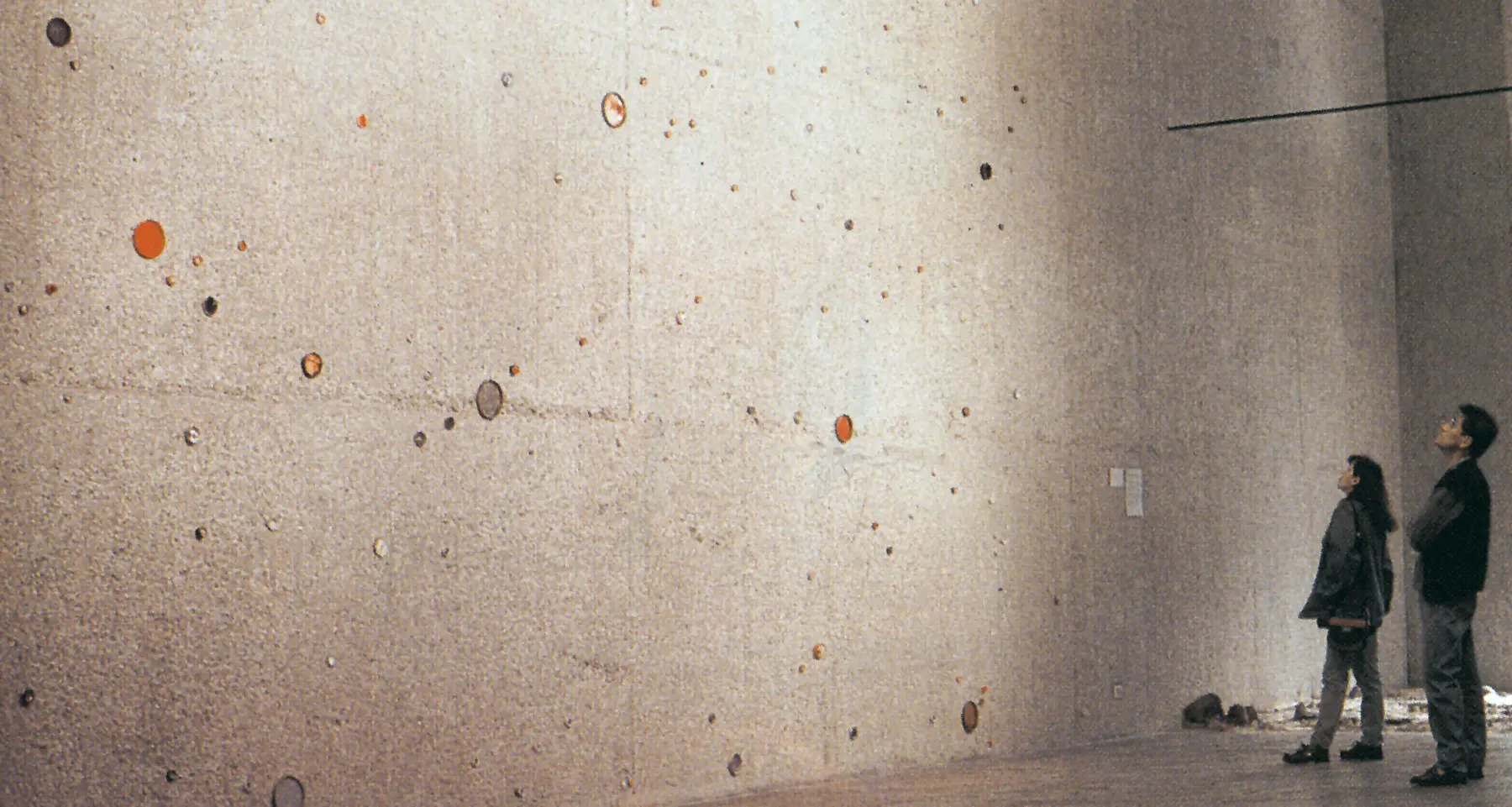
In the work at the Biennial, entitled Delicious and Tasty, the stretcher which in his previous work had been made into a container of layers of residue, now became a collection of all kinds of colored bottle caps and jar tops, invading the wall with concepts of brilliance, levity, velocity and weight. The technical fiche said: «caps and waste materials on a wall». For Roldan the wall is important. We should not forget that the grey, textured walls of the Museum of Modem Art in Bogota are the (rather mischievous) work of the architect Rogelio Salmona, whom no artist has tried to challenge in his work, which has been passively accepted but Roldan's subtle perception takes up this challenge, establishing a conversation which begins by being amusing, but very profound as regards his profession as an architect.
It is a pity that the artists represented at this Biennial did not have the respect, the sense of perception, the sense of humor or irreverence necessary to place their interests in the context of a communication with «someone else», a conversation in situ with a country, with a spectator, with a place or even with the museum as a «container» with its own «content». Instead, they seemed to prefer to engage in exhibitions of their own egos, travels and personal references.
Natalia Gutiérrez
Dean of the Faculty of Art of the Jorge Tadeo Lozano University in Bogota