
Garbriel Orozco’s last exhibit in New York raises a variety of issues that analytically addressed would make the work resemble a philosophical treatise. The show is not only diverse and rather large but also complex and carefully installed. The main or north gallery displays a serie of works thematically, conceptually and formally related. They consist of blown up images of sportsmen, presented in computer generated prints coated with plastic. The glossy «portraits» of men in intense action have lost definition, and the saturated colors have paled due to the enlargement of the photographs. Instead, the grain of the print is quite noticeable and the link with bad newspaper reproductions becomes immediately evident. Indeed, the photographs seem to be taken from the sports section of the daily press, the emphasize composition, the capturing of the precise moment (very much a la Cartier-Bresson), the concentration of the player and other features characteristic of sports photography. Orozco continues thus an inquiry into those spaces of public interaction mediated by the media such as the ritualistic sportive event. But the images reproduced undergo in these prints a very particular alteration. Following the rythm of the composition Orozco has inscribed on the surface of these prints combination of ovals and circles that in color and form map or trace the compositional and chromatic configurations of the photographs. A pervasive graphic design quality juxtaposed to the immediacy of the photographed event makes one think of the codified visual languages of the media. In this sense, this series of works evoke eighties critical strategies against institutionalized visuality as those deployed by artists like Sara Charlesworth and John Baldessari.
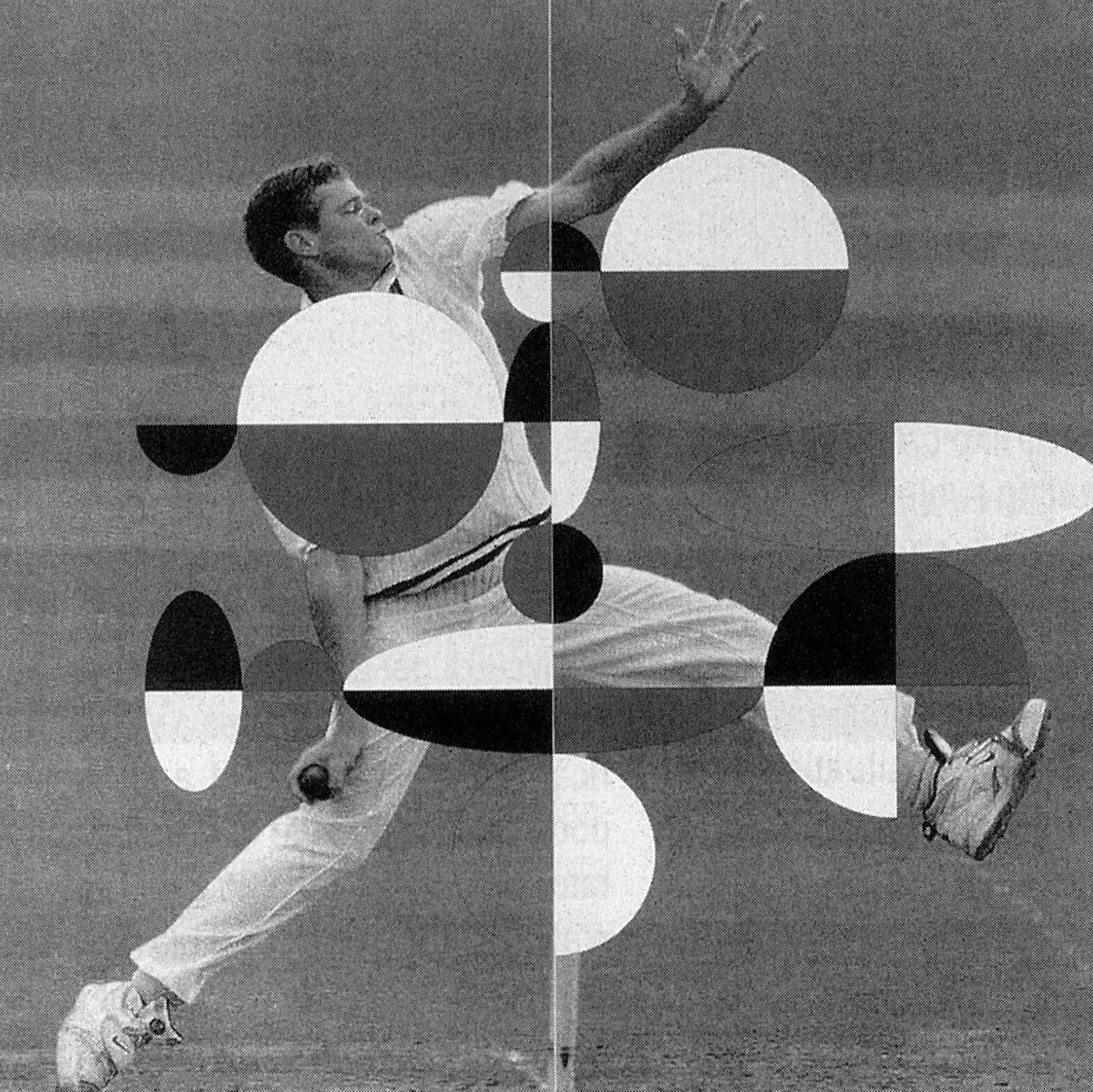
In these images there is a feeling that pure form (the graphic configuration of colored ovals and circles) and content (the photographed event) split, the first lacking the content/meaning of the latter and this one lacking the graphic definition and chromatic saturation of the first. This polarization between form and meaning seems to be pointing at the imposibility of form before discourse, or as Roland Barthes indicated in his seminal essay Mythologies (1957), at the difficulty of encountering form before mythical speech (particularly that reconfigured through advertising, media and other public institutions and spaces). (*)
It is at this point that one can glimpse at the philosophical dimensions of Orozco’s work. No wonder these new series of images share in their title the word atomists which alludes to a theory that thinks matter as conceived of minute indivisible elements. This rather conventional theory suits perfectly well man’s will to order since units are easier to arrange, organize, categorize. Organization allows one are easier to arrange, organize, categorize. Organization allows one to overcome the absurdity of form before discourse, the absence of an inherent logic to form, the lack of a natural rationalism. In a way this feature of Orozco’s work is continously explored in his poetic photographs, some of which could be found in a separate room of the gallery. In these prints, Orozco deploys and object trouveaesthetic that one can link to surrealist photography unveilling of the absurdity of form before categories and discourse. This had already been addressed in the artist dislocated still life in which the serialized object of the supermarket and its conventional organization: usually cans of food, vegetables and other popular objects characteristic of this vernacular space, destabilized the conventional organization of the object through aleatory compositions based on apparently disfunctional systems. This lack of instrumentality is taken up by an oval billiard table located in the south gallery that lacks holes to aim the balls at. Even game is ruled by a system.
The leap that one encounters in Orozco’s work from his highly poetic pieces from the early nineties to the more radical and analytical recent gestures can be bridge by photography images such as Blue Sandals, 1996. The photograph consists of a picture of abandoned sandals on the beach that are carefully positioned within the image (in atriangularformat that echoes the pyramidal composition of the photograph) and whose colors contrast the artificiality of the blue sandals against the naturalness of the brown sand. In this sense, as much as the photographic practice of Orozco drives from the Duchiampian ready-made, not only because he takes photographs of ready-made objects but also because he conceives of the visualized image as already out there and not as «created» by the photographer. It also seems to be in close dialogue with the photographic Mexican tradition championed by artist Manuel Alvarez Bravo. Indeed, Alvarez Bravo delightfully juxtapositions the natural and the artificial, of the man’made and the organic. He seems to share with Orozco a blurring of hierarchies, polarizations and dualisms that problematizes the beloging of things towards determined and specific categories.
The imposibility of form before discourse is read as absurd and it is the absurdity of cultural forms as natural, that much of Orozcos’s work underlines.
NOTE
In this sense it is important to note that Orozco’s show was originally presented in London in an exhibition space that was a men’s club.
MONICA AMOR