
At his second one-man show at the Sandra Gering Gallery in New York last October, 1996 this young Venezuelan artist presented two sets of work, consisting of the memory of an action or event. In the main room of the gallery, there was a set of panels in neutral, everyday, inoffensive colors, of the kind used in kitchens, all of the same size and arranged separately or to form diptychs. There was a clear reference here to minimalist painting. But here was also a contrasting, disturbing element which upset this initially tranquil sensation - a kind of bite by some gigantic animal on the monochrome, perfect surfaces of the pieces. In line with the general arrangement of the works, the bites were all of the same size, and all in the same place: in the lower part of the «pictures». The scene was complemented by a table, the inevitable symbol of everyday life, which itself was the victim of a rigorously ordered attack. In the adjacent, small room, which looked like a chapel, there was a group of high resolution photographs showing children’s plastic dolls. Here the colors were strident and psycholic, the color of toys. The little figures also had been the victims of some kind of bites, this time more irregular and random. A compulsive and automatic gesture - that of taking something we have in our hands into our mouths and biting it - was handsomely aestheticized. The victimized little toys, which fit into the palm of the hand, were magnified in the photographs. It was not possible to determine exactly the size of the biting mouth, or thus the scale and real nature of the attack. The artist thus established a strange dialogue between the child-like, capricious and logical bite with an equally child-like logic of scale - a dialogue which in its playful innocence began to acquire a connotation and meaning.
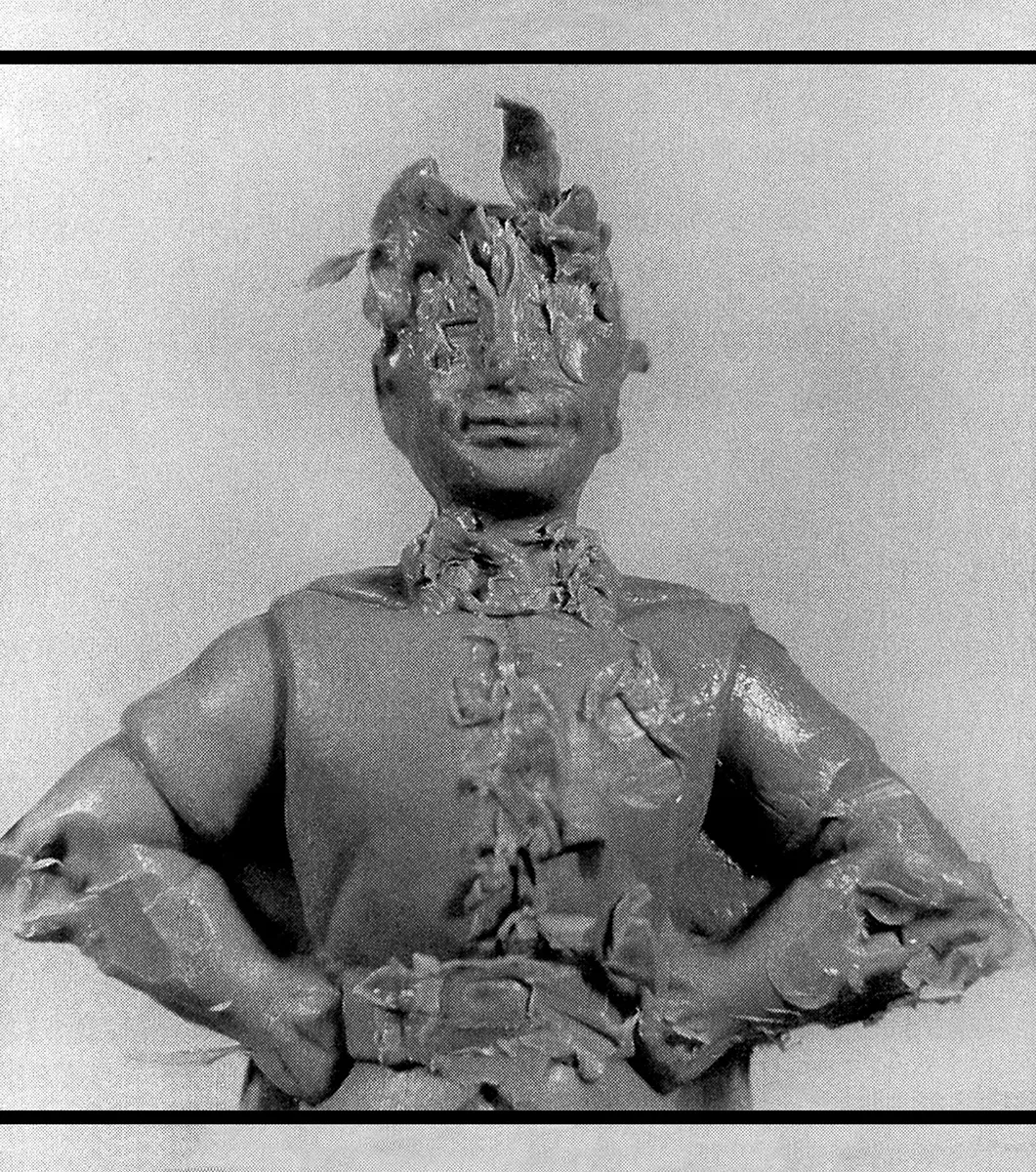
Are these bites an alllusion to the cannibalism of Oswald de Andrade, a primordial triggering idea behind the modern Latin American artistic project, whereby artists from the periphery irreverently masticate and digest the sacrosant aesthetics of the center? Are we, as spectators, bitten by an even bigger mouth, which turns us into little figures, the mishandled toys of the absurd, futile and constant feedback process of the cultural circuit? Might not this strange attack, perpetrated by the artist within a gallery, and against a network of artistic traditions, be a projection of his destabilizing intentions originated in an aesthetic sphere and directed towards a social one? None of these is the case. If we examine carefully the recent work of Jose Antonio Hernandez-Diez, the closest references to these works would be the photographs of street dogs devoring skateboards - an intrinsic and devotional object of the postmodern tribe known throughout the world as cosmoskaters - made of ephemeral and popular crackling. Once again, the absurd aspect of a casual event, which is as compulsively casual as biting little dolls, appears in the chain of successive meanings which the artist establishes in a long series of works focusing on the imposition of various materials and contents on a formal vehicle, in this case skateboards. A random event recorded by the artist paradoxically becomes a testimony of his deliberately incidental, lateral position, his refusal of the obvious solution of closing this same chain of meaning.
The cornerstone, or backbone, of Hernandez-Diez’s work is its humor. It is not the humor of the despotic and provocative gestures of a pseudo- dadaist enfant terrible, nor the deliberate irony which invariably leads to a «lucid commentary", but a refined humor, almost stylized in its self-referential rhetoric, and slightly autistic. His unusual use of this kind of specific humor, which explodes and implodes at the same time, also characterizes the work of his compatriot and contemporary Meyer Vaisman. The work of this artist has explored such apparently contrasting subjects as the possibility of working on the logic of a work of art like a piece of merchandise, i.e. on the production of cultural commodities, as a commentary on the history and social situation of his country, always in amusing and revealing terms.
We all know that the joke, in its relationship with the unconscious, is supposed to bear the marks of truth. The adoption by the artist of a ludic approach, which contrasts with the idea of artistic practice as «work», is already a cultural logotype which has been coined by modernity. However, there is in the work of Jose Antonio Hernandez-Diez a significant feature which is related to a specific situation, the possibility which he has of moving in the course of his humor through the dynamics and strategic tensions characteristic of the traumatic relationship between the center and the periphery. This humorous process results in a nonsense which ends up by acquiring a meaning, an appeal to individualism which expands the possible readings of his work and which generates reflections on those tensions which seemed to be foreign, and which he finally deconstructs and reveals as constituting yet another game. This kind of work is sufficiently related to a set of cultural realities to exercise, if we wish, a critical effect on them. The slightly crazy perception, gently dislocated from reality, inevitably takes us towards another reality, an intimate constructionof the artist. Hence the charm of these pieces which has a certain fictional character, bearing witness to the actions of a figure, the self-mystifying process of the artist - an equation made of witty and relevant excentricities.
NICOLAS GUAGNINI