
When the leading chronicler in the Chilean press, Joaquin Edwards Bello, wrote his novel El roto in 1918, he did so, in his own words, in an attempt to «depict the sadism and cruelty of the country». The «roto» is a stereotype of the lower classes, someone who is scorned, who is both punished and feared at the same time, someone who is tolerated only at patriotic national fiestas.
Edwards Bello, in a scene set in the area around the Central Railway Station, of Santiago presents a gang of tattered children «with bands of filth around their legs» and scabs on their head, the aftermath of bouts of smallpox. They are human beings who seem «to be made biblically with waste material, with rotten dung and mud». Because they were born and will die in their lamentable state, they are cynical, shrewd, good- for-nothing vagabonds and thieves. They are helpless against destiny which has condemned them to a precocious and full-time drunkenness, which undoubtedly will end in brothels and knife fights.
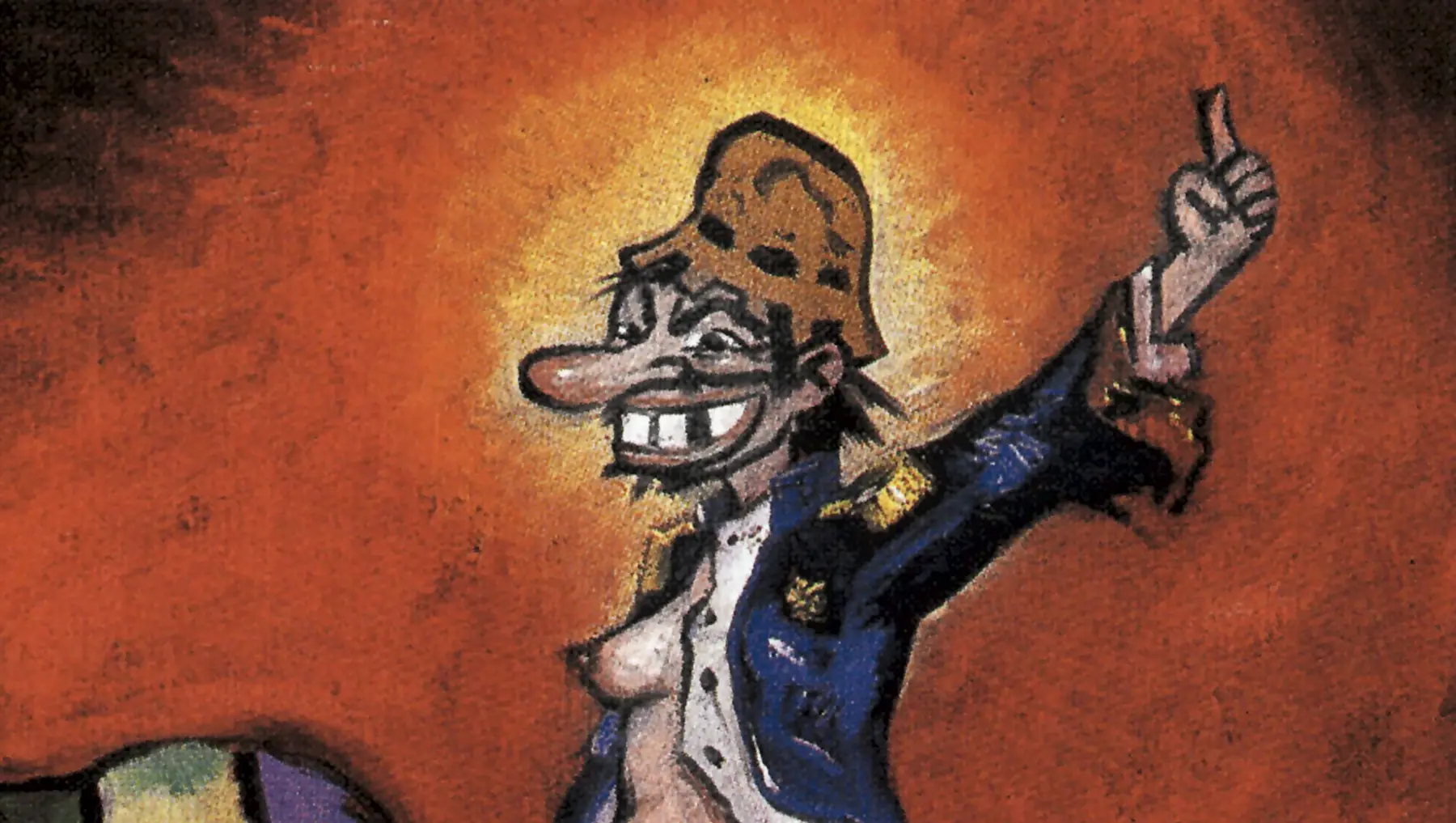
Rota is the title of this exhibition by Juan Domingo Davila (who has lived in Australia for the last twenty-two years) at the Gabriela Mistral public gallery. Davila uses the image of the down and out «Verdejo», immortalized by the illustrator Coke in the Chilean magazine Topaze. He is a physically unattractive vagabond, although shrewd and witty. He is the popular and festive caricature of the tolerable «down and out». But Juan Davila does not indulge in innocent jokes, but vomits out the figure with the compulsion of black humor. Because black is the manouvre which endowed Verdejo with a comic pose so as to overlook the damage of that kind of national cruelty which outraged Edwards Bello some seventy years ago. Behind the innocence of the little broken figure, which Davila makes increasingly submissive and less subversive, lies a strategy justifying the power of the dominant class towards a so-called «original purity» of which the masses lack. It is a strategy which in a sense articulates all the systems of hierarchy.
Davila gives back to Verdejo all the terrors which the caricature tried to eliminate. He systematically transforms his sex, destroying his symbolic identity and in the process mocking the classification process which made him inoffensive and pleasant. Verdejo thus appears in a new context and setting, posing garrilously amongst a kind of painting sanctified by the most official history of Chilean art. Verdejo thus becomes installed uncomfortably in a prohibited place. He poses naked, feminized as in the porno comics, guffawing with laughter and making an insolently vulgar gesture, like the Simon Bolivar of the famous postcard which provoked outraged diplomatic reactions.
The writer Diamela Eltit, in her text for the exhibition catalogue, sees this figure as a kind of «creole Frankenstein». He has become a source of threat for the very class which created him, «because his broken body remains crouched - ready to jump, in each of the physical corners of the territory or in the uncertain depravity of the cracked spaces in the psyche of the local inhabitants». Juan Davila knows that the «spaces in the psyche of the local inhabitants» are cracked and that a kind of uncertain depravity» inhabits those spaces. It is the clear knowledge of this fact, which for him is quite obvious, which gives his images their disturbing power. It is not that Davila wants to disturb anyone: there is nothing further from his reflective and peaceful nature. Violence, if carefully observed, does not characterize this artist’s gesture or images. What is however shocking is the exteriorization of contradictions which have for so long remained hidden. It is like turning a body inside out, exposing the internal organs in all their bloody complexity and repulsiveness.
Davila not only «questions» the meticulously constructed symbols of identity but dismantles them, exposing the perverse devices used in their elaboration. But what is the origin of the fear of crossbreeding which these symbolic representations do not conceal completely? What is the origin of the panic about cultural, racial, class and above all sexual hybridization? This is the question which Davila has insistently asked throughout his artistic career.
Juan Domingo Davila has carried to the extreme his act
of sabotage against the mania of taking models of identity so seriously.
Identity is based on a purity which nowadays can only be but illusory. And it
is precisely because it is a fiction that books, muralism, etc.
It can be manipulated as a handsome irony. This is what Davila does starting with his own name. Davila makes fun of the authorship attributable to a single subject. He says that he is not one or homogenous, but many and all mixed together. He likes to move in and out in many different folds, with the works being signed «Juana Davila”, “Juanito Laguna» or «Maria Davila». «Juana Davila» was the signature on the controversial figure of Simon Bolivar in women’s clothes, and it seems that the signature was as or even more offensive than the breasts of the hero of the Americas. But the artist does not only multiply himself into thousands of fictious «authors», but directly incorporates into his work materials prepared by others, sometimes manually, and which belong to very different registers. For example, in the Rota show, «Verdejo» sometimes appears painted by Davila’s hand - using various signatures, and sometimes in an embroidered form done by some female handicraft worker. There is a painting with a flower done in crochet work by a woman who still practices an almost forgotten craft. In another mural piece, little squares have been worked by different women from the artist’s family. It is not by chance that Davila has recourse to traditionally female crafts, which on the one hand they conjure up the world of the past and on the other, they evoke a subordinate and domestic world, excluded from power: the same place where «Verdejo» comes from.
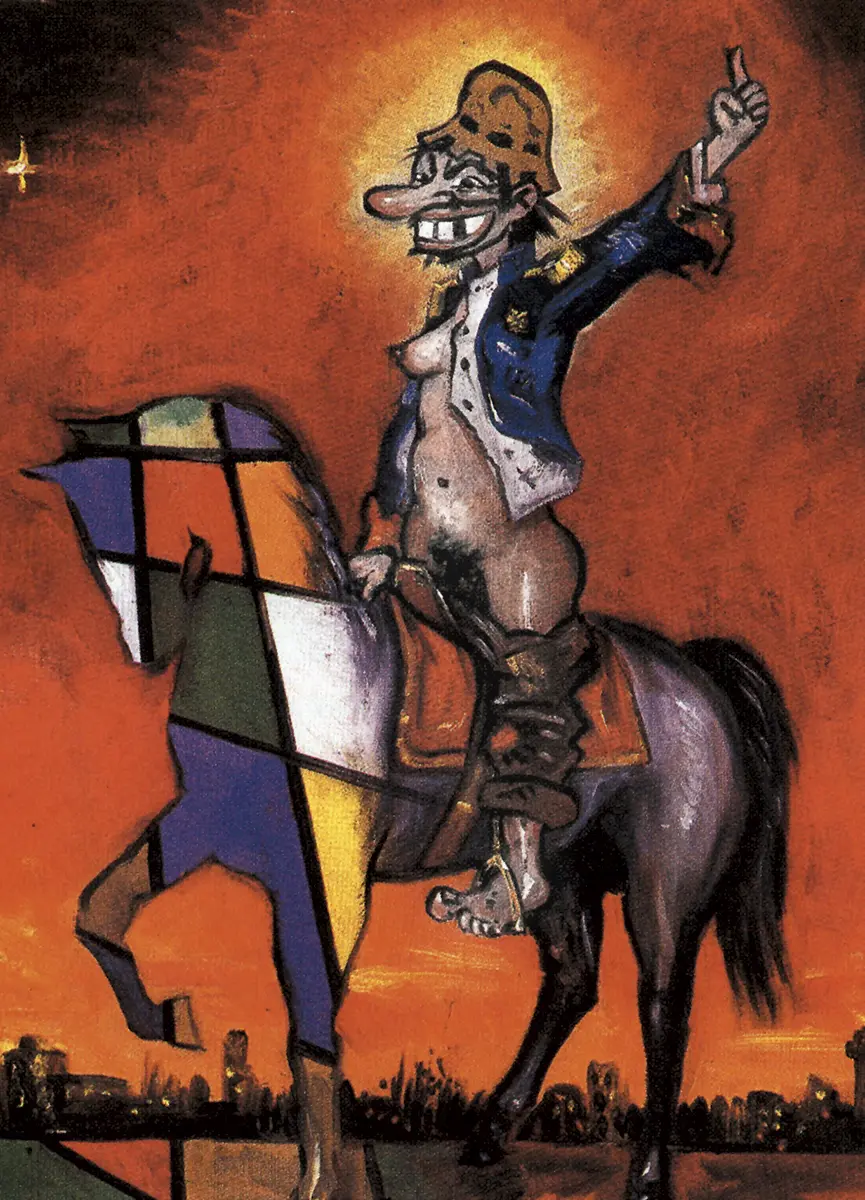
Invented and real characters mingle together in this work with others from distinct cultural traditions; between them, they reflect the multiple stages of the crossbreeding process. The techniques and materials also suggest an exuberant promiscuity: painting, embroidery, weaving, laser printing on sythetic fabric, a patchwork use of hides and skins, bits of scenery done in cardboard... materials and devices which are sometimes taken from popular handicrafts and sometimes from the most sophisticated computer technologies. The languages, which are also very varied, create a profuse and intricate hybridization, made up of traditional painting, porno prints, journalistic rhetoric, graffiti, popular Latin American imagery, school note-books, muralism, etc.
What is really «broken» in Davila’s work is the entire cultural fabric. Davila tears out and sews together bits of history, which appear as symbolic ideas and images, but also as material expressions.
This strange and fascinating exhibition, in addition to a wide variety of different resources, it reflects a surprising sense of economy. There is not too much nor too little.
Everything is broken and sewn together. Everything is recognizable,
but nothing is what it seems.
CATALINA MENA
Chilean art critic. Resident in Santiago.