
In a recent article published in the October, review Hal Foster refers to the images of disaster which abound in the art of Andy Warhol (crashes, explosions, air accidents) to examine two opposite interpretations of pop art: the first claims that the images which appear in this kind of art are a mere «simulacrum» which has nothing to do with the external reality within which they were produced; the second maintains that the images used in pop are completely «referential» and therefore subject to a political or sociological interpretation. This debate has turned into a kind of unresolvable discussion and even today - almost three decades after many of these works were produced, the critique of pop continues to be be divided between the partisans of the «simulacrum» view and those who advocate «referentiality».
This debate has been broadened to other artists, such as Mike Kelley and Jeff Koons, who in the I980s and I990s chose to work with the pop legacy. It would therefore seem that the most recent one-person show by Liliana Porter in New York - which gathered together a number of photographs (and a couple of paintings) of scenes and «dialogues» between little dolls, monkeys and other toys from some stall selling trinkets and knick-knacks - would also lead to the same questions about «simulacrum» and «referentiality».
But this is not the case. These pieces take into full account the history (and the debates about) pop art and kitsch: unlike artists such as Koons and Kelley, Porter has reflected on the meanings conjured up by the objects and toys she incorporates into her pieces. Her work includes figures of Mickey Mouse and Minni, archetypes of our consumer culture, which have been able to exploit not only toys but their actual images, which appear on T shirts, ball point pens and coffee cups - but which are also political emblems, as in the case of Che Guevara’s face or the stereotype Marxist-Leninist symbol of the hammer and sickle.
With this playful juxtaposition of toys and political symbols, Porter goes beyond the typical pop or neopop artist. Whereas the latter two created works based on the artifacts of popular culture to refer to the loss of meaning involved in mass production, Porter extends this commentary to the political symbols now made banal by stereotype and the common place. Just as the consumer society has made the felt animal into an object emptied of any meaning, so the exaggerated repetition of certain political emblems has had the same effect.
We can see this critical process in action in the triptych of black and white photographs Untitled with out- of-focus Che (1991-1995). The three photographs show the same image - Mickey Mouse in front of a souvenir plate showing the figure of Cheve Guevara, which gradually becomes out of focus until it becomes almost abstract - just as the meaning of the object too is gradually lost as it becomes transformed into a consumer object. Porter’s triptych shows that the image of Che Guevara - an image which has suffered a «Frida Kahlo» effect and which we can find reproduced on T shirts and other paraphernalia - has been as exploited by consumerism as the figure of Mickey Mouse.
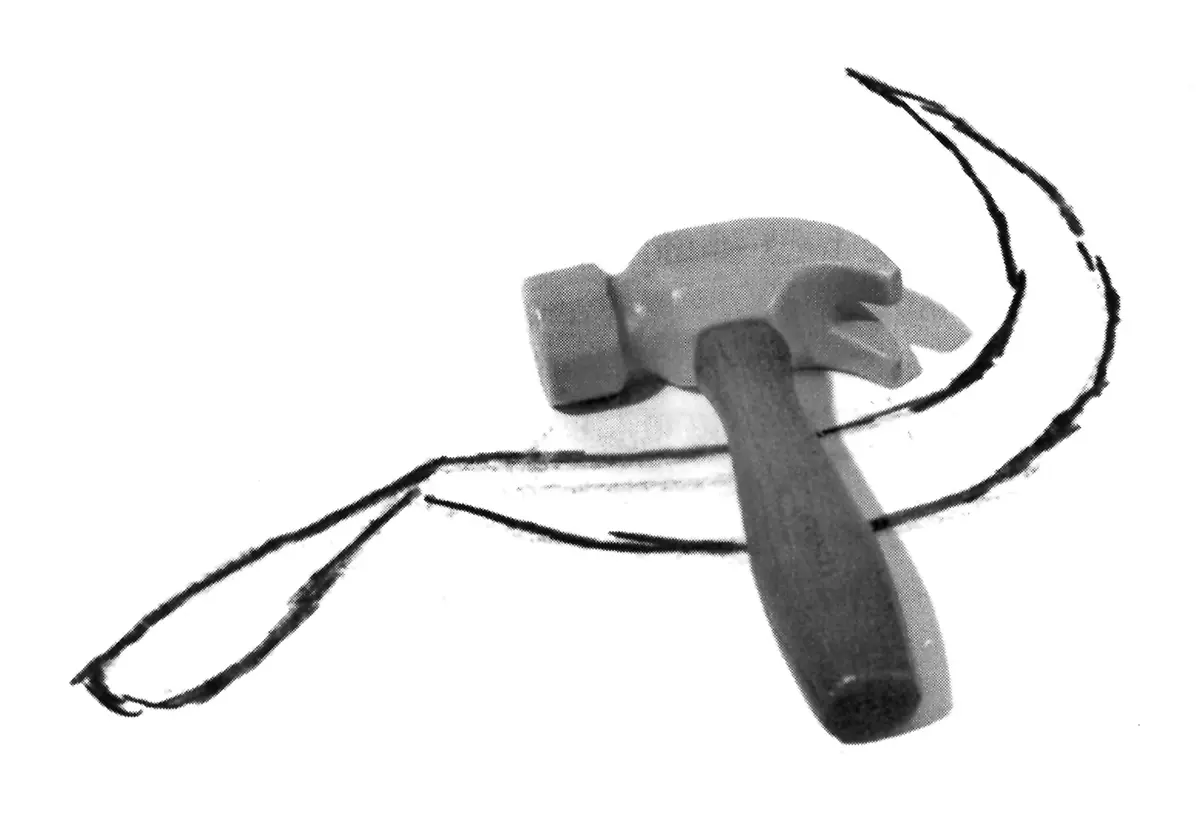
Something similar occurs in Drawing with Plastic Hammer 1993-1995), a black and white photograph of a toy hammer, under which Porter has drawn a large sickle. It is obvious that the plastic hammer is nothing more than a simulacrum (who would dare to try and hammer a nail with it?). In this work, the symbol of the «hammer and sickle» - which used to be a proud Marxist-Leninist symbol - has been plastified and reduced to the level of a toy: something which is not so far from the reality of the 1990s (think, for example, about the «KGB watches* and other objects full of Soviet insignia which an entire generation of Russian street vendors have used to venture into the territory of capitalism).
Elegant and playful, these works by Liliana Porter show how symbols and images can move from being «referential» to «simulacra». Porter reminds us that not only consumer products but political emblems too can lose their meaning when they fall victims to the abuse of mass culture.
RUBEN GALLO