To see the painting of Manuel Salinas is to think about the light of Seville. About the Guadalquivir, from which the three sailing ships began their journey to the Americas, taking with them in the bilges the first editions of Don Quixote and the saints, so luminous and handsome, with their rich plastic texture, depicted by Zurbaran. A chiaroscuro burning with the pure sun. The same is true of these large canvases.
The powerful works which are now being presented in Colombia, like all abstract art, evoke suggestive sensations which are difficult to capture in words. A reconstruction, for example, of a classical architectural past, thanks to its essential features? Perhaps. At all events, this arduous combination in which lyricism becomes a kind of strictness induces us to try and clarify certain things.
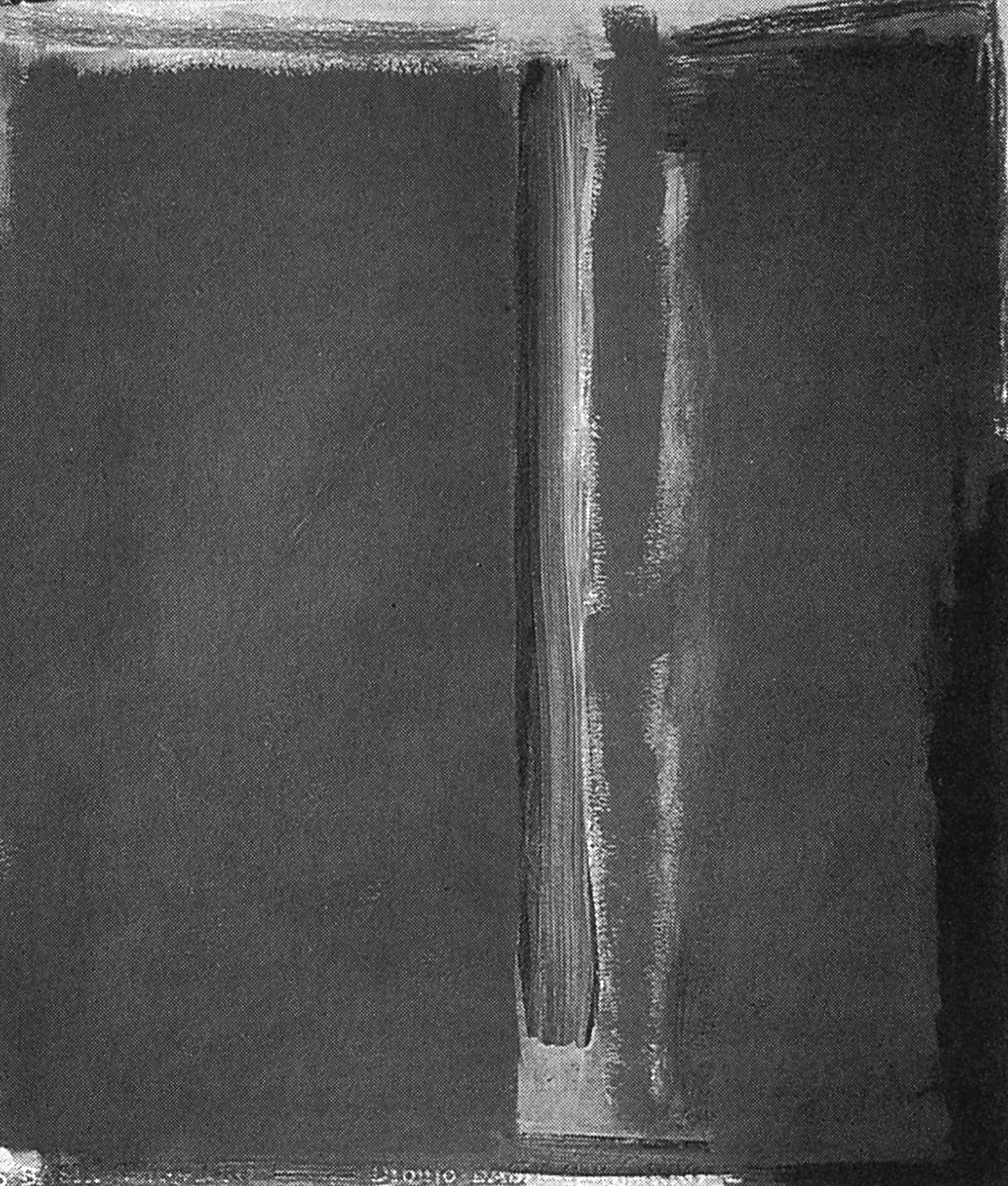
First of all, there is the pure pleasure of the very free color, which is sometimes all-enveloping, dominating the space with its gestual tide-like movements, the tactile brilliance of its sinuousy textures, and which pays due homage to informalism - but rather that of the school of Paris than of its Spanish version. Dark pictures, and strongly toned, whose only reference is their own delight in exploration, enormous masses unfolding the enveloping whorl of their perpetual genesis. It is the eye of the spectator which brings them to life.
Then there is the architect’s presence, who draws, sketches, suggests and builds, constructing his visual modules as if in a notebook of the background of the imaginary architecture of the world. Triangle, rectangle, polyhedron, trapezium, cube, insinuating rather than measuring; instead of limiting space and shortening perspectives, the artist opens them up towards an unpredictable subjectivity expressed through a geometry always interrupted by the unexpected stuttering of poetry. The doubtful white line breaks the spherical black block. The gush of green disturbs the balance of the strictly symmetrical masses.
A world, in short, which thinks, doubts and retraces its steps against these backgrounds where reds, yellows and blues suddenly become translucent with the sea. Thus, the prettiness of an aesthetic harmony is broken by something hard which stains or darkens it, recalling that although the artist wants to paint without reason this void of references is always a risk which calls out for its own solutions.
Then there is the gestuality which breaks schemas with the unpredictable pigment of its brush-strokes, and the contrapuntal repetition of these pictorial masses which harmonize or refute one another in the artist’s compositions, all of which, including the small format pieces, which well might appear to be flecked ideograms, retain the spatial impetus characateristic of the work of the major figures of North American abstract expressionism, such as Barnett Newman or Mark Rothko. Or perhaps the dilated respiration with which oriental painting expands space, barely recording, like a small incision, the ephemeral trace which leaves behind itself by the work of man.
Finally, and always, there is the color, which studied in series of three or four sequences, recovers all its fortunate prerogatives, in the color spectrum of its vertical bands, which in the end dominate the canvas, until they saturate the entire atmosphere with their dominating presence. A interlocking mesh which captures our sense of vision.
But it is color which has already reflected on its structure, which has already broken with its immediate beauty, which has already resolved to go beyond primary satisfaction - towards that emotional intelligence in which gesture becomes disciplined but never sterile. On the contrary, it becomes more generous, as in those dilated canvases in which the brilliant red becomes euphoric and takes flight, recalling the masterly lines of Fray Luis de Leon in his ode to the musician Francisco Salinas, which might serve as a fitting symbol of this painting:
The air becomes serene/And cloaks in splendor and spare light,/Salinas, when the celestial music sounds/Un- der the guidance of your wise hand.
The hand of this painter from Seville, born in 1949, has modulated his painting and transformed it into music. The hand that expresses itself, and the pulse which can be felt, both free and restrained.
JUAN GUSTAVO COBO BORDA