
The work of Oscar Munoz, from its beginnings in the 1970s, has remained closely linked with drawing. For an entire generation trained in the language of drawing and print-making, his charcoal works on erotic themes were memorable - works which showed his mastery of his medium, his belligerant and critical attitude which, like that of so many artists of his generation, based on photographic images taken from all kinds of magazines and publications. It was this photographic language which led to his hyperrealistic treatment of drawing, which gradually developed and matured through supremely urban themes in which Munoz worked interior scenes, corners of dark rooms, passageways, abandoned mattresses, where there was always some sign of human presence.
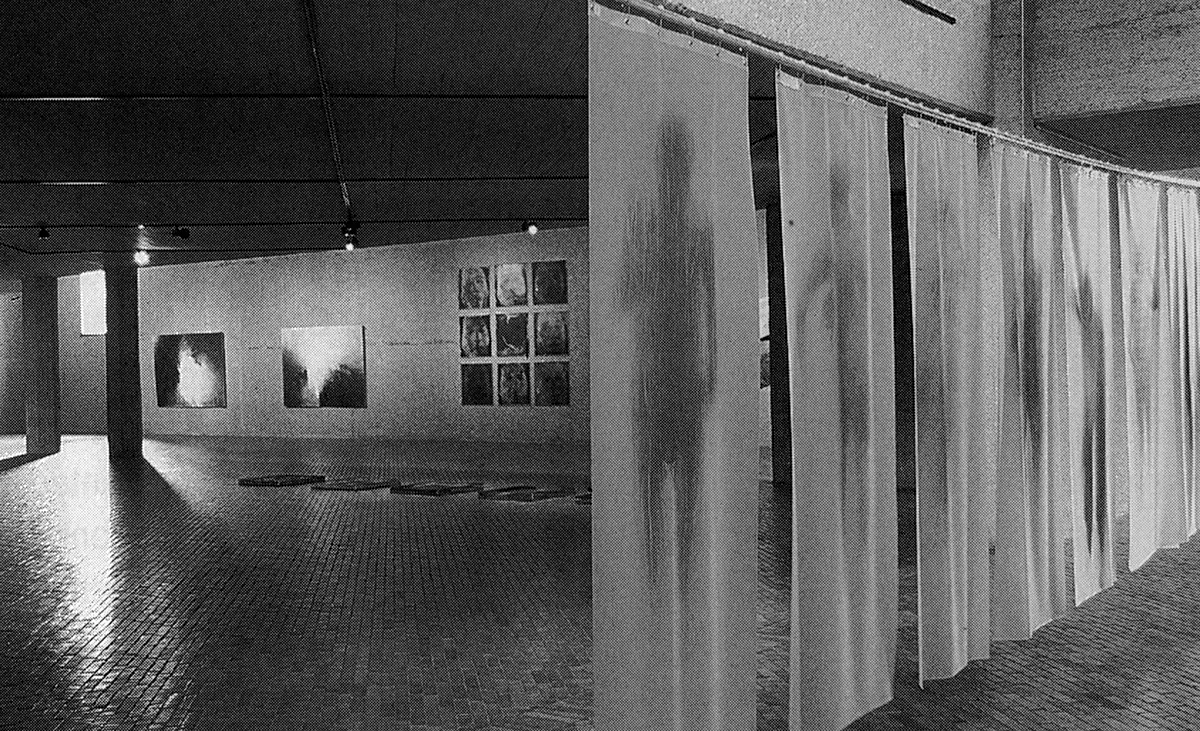
The exhibition which was presented at the Museum of Modern Art of Bogota last August and September was a selection of his work from the last decade, in which we can see how Munoz has continued with his constant investigation of the possibilities of drawing. It is this search which has give body and substance to his process, in which he has used a variety of supports and procedures, without ever losing the guiding thread which seems to be provided by his compenetration with the medium, with his craft, and with the resulting image. Above all, there is a kind of recalcitrant idea or conceptualization which seems to shape and guide all these factors.
The show, curated by Miguel Gonzalez, focused on three themes: bathrooms, surfaces and portraits. The subject of the bathrooms was illustrated by two series of works, the first consisting of some drawings which explored the problem of real appearance and the representation of the bathroom walls, seen as surfaces which gather light and humidity and which retain deep traces of human presence. This themes leads Munoz towardsn a experimentation with large canvases, in acrylic and plaster, in which he uses new resources and a heightened sense of perception to continue his exploration of light, the essential protagonist of his previous series, in which Munoz plunged himself into the dark inner spaces of the urban environment. Secondly, as part of this same theme of the bathrooms, there were the bathroom curtains, which are used as both support and theme. In this series from the mid- 1980s, Munoz imprisons and delays a moment of the activity carried out by any human being in the process of the daily shower. These images capture the silhouette of the human body and certain marks on the tiles and produce some very disturbing imagery.
In the series on coal/charcoal surfaces on which he worked at the end of the 1980s and early 1990s, Munoz retakes to the problem of surface - and it is here perhaps that there is a period in which reflection goes beyond the theme itself and is directed to the actual drawing. In this process, the problem of reality and representation persists, but this time they are seen from the standpoint of the craft itself, in terms of the possibilities and limitations of drawing, the condition of being a two-dimensional surface. Sometimes, on looking at these works, we have the sensation of looking at enormous abstract surfaces where, in the dying light(l), matter itself acquires an unusual validity and presence.
Finally, there is the Narcissus series, the artist’s most recent production, where the theme of the portrait is used to explore other aspects of the image in which, through a new perspective, he re-examines the relationship between drawing and photography which has provided his point of departure. This series is particularly interesting and complex, and has given rise to a multiplicity of readings, clearly demonstrating that Munoz’s work «ref lects upon itself and can be read as a matter of politics, investigations and procedures»(2). Of the many aspects reflected in this series, special mention must be made of the procedure used without intervention by the artist’s hand. The drawing of the Narcissi is the result of a photograph which is subsequently printed onto a photo-sensitive silk, with - as in photoserigraphy - spaces being left to allow charcoal dust to filter through, resulting in an image which is depos^ ited on a piece of paper at the bottom of a bucket containing water. The second part of the process consists of waiting for the water to evaporate - so that it is chance, water and the passing of time which actually do the drawing, i.e. create the final image.
Each of the images which make up these periods was a challenge to the difficult space in the Museum in the transformation of each place into an appropriate setting for the blackened, sometimes humid and occasionally magnificently deteriorated surfaces. Surfaces which speak more of perception than linework, the seduction of the marks left by the charcoal, the presence of life, light and the ephemeral, as well as chance, ungraspable and barely nameable things which in Munoz’s work are given a concrete form of expression and become lasting images through his exploration and reflection on the ancestral act of drawing.
The show was accompanied by an excellent catalogue which documented in detail the processes of this artist born in Cali, where he has always lived and worked. The large number of photographs was in turn complemented by texts by various critics who have examined different periods of his work, as well as a conversation with Miguel Gonzalez, which highlights the artist’s awareness and vision of his own work processes. The catalogue will remain as a testimony of an excellent exhibition by an artist from a generation who, using their own proposals from the 1960s and 1970s, has continued to produce very interesting work which has vigorously withstood the challenge of art from the younger figures. Unlike the case of the latter, the art of Oscar Munoz confirms the necessity of solid processes which give a special place to reflection, and which create images that are only possible through the slow and purifying effect of the passage of time.
NOTES
1. William Ospina, in an article published in May 1991 and included in the MAM exhibition catalogue.
2. Miguel Gonzalez, in the presentation note in the MAM catalogue
MARTA RODRIGUEZ