
Roberto Huarcaya worked as a psychologist before becoming interested in photography in 1988. His work has a pattern of staged photography, using color or b/w and different sizes, depending on his intentions for the outcome of the series. In a span of nine months, Huarcaya worked hours at a time in an insane asylum, to complete this series of 36 untitled b/w photographs named The Vessel of the Forgotten. He was interested in the architectural spaces of the hospital built in the 1920’s, but the main reason of the series was to portray the patiens. My intentions towards the spectator are multiple. I want to transmit my vision in relation to insanity, vision of respect and equality. My desire to brake the idea, that exist of the infinite differences between them and us. I want to build a bridge, so the spectator would slowly enter the forbidden spaces. (*)
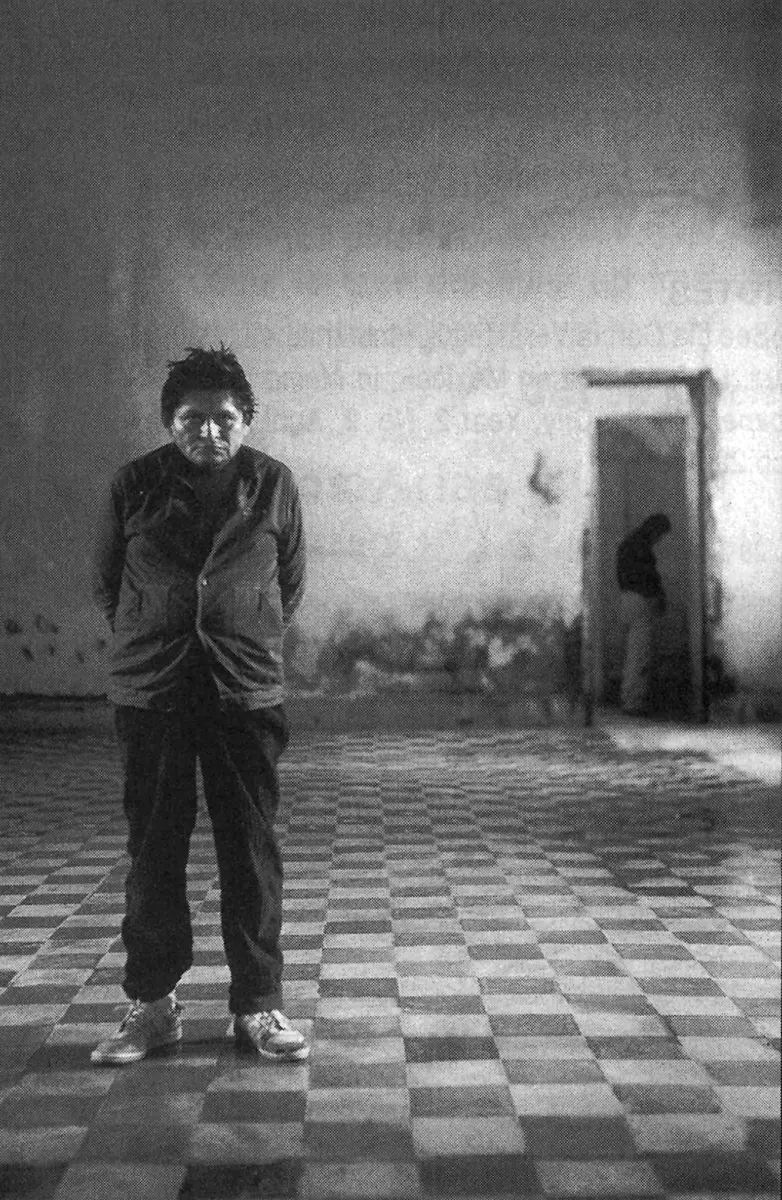
The viewer is confronted with images of insane persons with senseless photograph smiles and vague looks, dressed in too small or oversized clothes, some wearing odd shoes. In one portrait the patient is under a portal, he is wearing a white suit with a boot on one foot and a sandal on the other. We can also presume they are not getting the help they need. Huarcaya puts emphasis on the architectural spaces where his subjects pose, as each portrait is not a close-up, but the patient in a specific site of the hospital. The patients gave their permission to be photographed and also decided when and where to be photographed. If there is a repetition of spaces, it is because the first patient would choose one specific site and the others would select the same location. In one photograph the empty sleeping quarters are seen, the floor tiles are black and white squares, like a checkerboard pattern. The beds are of diferent heights, with different blankets and no pillows, giving the impression of order and disorder within the room. Another photograph show a symmetrical view of a long dark corridor with a window at the end. The light comming from the window is at the center of the picture; this work has double meaning, and can be read as a limited mental state of the patients. In another photograph there are a dozen patients sitting at an outdoor table, eating fruit. No one is interacting as if everyone were in their own worlds, their looks are lost in space, the silence is felt through the photograph. At the end of the exhibition, the viewer accepts the portraits as aesthetics works without ignoring the subject matter.
NOTE
* Interview with the artist, October, 1996.
LUIS LAMA