Roberto Marquez’s recent exhibition, entitled Divine Prison, is inspired, like many of his earlier series, by a personal experience. The idea of using religious themes is the result of a conversation with a friend. According to Marquez, music, in which he has a great interest, is constantly nurtured by religious tradition, while contemporary painting in general makes little use of this source. The works in this show combined religious, musical and aesthetic experience, in an attempt to create a metaphor without lapsing into a devotional intention. The artist achieves his goal, using a language which harmoniously combines erotic and mystical elements.
In The Mystery of the Fire, for example, a woman with a bare torso drags herself towards a pot of fire hanging from a rope. Inspired by the martyrdom of St. Ines, the image evokes the mystical experience of sacrifice. The fire, a symbol of purification, is a constant feature in the exhibition, as are certain characteristics of the female figures, such as the postures of submission and prayer, their long hair, their fixed, almost frightening expressions, which like a mysterious veil seem to highlight the mystical character of the series.
The Transfixion of Teresa, which is the inspiration behind the title of the show, shows a bound woman in a prayer position. The arches enclosing the figure recall the importance for Marquez of architecture (he is a trained architect) and a poem written in red in reverse symbolizes, as in other pictures, the idea of a «window» or «magical mirror» which in some way links the spectator with another world.
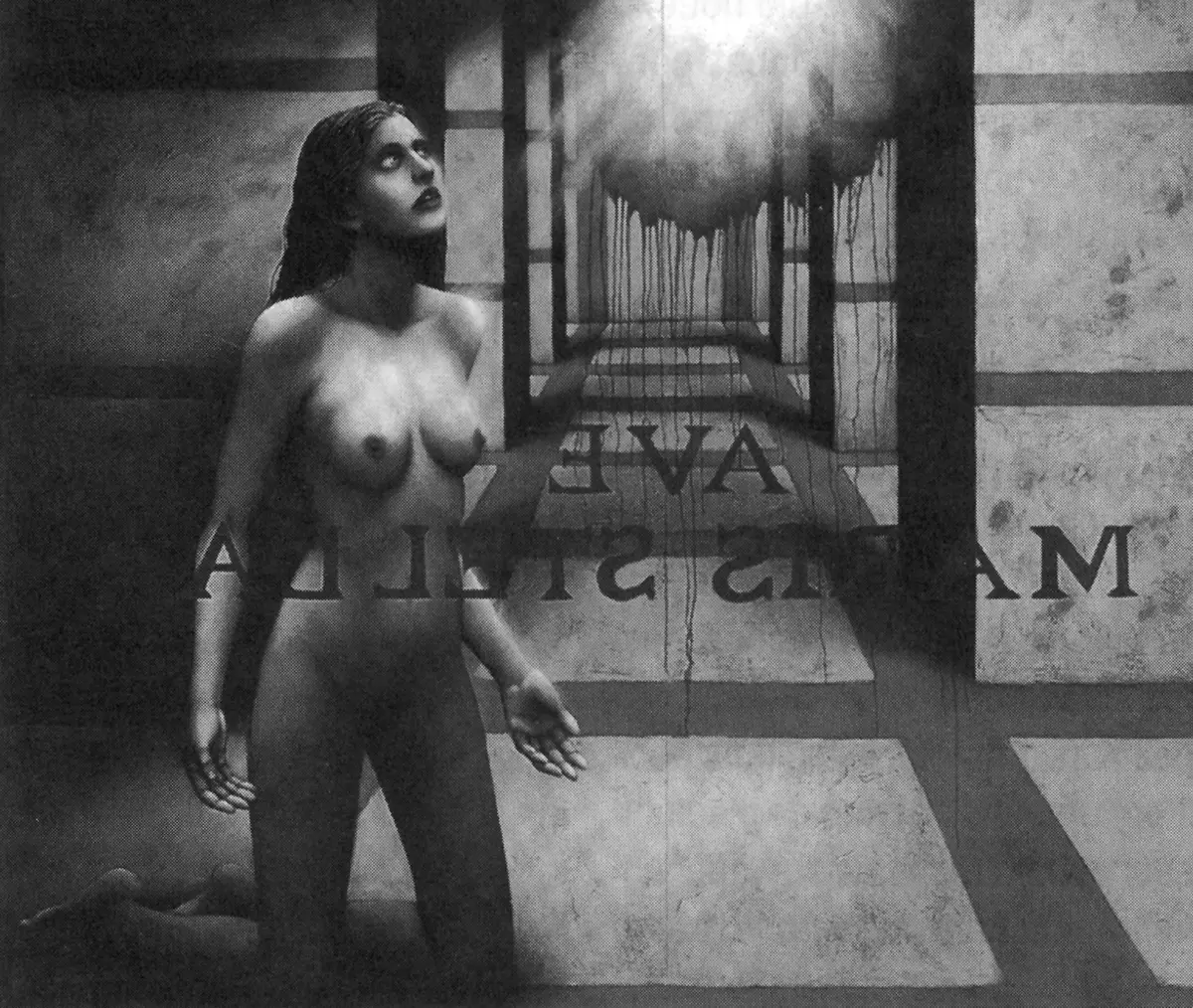
One of the most impressive works is Stella Maris, an annunciation based on a text by Rilke on the life of Mary. The young woman, kneeling down with her hands open in the act of contemplation, observes the light which streams down from the top part of the picture. Unlike the traditional images, Marquez’s rays of light are framed with a red blood stain dripping down to the middle of the picture, where the words AVE MARIA STELLIS are written in reverse. The image has a twofold meaning: in addition to representing the conception, it also symbolizes the annunciation of the sacrifice of Christ (the blood symbolizes his passion). At the emotional level, the woman inspires feelings of submission and suffering, which are emphasized by the grey and cold tones of the concrete walls against which the scene is set.
Another work, Ines the Sinner, relates the legend of St. Ines, who was put on show in a brothel and whose hair grew so long that it covered her body. Like the other works in the show, this was an allegorical composition. The figure appears covered with red squares which symbolize blood, an element of sacrifice and torture. The grid, a typical architectural element, in this case becomes a pictorial symbol.
One of the most poetic paintings in the exhibition was Waiting for the Millenium, inspired by a text by Paula Cela. It shows a reclining woman surrounded by pots of fire. The reddish tones of the setting create a gloomy and dark atmosphere, which emphasizes the idea suggested by the word «tenebrae» written at the top of the picture. The fire symbolizes the offering and at the same time the submission of the figure who humbly accepts her conditioin.
In addition to the pictures, the show also includes a series of three-dimensional objects, such as The Net and The Martyr with the Blue Veil. In The Net, a woman’s body with jaguar skin, set inside a box like a reliquary, symbolizes the hunting of the animal. Hunting itself can be seen as a metaphor of the passion. The same idea is repeated more clearly in The Martyr with the Blue Veil, another box in which the woman’s body, tied and painted with the concentric symbol of a target practice board and with crossing arrows, becomes a new version of the martyrdom of St. Sebastian.
One of the best works in the show is The Widower, a plaster face, with wings and covered with a delicate veil, placed on a pillow and alongside a wooden urn. It is a self-portrait which refers to Gerard de Nerval’s poem entitled The Unfortunate One. The image is both dark and melancholy. The Night of the Hunter, another self- portrait included in the exhibition, shows a tiger in a cage. Once again, many different readings may be possible, since in addition to depicting himself in feline terms (the artist is fascinated by tigers), Marquez makes use of a symbol previously used as an image of Christ.
The exhibition undoubtedly tries to create a sense of doubt in the spectator. Rather than attempting to illustrate through the use of symbols or encouraging a specific reading, the works created a purely mystical and aesthetic experience. The absence of any fixed symbolic correspondence made the works ambiguous, impossible to understand fully. The stories depicted are of a personal kind which in the end only the artist himself could fully interpret. However, this is not his intention.
Roberto Marquez is represented by Riva Yares Gallery and will inaugurate a retrospective exhibition at MARCO Museum in Monterrey in January 1997.
FRANCINE BIRBRAGHER