
To judge by the results of the BID Young Painters Competition presented in the Cultural Center of the Secretariat of Finances and Public Credit in Mexico City last February and March, most Mexican painters under the age of 30, have little ability to surprise or impress us. Various explanations can be given for this. Perhaps the spirit which marked the 1980s is still with us in Mexico. Perhaps the professional art schools in this country (of the 34 artists included in this event, 26 have received professional training) do not tell their students that they might like to try the now less than new deconstructivism or the most recent cutting edge tendencies so that that do not become late postmodernists so much by choice as by a lack of options. Or, accustomed as they are to creating predictable kinds of works and cultivating hackneyed language as tactics to obtain prizes and government scholarships (24 of the selected artists have been granted distinctions or scholarships or both) and make some sporadic sale, young Mexican painters are unable to distinguish between such domestic circumstances and a competition in which they are judged by international criteria.
This banal panorama notwithstanding, some of the paintings on show at the IDB event did stand out, while others only just managed to surpass the general mediocrity. The work by Mónica Prieto was noteworthy in its moderately critical representation of a characteristic member of one of the groups of the local oligarchy; the same was true of the work of Lorenza Orozco's high degree of expressiveness and provocative treatment of her subject and her shift from predominant vocabularies; Heike Muller’s neo-academic affiliation; Carlos Luna's far from solemn approach that deviates far from the current languages of the Mexican cultural environment; Cisco Jimenéz's planned aggressiveness, irreverence, and dynamic complexity; Leopoldo Gout's allusions to sexuality and successful distancing from painting; David Garza’s political references (although they were rather timid), indispensable in a country where there is a war; Enrique Ciapara’s stylistic independence; and the complexity and impeccable finish in Rodrigo Ayala work coupled with his far from superficial allusions to the Western pictorial tradition.
In accordance with the regulations of the competition, a selection committee made up of Efrain Bernal Acevedo, Ana Isabel Perez-Gavilan (art historians with curatorial experience), and Juan Carlos Pereda (curator of the Tamayo Museum) was selected (on the basis of slides and prints) those artists eligible to participate for the prizes. The members of the committee examined 648 entries by 34 artists and selected a total of 34. The prize jury included Monica Castillo, Rita Eder, and Osvaldo Sánchez (artist, researcher, and critic, respectively). They awarded the two acquisition prizes (of equal merit and monetary value — 40,000 pesos each) to Víctor Rodríguez and Marco Arce.
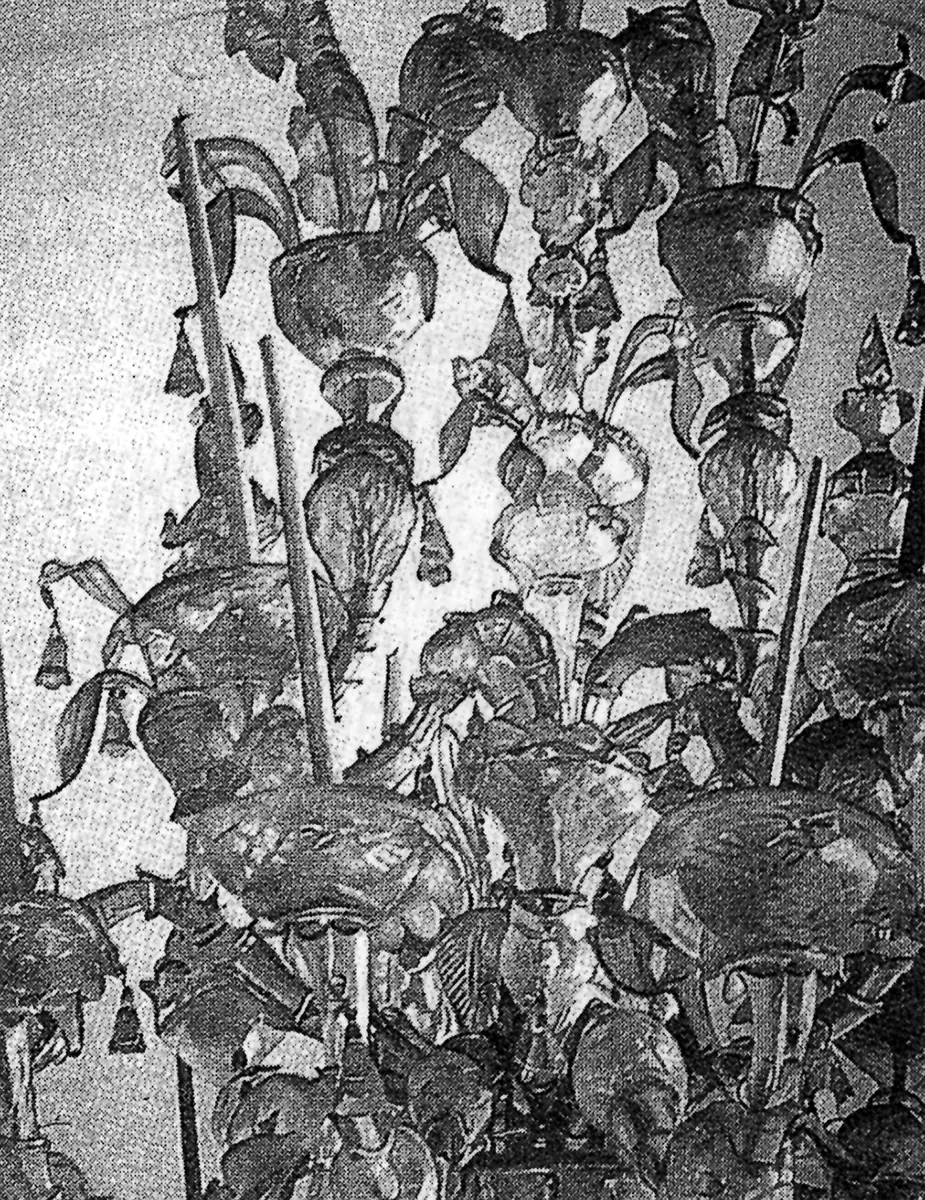
Rodriguez's work, an acrylic entitled Laocoon, measuring two meters square and done basically with air brush, solidified his link with a neo-figurative kind of photorealism — although updated in this case, and considerably less aseptic than in the earlier version — the demise of which occurred in the 1970s. Of course, the work was done with care and showed a moderate cultural irreverence in regards to the solution of its theme. Arce's work, Candelabro (1.52 x 1.22 meters) confirmed his frequent stylistic variations — so characteristically postmodernist — and his current tendency toward a mimetic figuratism, in this case, related, to the frame, to photography and video, although resolved in terms of elaboration and technique with eminently pictorial resources, which Arce worked with skill, determination, and refinement.
Thesamejury awarded honorary mentions to Luis Alonzo Barkigia, Enrique Ciapara, Alejandro Díaz and Lorena Orozco. Alonzo presented a set o‘ five oil paintings on wood, similar in effect to other thematic-iconographic explorations so common in the Mexican cultural environment. Ciapara (without a doubt the only artist among those receiving such distinctions who has really lived and worked far from the capital of the country) was recognized for his previously acknowledged stylistic autonomy. I do not know why a mention went to Diaz, since the results of his work betrayed too many references or even citations. In the case of Orozco, the mention was based on her noted expressive strength, lack of complacency in treatment, and use of vocabulary that, in the Mexican context, is a precocious one. It should be noted that Pilar Ramos Sánchez and Fernando Aceves apparently sent the selection committee photographic material of work of only middling quality —both are painters whose importance is much greater than that reflected in the pictures included in this competition, which was coordinated by Efraín Bernal Acevedo.
CARLOS BLAS GALINDO