From the beginning of his career, Carlos Enrique Polanco has been an outstanding painter. His early expressionism distorted bodies, landscapes, and perspectives, depicting an irrational world the absurdity of which was exacerbated by the actions which he recorded and the penumbras which he broke with flashes of color. Politicians and prostitutes, power and marginality were, along with phantasmagoric nocturnal visions, the main sources that nurtured his painting and gave clear proof of his talent. These were years of dark poetics, of a rage that did not mask its irony. It was these times of violence and confrontation with a reality which had previously been hidden, and which these pictures set out to study attentively, to reveal a kind of apocalypse awaiting us at the end of a cul de sac.
Later, Polanco went on a scholarship to study in China and his stay there had a decisive influence on his art. On his return, the color vibrated, light-flooded a good part of his pictures, and the earlier expressionism gave way to a sort of realism quite unusual in the plastic arts of Peru. The Made in China show, which he presented after his long absence, was a memorable recapitulation of his new experiences in that country. But his subsequent shows revealed the about-face which occurred in his work following his re-encounter with his native country and the renewed use of popular imagery as the basis for his art. Since then Polanco has been creating an artistically mature universe, a broad vision of the urban (under)world which he recreates that encompasses both dreams and nostalgia. His painting lost its sense of fury and acquired vital energy through the reflection required by courtesy of the images which he managed to disturb. In his most recent exhibition, Polanco reaffirms his interest in marginal space and his determination to reveal the strange beauty emanating from those settings. In his pictures of the cinema, for example, Polanco fragments the architecture in geometrical planes, with the brilliant night sky behind it, encouraging fortuitous sex. We are familiar with Polanco’s streets. None are clearly identifiable as they are the sum of all the streets through which we have passed in Lima. The generalized architecture ends up as an identifying marker of our culture. This is the case with the picture of the red sky behind a structure with painted stone walls and trapezoidal doors painted with the faces of Manco Capac and Mama Ocllo. It is imaginary settings like these that Polanco endows with great hallucinatory power.
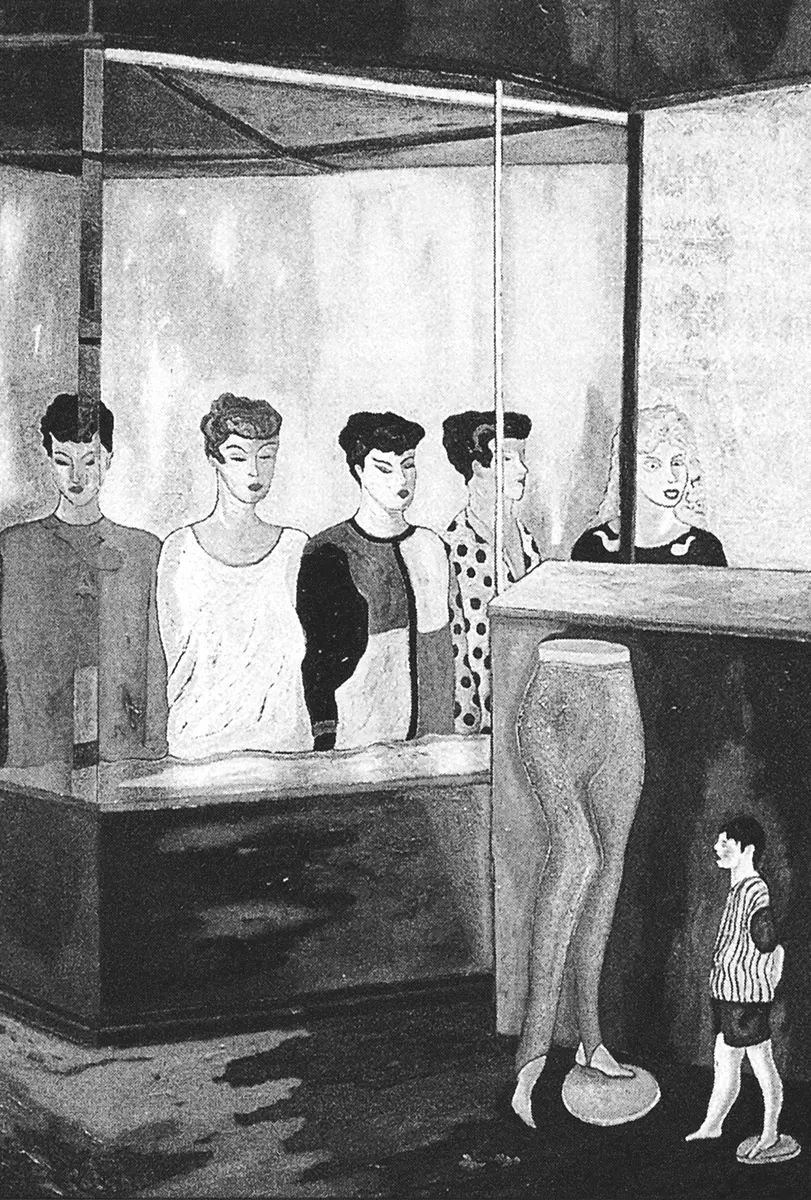
In a manner seldom seen in previous exhibitions, Polanco plunges us into an environment laden with oniric power, a kind of Lima metaphysics, as when he paints his red manikins, with their sardonic laughs, in La Parada, or a solitary shop window, where the absence of the human being is particularly evident. But it is the market scene with the yellow chicken hanging upside down in the foreground, while others in their cages await their own sacrifice, that was for me, the most impressive work in this show.
There were other outstanding pieces, such as The Belvedere of Acho or The purple wall of The Museum, but I should like to conclude by referring to two others. The first is The Virgin and the Child, as seen by a contemporary painter looking back to the Cuzco school. Religious imagery is not foreign to Polanco's iconography, but this work has an unprecedented power that flows from the treatment of the woman and child and the cherubs who open the curtain onto a dark scenario. Finally, a street scene featuring a small cart full of folded quilts and blankets that form multi-colored rectangles, each with their own design an exceptional motif for a picture that highlights the artist's magnificent talents.
There are many works by Polanco which I find unforgettable. One that always lingers in my memory depicts a man dressed as a figure of death, looming in the foreground of the chaotic city. There were other works in this recent show that will linger on in the same way. To find an artist capable of enriching our memory in this way is one of the greatest kinds of stimulation we can experience.
LUIS LAMA