
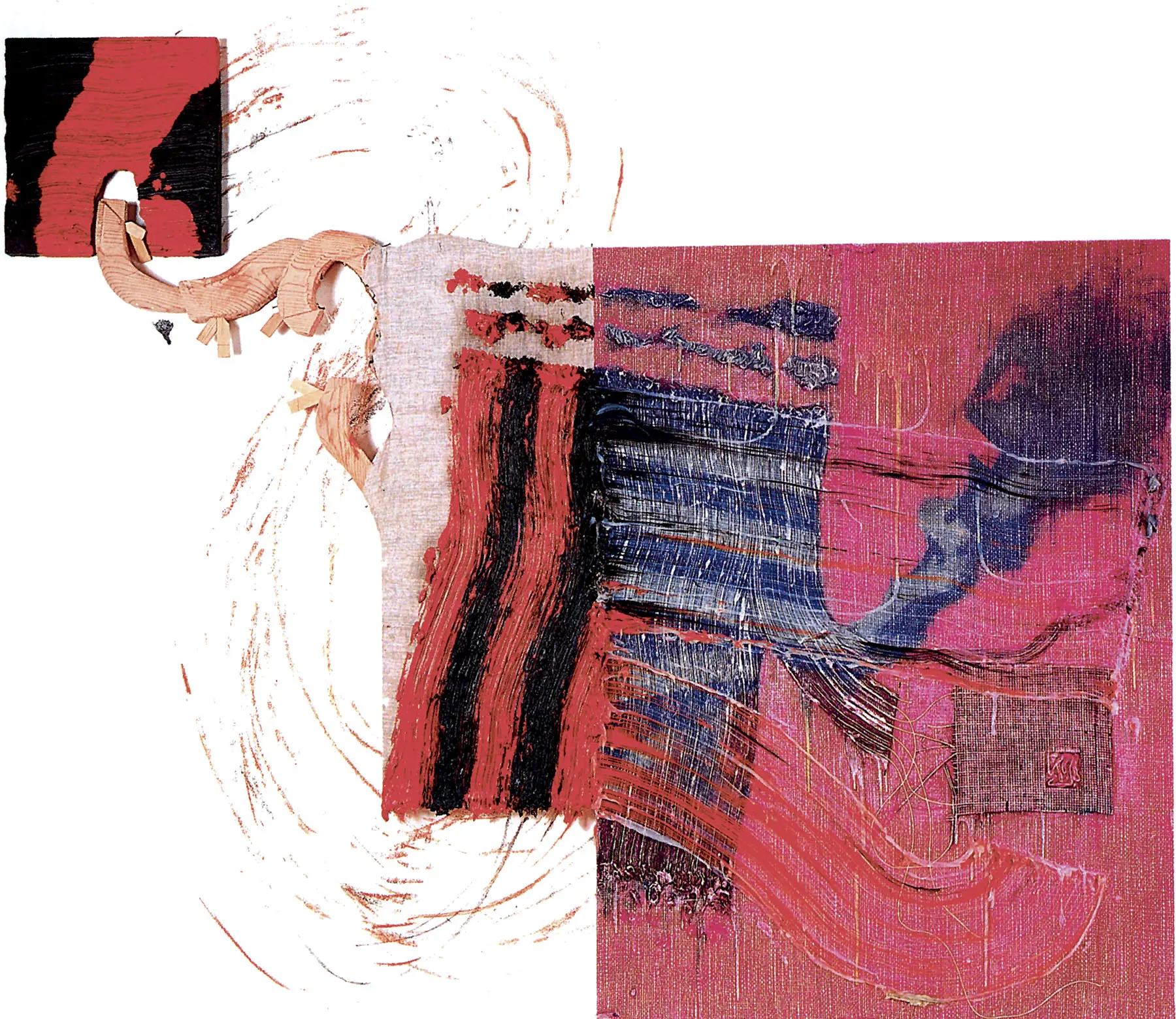
How can we define the experience of an activity which excludes the very concept of rest? Or rather, the model, paradoxically immobile, of such frenzy? In these paintings everything seems to be unstable: the background jumps to the surface, tentatively takes hold of the wall, contradicts the marks that a precarious and clumsily hidden structure leaves on the canvas. Canvas, background, support, structure, motif, and brushstroke all furiously assume a false kind of predominance, with everything struggling frenetically, and above all against itself. If Fabian Marcaccio's painting were described in terms of the grammatical structures of language - parallelism whose effectiveness I shall examine below, then in the phrases which make up his works, there are only verbs, or rather, all the elementary particles of this synthetic language have been simultaneously activated: conjunctions and articles transformed into verbs, pronouns, and nouns all verbalized.
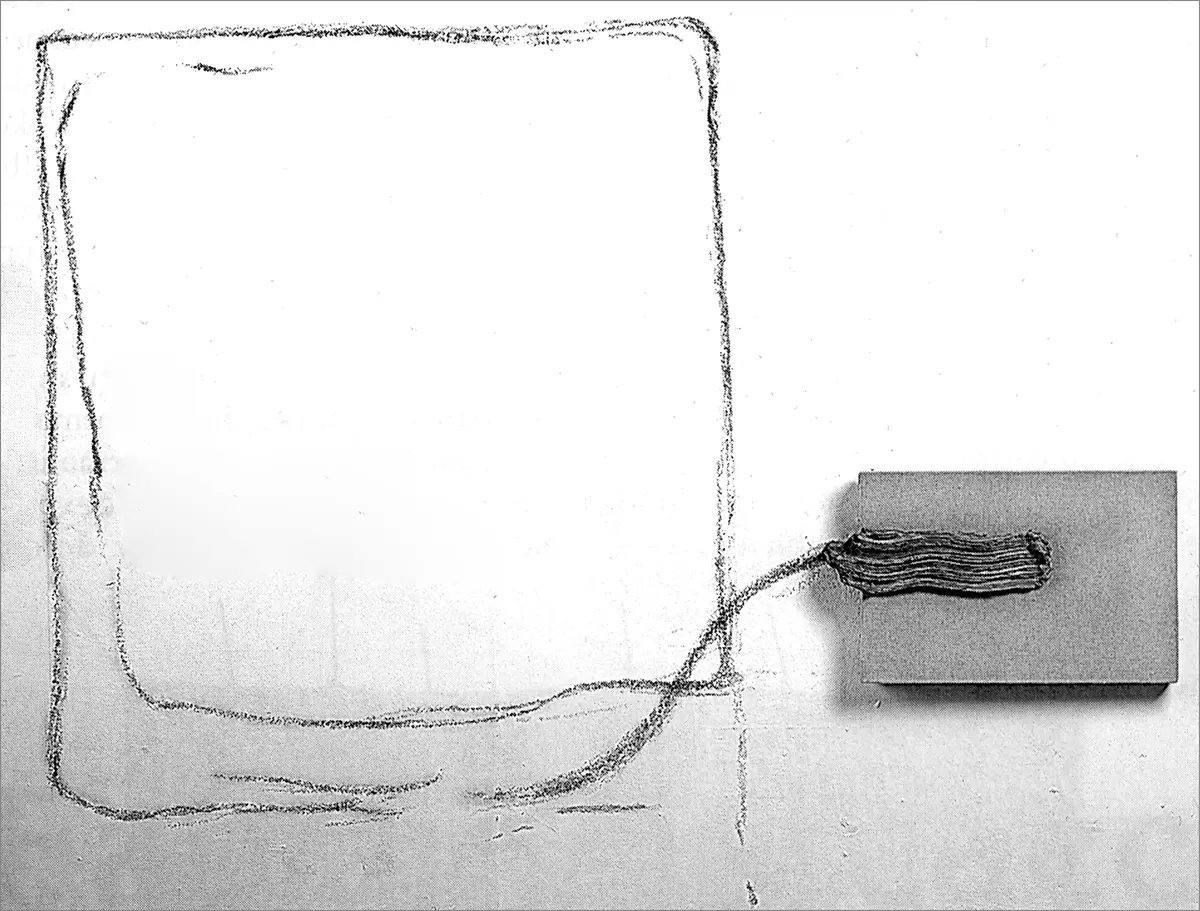
It is easy to conclude that such a project could not be carried out in linear terms, and would have on the contrary to be developed through the integration of divergent experiences - which would reflect the polymorphism of a work that ranges from wall installations to schematic drawings and photographs.
All this happens, and has been happening, in a work whose curiously logical development extends over the last eight years. Indeed, the first paintings of this period date from 1988, and since then, Marcaccio seems bent on modeling pictorial practice, which in the first instance led him to mediate it and consider it in analytical terms. I use the word "mediation" to mean the use of printmaking in his works to depict the basic elements that constitute modern painting - hence the analytical component of his work. The object is to separate fragments of the whole which would result from considering a virtual picture with a virtual development within a virtual whole.1 The metaphor here is more than valid: if that imaginary picture were a body, Marcaccio would be examining it like a forensic scientist. Thus the first pictures of his series could be likened to the representation of experiments of a surgical kind; a brushstroke is isolated which is communicated with an ornament, the texture of the background is injected in the wall of the room, and so on. There was a kind of delirious taxonomy in the entire series entitled Cases of double and multiple take, which Marcaccio undertook at the same time as his paintings over a period of almost five years - a supposedly infinite catalog of drawings which constituted a dictionary of exceptions, and which was related to the latter only indirectly as if they were "false relatives".
There was, therefore, from the beginning an analytical intention -which was almost perversely surgical, coupled with an emphatic attempt to avoid any aspect which might be assimilated to a pictorial gesture, anything which might in one way or another evoke the idea of presence, itself inseparably linked in the history of modern painting to the concept of expression. It is precisely this which seems to account for the insistent use of mechanical printing techniques related to printmaking, and more recently, photography, in his work. In the pieces done between 1988 and 1994, the application of paint appeared to have a sarcastic reference through the deposit on the canvas of silicon marks - fantastic schemas of some eventual brushstroke - or through the rough line of thick brushstrokes of oil on a fragment of sackcloth leaning against the rest of the picture surface. These brushstrokes - the surface color of which, rarely homogeneous, contradicted the meaning itself of the movement associated with gestuality - functioned as a silent and parodic indication of the impossibility of conceiving of pictorial practice in terms of presence. Both procedures were used to emphasize Marcaccio's rejection of any relation between his project and the various expressionisms. These brushstrokes, with their histrionic falseness, referred to the brushstrokes printed on the canvas as their authentic counterpart: what was true was what was absent. In his recent pictures, the appearance of silicones or the thick grooves of oil has been replaced by a vicious register of correction and retouching. The "paint" marks that can be detected on the canvas are now intended to give slight emphasis to certain dramatic aspects of the work. They are undoubtedly a kind of impatient make-up, which gives a nervous kind of movement to the surface of the pictures, heightening the sensation of stability that seems to underlie them. The relationship between the techniques derived from printmaking and painting in these works can no longer be seen in terms of a simple opposition, but rather as an attempt to construct an inexpressible level between both procedures, to integrate them within paradoxical contamination of the one by the other.
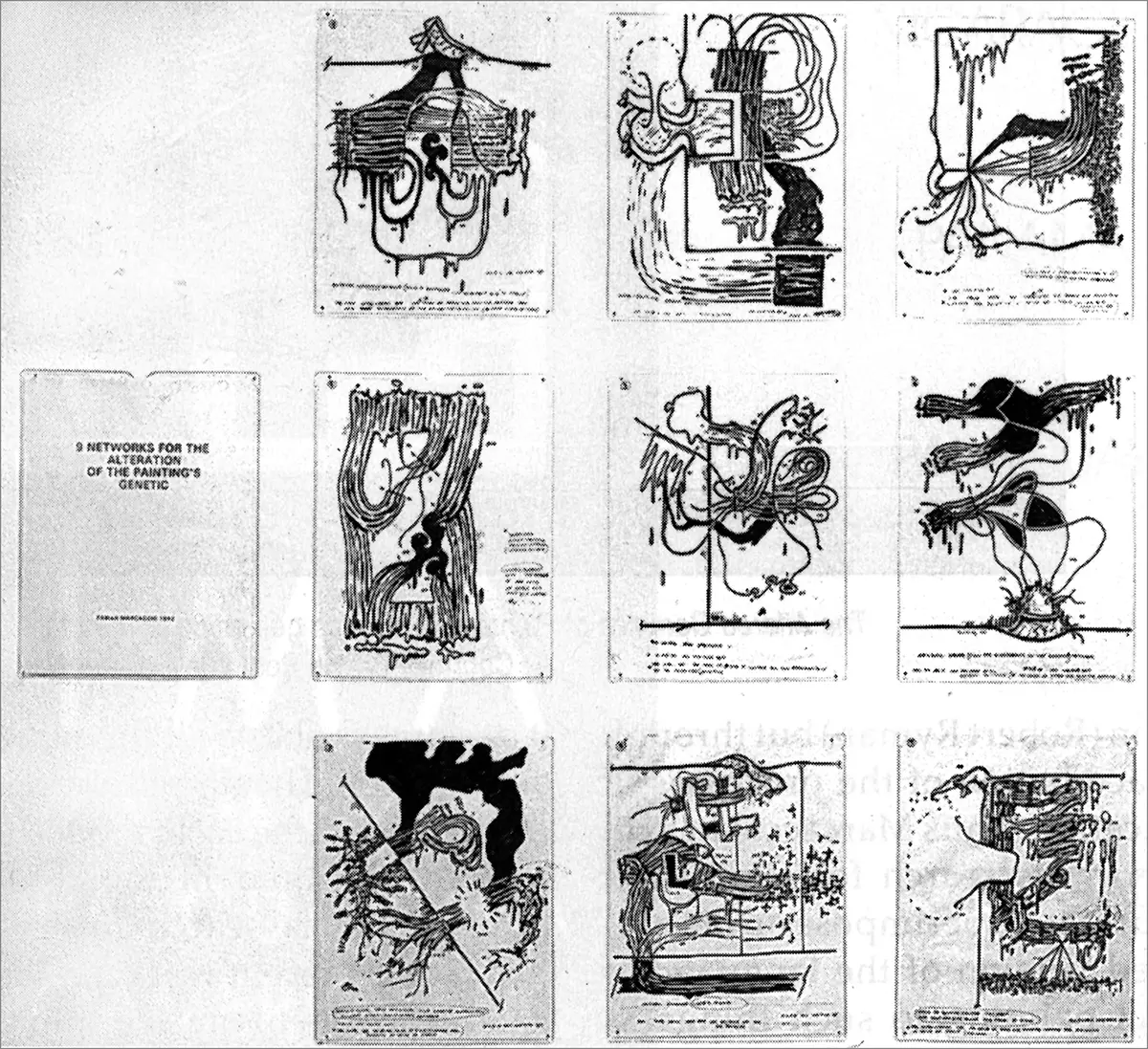
In the early works from the series, the artist attempted to compose phrases with fragments of elements normally associated in formal analyses with modern painting and, in particular, abstract expressionism: background, brushstroke, dripping, frame, and so on. Marcaccio worked on this version of abstraction like an autistic translator, making the frame into brushstroke, the background into a dripping, and the dripping into an ornament. It is not necessary to point out the subversive potential of such a practice in the context in which it was conceived and executed: the restrictive tradition of North American painting, through the normalizing vision of Greenbergian formalism. In this sense, a model of artistic experience which would savagely decode this corpus, transforming it into a corpse animated by everything that, in its constitution, should be suppressed, would, without doubt, prove liberating. Like a guffaw of laughter, Marcaccio's painting had the violent passion provoked by the emergence of what had been suppressed, in this case, a kind of mocking of the concept of presence - of expression - which paradoxically came from informalism and a peculiar abstract variant of certain Magrittian surrealism. If Greenbergian formalism could be seen as the repressive conscience of modern art, then Marcaccio's work would be constituted on the basis of its failed acts: the accidental and incomplete remembrance of the tradition of post-war European painting and what, in the words of the artist, could be called "bad Latin American painting".
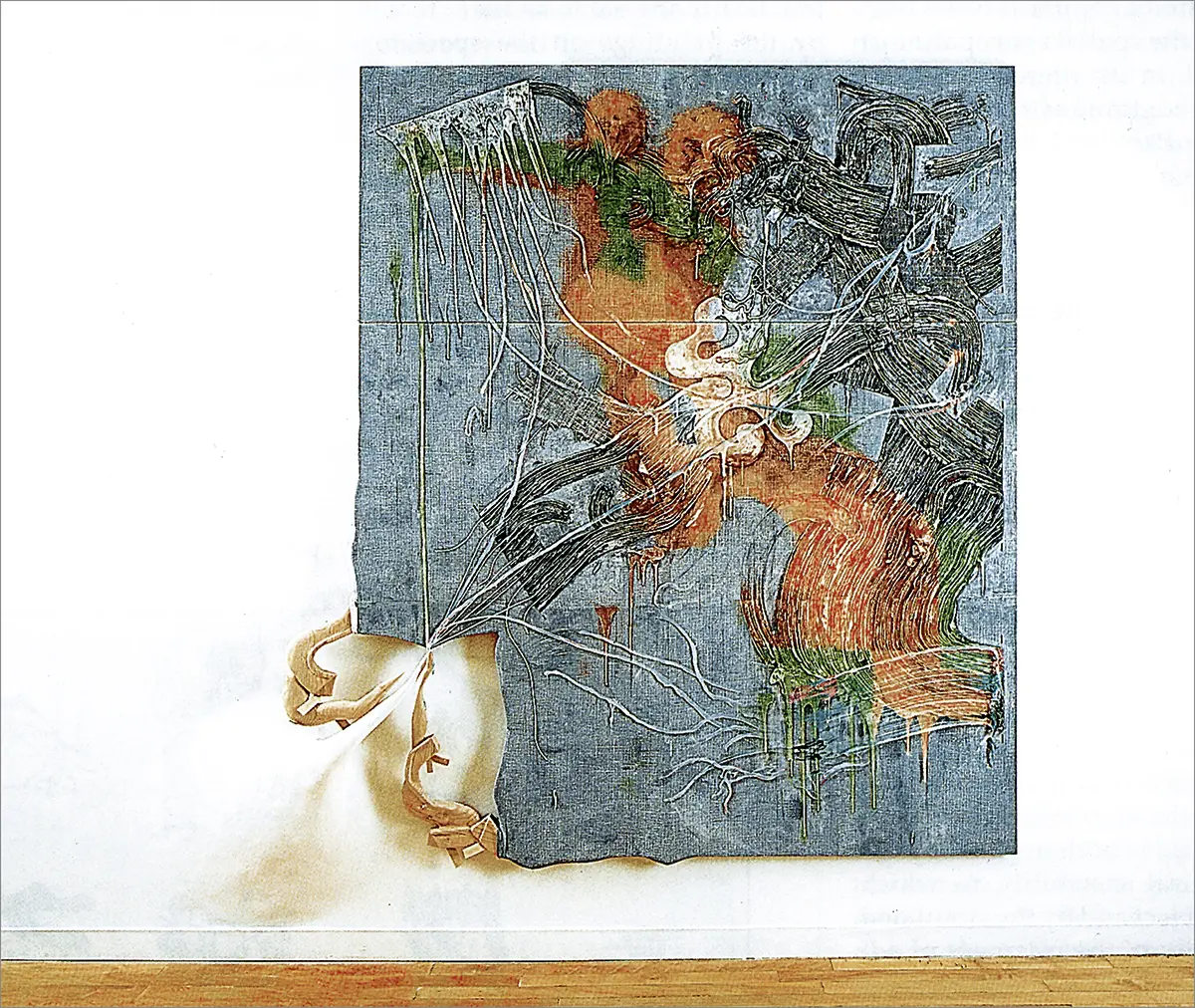
While this distortion of the alphabet evident in the early works in the series was sufficiently aggressive in its internal structure and critical range, the recent works cannot be classified as other than purely violent. First, the autistic phrase, and now, the ecstatic representation of a continuous activity, the verbalization of dead times, the conjunctive tissue of the phrase. To get a clear idea of the effect produced by these works, one would have to think of a prayer in which there was no silence between the words. The terms of this phrase would be indicated from one to another, meaning would circulate in all directions and the visual result would be similar to the meticulous description of an internal explosion, the implosion of any guarantee of meaning. An example is New Juvenile No. 2 (1996), a work from the "tent" series (clearly related in various ways to the Parangoles of Helio Oiticica), in which the canvas no longer rests on straight wooden stretchers but appears stretched taut over a wall with a series of mountain-climbing ropes around its perimeter, and which are prolonged through metallic tensors that are in turn fixed on the surface of the wall. The canvas does not lie straight on the wall but exerts pressure on a metallic structure, made of soldered copper tubes placed against the wall, which the artist designs separately for each work. The overall impression is that of finding oneself being a disturbing parasite of the traditional form of painting, an amorphous body whose surface has been transformed into a kind of topological model. The irregular relief of the "tent" in turn contradicts and strengthens the capricious and volcanic narrative of its surface, contrasting with the centripetal thrust of two curved brushstrokes which, in the middle of the canvas, give rise to a cancerous proliferation of ambiguous signs: an explosion of bubbles, or the column of smoke left by an explosion, a hybrid between the seventies' symbol of peace and the gothic heraldry of heavy rock, and a star whose points evoke the incomplete segments of a swastika and a sickle with its hammer. Furthermore, the green background merges at times with the confused image of an exalted multitude, with the entire scene embroidered with elementary particles from the language which Marcaccio had previously isolated from the body of an expressive abstraction - from background to brushstrokes, and from the latter towards the frame, and so on.
In Time Ad for Paint (1996), the "the- ater of operations" consists of making violently explicit the symbiotic relationship between painting and advertising, the reverse of which condemns the art object to the order of merchandise. In this work, a number of unequivocal references to mass culture co-exist: there is a kind of fragmentation of the advertising sign which can be ambiguously read in relation to the tradition of geometrical abstraction, an almost stratospheric agglomeration of symbols whose changing contours point to the possibility of a process of endless mutual exchange, and the already characteristic mottled background which, in careful reading, proves to be the image of a multitudinous group of people. At first sight, it seems a simple narrative: the placard which becomes brushstroke which becomes a bloody spoliation and an agglomeration of emblems emptied of any meaning. The setting is a musty background of green bubbles which seems almost to rise up, like some gaseous emanation, out the broadened fabric of the canvas, and which in turn has become an expectant multitude. The apprehension of the work is furthermore conditioned by the displacement of the spectator around it since the canvas once again appears taught and distorted by a complex system of mountain-climbing ropes, tensors arranged irregularly on the wall, and
the structure of copper tubes which articulates the spatial syncopation of the images. In its altered emphasis and its discontinuous nervousness, Time Ad for Paint see the symbiosis between painting and advertising as pure variation belonging to the order of parasitical relations. The correspondence is immediate since both advertising and modern painting coexist in their symbolic existence as pure surface - at least as regards the dictum of the North American formalist logic. In this work, Marcaccio temporalizes the surface by submitting it to a topographical process, which thus denies the flat quality of the elements which it at the same time extends over the surface. The figurative references enhance this effect, the result of which is the composition of a series of unresolvable oppositions: the immediacy of the surface contrasts with the historical density of the emblems whose temporal solidity is both negated by the structural instability to which they are subject and by the simulated ephemerality of the fragment of advertisement. And although there is nothing in the work which might refer to critical distancing, violence can be detected which may be properly described as mimetic, almost a passage towards an act - but an act understood in its twofold meaning of action and acting at the same time.
However, because of their linear nature, descriptions such as those given above can only deeply betray the experience of the work, which is less that of a delirious narrative than of a pure creaking, as if the gears of a language were forced to drag themselves against one another, preventing any kind of articulation and ordered sliding of their parts, denying, in the final analysis, any possibility of one-way meaning. The pictorial phrase appears decomposed into a myriad number of contradictory elements, like the paths of a crossroads which capriciously point in one direction or another: literalness and ideology in this setting are but facets of the same amorphous aggregate in a permanent process of crystallization. If all the relations between the members of the social fabric were overloaded with meaning up to the limit, the resulting effect would be practically the same as that created by the paintings on the spectator. This is the reason why perhaps Marcaccio's paintings can be interpreted as a model, in line with the modern tradition, but by insisting on enacting within its structure something which it would otherwise merely represent, the model, in turn, becomes an event of that something whose thought it encourages.2 In New juvenile No. 2, as in a game of chess carried out simultaneously at various levels, each "move" can go in at least two directions, which may, in turn, be opposed or complementary: the background is an undistinguishable mass of persons, the signs are both literal and ideological elements, the explosion is a narrative process and at the same time an integral part of the composition.
It was noted earlier that these new paintings appear to the spectator like theaters of some strange violence since the objective is no longer that of achieving a liberating explosion - as in the case of the works from 1988- 1994, but a continuous distortion, the image of a background noise which suddenly moves to the foreground and fully occupies the spectator's field of vision. But the appearance of this violence in modern pictorial practice is anything but situational and a marginal history of painting might well be based on an identification of the works in which this facet appears. One example would be Jackson Pollock's drippings, another —perhaps in response to the former, the incisions of Lucio Fontana. There is violence in the distorted and monstrous women of de Kooning, as, in an opposite sense, in the strict simplifications of Malevich. In some cases, the violence is literal— the incision, and in others, it appears in the marks left by a violent act, as in Pollock; and finally, it might be said that modern painting as a whole is an act of violence against a specific system of rules to standardize practice (and here we would have once again to quote the names of all the previous artists, and add to the list a rosary of missing names). Thus the cold, mediatized, and troublesome violence of Marcaccio's pictures remain within the circle of a tradition of rupture that usually goes under the name of modernity. It is clear that the objective, once again, is not to make paintings worthy of the name, to make the painting into a phrase which cannot be translated into the language which apparently lies at its origin, to have nothing to do with that language, not through oblivion (Robert Ryman) but through the exacerbation of the processes of signification. Thus Marcaccio has recourse in his search for significant structures to superimpose on his bastardized version of the language of abstract painting to such things as advertising, television, computers, and all other systems saturated by images.
But it is not enough to establish the relationship linking Marcaccio's work with modern painting; it is also necessary to establish as a counterpoint an important differentiation that identifies the singularity of the work. Whether in the case of Fontana, Malevich, or Barnett Newmann, the type of operation through which the violence is exercised - literal or metaphorical - on the conventional nature of painting is the same: an extreme gesture of simplification. In the case of Marcaccio, however, the violence is the product of excess, it is a pure excess which is cornered and cannot escape the weight of its signifying nature; it cannot cease declaring, although what it declares is above all the same act of declamation. The simplification which characterized the early modern artists seemed anchored in the confidence provided by a search for essences; Marcaccio's recent work, on the other hand, consists of an interminable accumulation of senseless suspicions. The distance between the one kind of procedure and the other is the same that might be said to exist between a specific and precise act and a continuous activity in the process of expansion, between, perhaps, a discrete series of armed conflicts and an underground, subliminal and generalized war.
NOTES
Argentinian Poet, art critic and independent curator, collaborator of Art Forum, and Contributing Editor of Trans. He is now working as curator of a retrospective of Tunga, which will be organized by Bard College and Miami's MoCA.