
The position of Fernando Botero in the US art world is both very secure and very ambiguous. Arguably the best-known Latin American artist of today, Botero is invariably included in large-scale group shows. He has had regular gallery exhibitions of his paintings and sculptures, principally in New York's Marlborough Gallery. His large-scale 3-dimensional works have appeared to have great acclaim on New York's Park Avenue and, more recently in Washington, D.C. where a selection of his monumental pieces created traffic jams along Constitution Avenue.
Nonetheless, there has not been a full-scale retrospective of this master's work in the United States since the 1979-1980 exhibition organized by the Hirshhorn Museum in Washington. Even this show only traveled to one other venue, the decidedly non-mainstream Museum of South Texas in Corpus Christi. While Frankfurt, Bremen, and Madrid enjoyed the recent major Botero exhibition organized by Werner Spies, no major U.S. institution has shown sufficient interest to mount their own retrospective of the work of this key figure in contemporary art. This is a great pity for many reasons. Botero is certainly a major artist of the pop-figurative movement who has inspired (often indirectly) many painters and sculptors in North, South America, and Europe. He is an also artist whose distinct style and artistic vision have remained constant throughout his career. It is, perhaps, an American art world myopia —if not to say elitism— that has kept him out of the loop of retrospective exhibitions of famous artists mounted by the likes of the Museum of Modern Art, the Guggenheim, the Los Angeles County Museum, the Museum of Contemporary Art in Chicago, and others. For the present, North American audiences will have to content themselves with the artist's gallery exhibitions.
Botero's most recent show of paintings at Marlborough Gallery in New York during the fall 1996 season, was the strongest and most moving show of new work by the Colombian master in many years. It left this reviewer not only in a state of awe but filled with a renewed respect and fascination for Botero's contribution to contemporary art. Although I stated above that Botero's visual vocabulary has remained consistent throughout much of his career, this exhibition represents, in a sense, a radical departure and a new mode of vision. While retaining his interest in sensual shapes, he now creates not only male and female forms but also still life and landscape elements that express his joy in spherical configurations. Botero thus appears, with the work in this exhibition, to be taking a new aesthetic path. His paintings, many of which are considerably smaller in scale than his earlier works, display a different sensibility to color. I find a greater depth and richness of tone in these paintings than in any of his previous efforts. In these new paintings, Botero demonstrates an uncommon (for him) interest in manipulating warm tones: reds, ochres, and deep blues. It was inevitable, at least in my view, to find the artist responding to a type of warmth of atmosphere and intimacy created by the depth of the color tonalities found in paintings of Dutch Old Masters, particularly Vermeer.
For many years, Botero made a conscious effort to banish virtually all traces of the brush in his seamless compositions. This preoccupation with an Ingres-like uniformity of paint application and almost-polished surfaces has now given way to a new conception of the brushstroke. While by no means re-creating his interest in the Abstract-Expressionist application of the loaded, gestural brush from the late 1950s and early 1960s (see, for instance, the well-known Mona Lisa, Aged 12) he gives the subtle, yet very visible stroke a highly palpable presence in these new compositions which date from 1994.
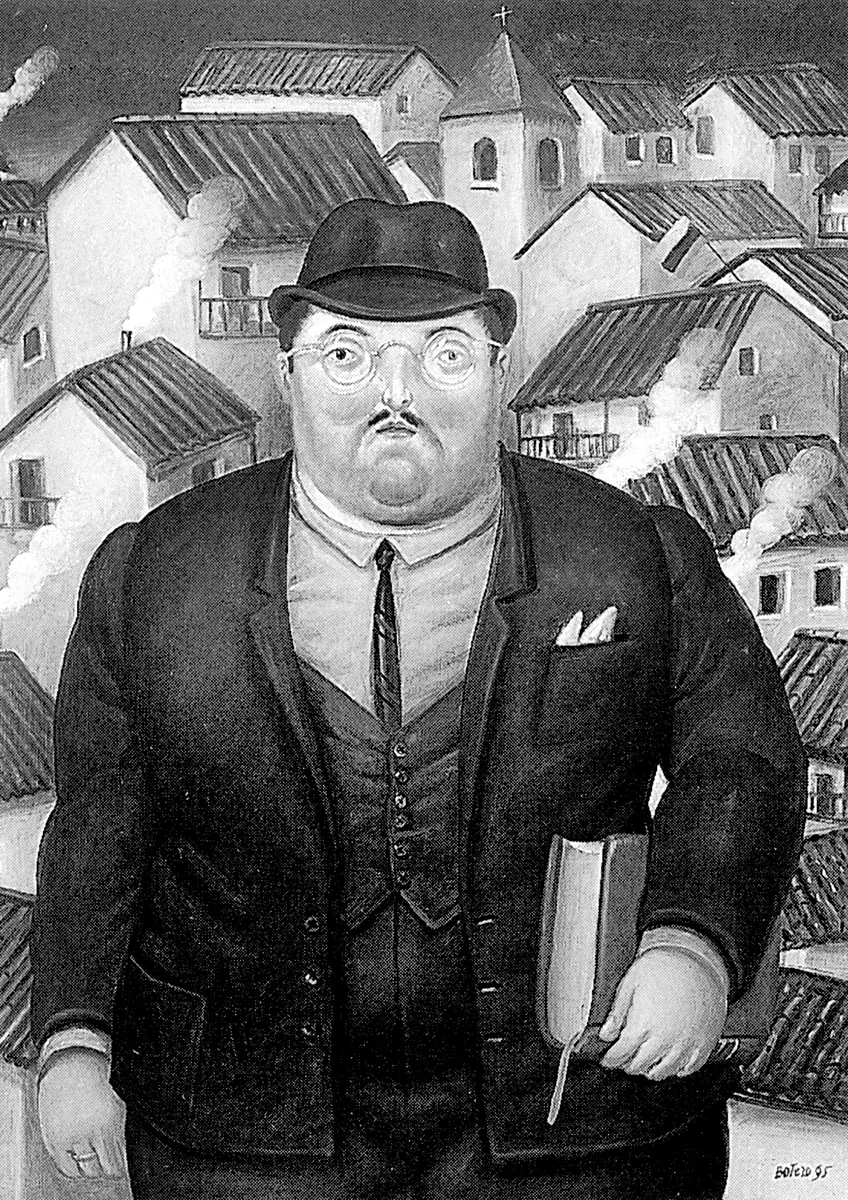
In this exhibition, Botero dealt with many of the themes that have been his preferred subjects for years: Colombian men and women, village landscapes, festive still lifes, etc. However, these paintings seem to have acquired a new emotional and psychological depth. One could even make the case for the presence of melancholia in some of these images. While the expressions of many of Botero’s subjects have been notoriously deadpan, displaying little or no emotion behind their placid, inflated faces, there are figures in his current repertory of images that are surprisingly emotive (albeit in their own, quiet way). Take, for example, the small painting titled A Lawyer (1995).
Standing before a modest Colombian townscape, an unshaven young man appears to evince a vague hint of dejection. While there is nothing here to depress the viewer, the gravity and unexpected seriousness of this and other works in the show are enough to cause a small shock among those of us who are intimately acquainted with Botero’s art. Is this a reflection of an artist who, like masters of earlier periods, acquires a greater emotional depth in his art as he grows older? Or is Botero perhaps ruminating on some of the melancholic events in his personal life in the recent past? Whatever the answer, we observe in this selection of new paintings an array of images that are masterful from both a technical and an intellectual point of view. These are some of the strongest statements yet made of Botero’s extraordinary creativity es has now given way to a new conception of the brushstroke. While by no means re-creating his interest in the Abstract-Expressionist application of the loaded, gestural brush from the late 1950s and early 1960s (see, for instance, the well-known Mona Lisa, Aged 12) he gives the subtle, yet very visible stroke a highly palpable presence in these new compositions which date from 1994.
In this exhibition, Botero dealt with many of the themes that have been his preferred subjects for years: Colombian men and women, village landscapes, festive still lifes, etc. However, these paintings seem to have acquired a new emotional and psychological depth. One could even make the case for the presence of melancholia in some of these images. While the expressions of many of Botero’s subjects have been notoriously deadpan, displaying little or no emotion behind their placid, inflated faces, there are figures in his current repertory of images that are surprisingly emotive (albeit in their own, quiet way). Take, for example, the small painting titled A Lawyer (1995).
Standing before a modest Colombian townscape, an unshaven young man appears to evince a vague hint of dejection. While there is nothing here to depress the viewer, the gravity and unexpected seriousness of this and other works in the show are enough to cause a small shock among those of us who are intimately acquainted with Botero’s art. Is this a reflection of an artist who, like masters of earlier periods, acquires a greater emotional depth in his art as he grows older? Or is Botero perhaps ruminating on some of the melancholic events in his personal life in the recent past? Whatever the answer, we observe in this selection of new paintings an array of images that are masterful from both a technical and an intellectual point of view. These are some of the strongest statements yet made of Botero’s extraordinary creativity.
EDWARD J. SULLIVAN