If there are certain artists who provide an unseen kind of support for the art of a community and the theoretical and practical foundations of the creativity involved in the destiny of a nation, then Gabriel Morera would seem to play such a role in Venezuela.
Even though he was a member at the beginning of the 1960s of the rather militant Techo de la Ballena group, which marked the sudden arrival of informalism in Venezuelan art, Morera is basically a solitary artist, on the margins yet at the same time very present in the history of Venezuelan art for over thirty years.
Morera has himself explored informalism, surrealism, and pop, and in each case, they have left their mark in the form of a creative kind of mysticism, a fine sense of craft coupled with transmutations, a belief in transparency, a hallucination of vision, where art is seen as a depiction of the sacred and a reinvention of the cosmos. Central features of his work include his retablos, magical objects, the interplay of mirrors and the use of the color blue, his evocations of Alexandria, the presence of the house and its facade, the Trinity, the flight of a bird, and an unusual and old-fashioned instrument from some glass display case which might help measure the constellations or allow them to be re-invented.
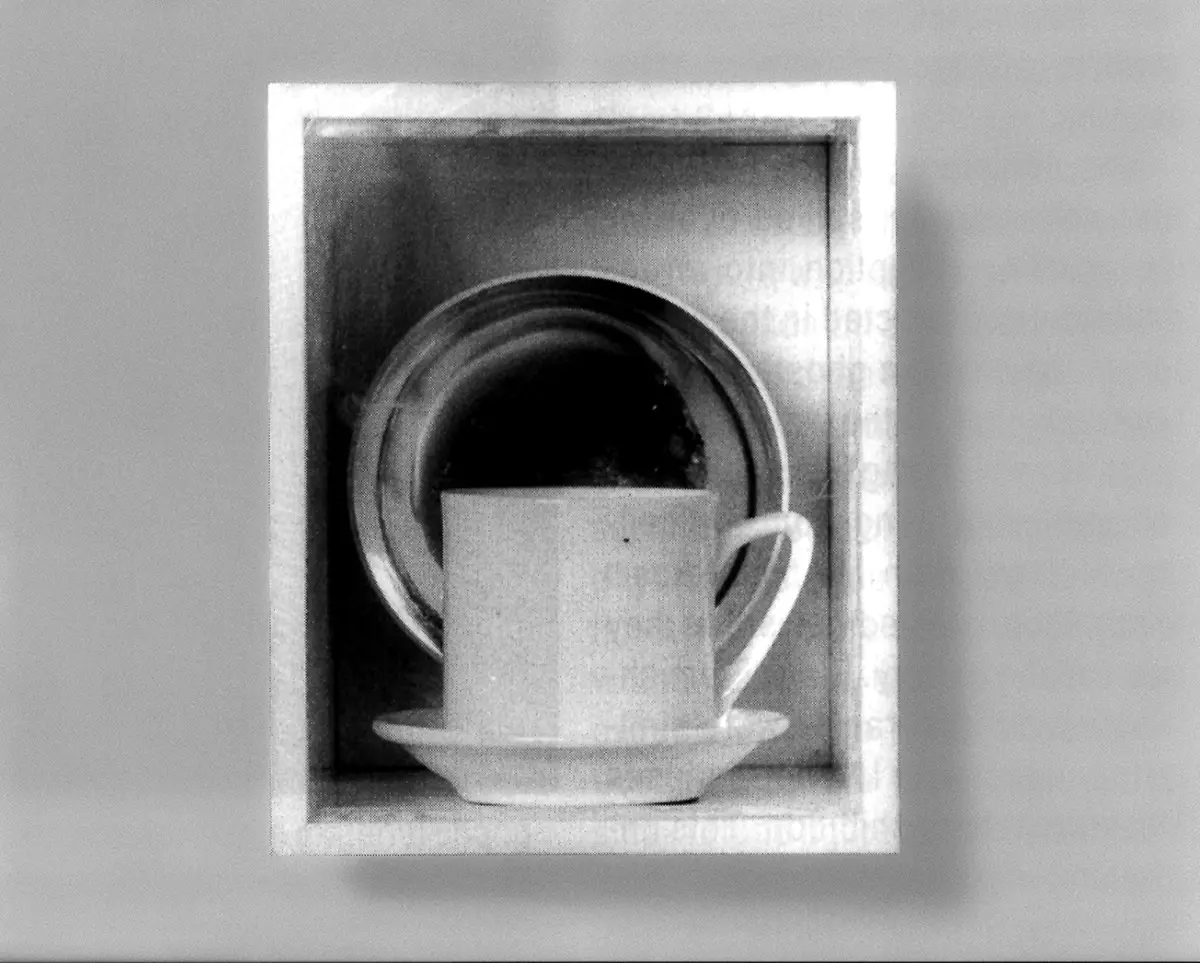
In Morera, as in Mario Abreu or Enrique Hernández d'Jesús, there is archeology of contemporaneity that begins with every day and takes us towards the sacred. Another feature of his work consists of his boxes, made either of plexiglass, in the 1960s, or wood, in the 1970s. Both types refer to an urban everyday environment, a re-ordering, a sense of collecting, and the creation of beauty.
Morera's painting shows the persistent presence of writing, calligraphy, and graphic elements which, in the final analysis, form a text to be deciphered, a painting that offers a two-fold kind of reading. In some of his pictures from the 1960s there is a dazzling use of white which recalls the high position — as a legacy of Reveron — it has played in Venezuelan painting. White as a theme of investigation and as a motif for an exhibition on the role of light and gesture reveals the legacy of Reveron in our art. In Morera’s paintings, as in the glass in his boxes, the color blue is also imposing. Initially, his pictures included various elements then there came the painting on canvas, with special attention given to oneiric elements. His more recent work illustrates the continued validity of plastic and conceptual phraseology.
This survey exhibition of Morera's work at the Museum of Fine Arts in Caracas was titled Alchemist of the Image. The well-chosen title reflected a sense of both support and concept, admirably capturing the importance of the imaginary, playful and everyday elements of Morera's re-ordering of reality, its underlying rationality, and nocturnal light.
JUAN CARLOS PALENZUELA