This seems to be the primordial longing of the artist: to express truth through art. Like Heraclitus, who believed that the philosopher comes closest to true wisdom (to truth, soplion)1, the artist aspires to an encounter with this essence, which is always eternal and true. We can speak, for this reason, of the transcendence of art. Manuel Quintana Castillo (b.1928) is an artist who rigorously pursues such an objective. In all of his work, he investigates ways of access to this transcendence through various responses that depend on his personal and historical circumstances. From the 1950s, he distanced himself from the fierce debates in the Venezuelan art scene about realistic and committed art of geometrical art, to paint works that illustrated this sentiment. Cupirn, The Weaver of Clouds, and The Woman selling Balloons, among other pictures, are key pieces to the artist's pictorial process, where the fascination with myth, dreams, and the symbolic meaning of woman in a nocturnal and poetic setting, are stages within this longing for transcendence.
But Quintana is aware of the fact that truth exists, paradoxically, only to the extent that it is absent. The artist creates through the impulse to embody this truth because he knows that the inaccessible element has the necessary strength to drive his work with the intensity that it does. It is precisely Heraclitus who said that nothing was immutable or eternal (except the truth –sophon– or wisdom which only God embodies), and the philosopher or artist, in this case, can only strive towards it. Moreover, the philosopher, like all human beings, is subject to a process of becoming, a process of change. Quintana Castillo accepts this fundamental premise of Heraclitan philosophy.
Aware of eternal and true essence, even though it is inaccessible, he now recognizes that his work is the result of a process of becoming, subject to vicissitudes, transformations, and changes.
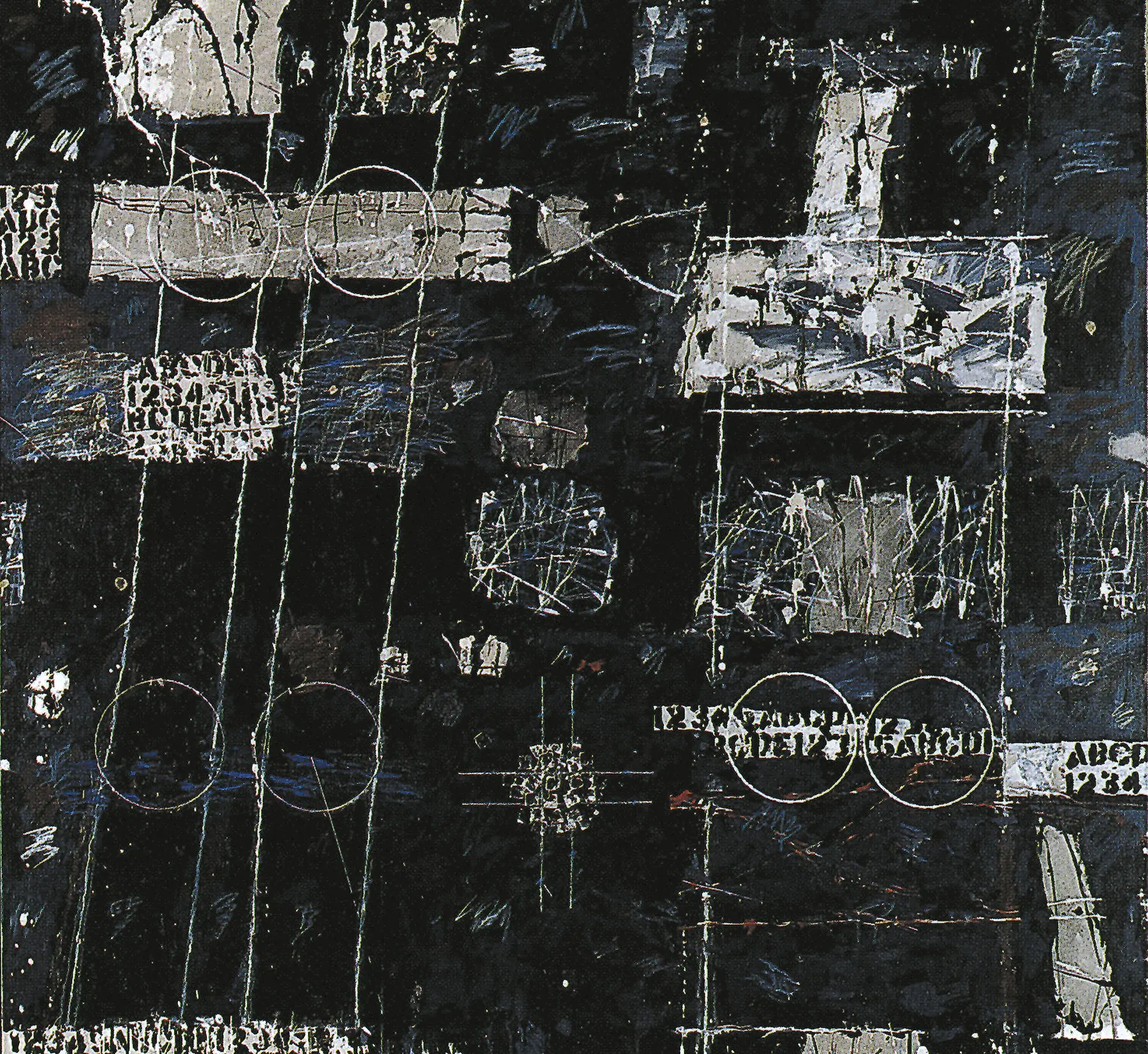
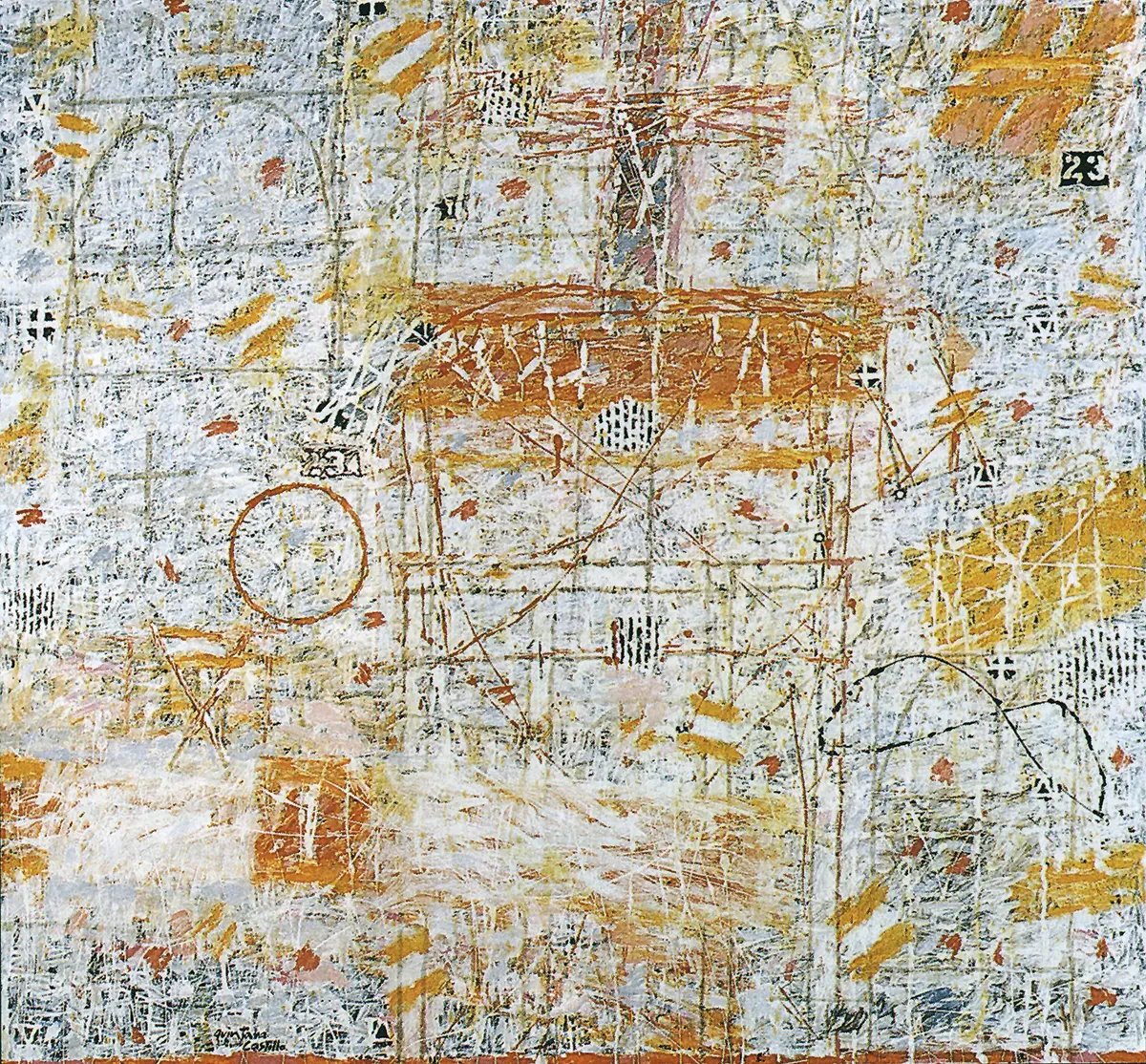
In his current paintings, which focus on the theme of Heraclitus, this premise is clearly evident. In this series, we can see what might be called a "Quintana compendium": all stages of his art, including the cubist period and the figuration inspired by African masks (the 1970s), are present, even in the most gestural, informal, and expressionist works. The Heraclitus series is the result of the artist's entire artistic trajectory, brought to fruition and maturity. The reader might respond that any artist is the result of his or her experiences. This is of course true, but the particularity of this work lies in how the artist has utilized this experience and how the various plastic aspects from each of the artist's periods have become what they are.
In 1961, Quintana spoke of "intuitions and memories" when he conceived the poetic world of Cúpira. At that time, it is clear that he opted for the creative instinct, rather than reason and knowledge. At the end of the 1960s, after an important period of informal experimentation, he shut himself up in his studio and disciplined himself into working with Cubism. Few understood the reason for this change. Quintana was one of the great exponents of magical realism in Venezuela and a champion of the emotive dimension of art. To return to Cubism seemed to be a total change of direction, something out of keeping with his development.
But Quintana, faithful to his principles and internal needs, sensed the importance that this experience would have on his subsequent work. There was, above all, his need to make a personal revision of modern painting, beginning with Cezanne and the Cubists. The suppression of perspective and thus the hierarchization of the elements distributed over the pictorial surface were some of the aspects taken into account by Cubism, culminating, as Juan Calzadilla has rightly said, "in the consecration of flat space."2 Consciousness of the two-dimensional nature of painting is essential to an understanding of the work of Quintana Castillo. He has remained firm in his conception of easel painting. In contrast to the outbursts of anti-art, or other forms of contemporary artistic conception which emerged in Venezuela from the 1960s, Quintana believes in the integrity of form and in painting itself. For him, virtual, flat space is a characteristic condition of painting: it is a limitation but it is also an inexhaustible source for the creation of infinite universes.
For Quintana, rigor and discipline are conditions essential to the freedom of creation, a premise which he has maintained from the start. He sees the pictorial plane in terms of the whole (a unity which he achieves through harmonious composition), resulting in the asymmetrical equilibrium characteristic of his work. In other words, from the time of his Cubist investigations, through the period of his interest in the imagery of African art (the Thresholds and Arcanae series which he presented at the São Paulo Biennial in 1979), Quintana has revealed an obsession that began to take shape in the 1980s, a system of plastic creation that acts as a base-structure for all his pictures. Once Quintana has achieved his plastic construction of the flat space of the picture, he has resolved the problem of composition. He then gives free rein to his instinct and to the non-rational and subjective aspects that co-exist in this rational structure.
He endeavors in this way to resolve aspects that can be seen as contradictory: the conflict between reason and emotion, the construction of a system and its deconstruction — what Victor Guedez calls the "legitimization of antinomies".3 These antinomies do not function as a struggle between opposites in Quintana's current work. On the contrary, the artist fuses these attitudes together so that reality itself becomes a compendium of reason and emotion, objectivity and subjectivity.
All these facets highlight Quintana's versatility as he moves from the "marvelous" (the emotive) toward the reflective, and vice versa. He simultaneously explores the dichotomy between permanence and change. As a result of the base structure which is common to all his pictures (a product of the creation of his system), impulses coexist which are emotive and wild (expressed through nervous brush strokes) that determine the way in which one works is different from another. "No one bathes twice in the same river," Heraclitus wrote, "because the river remains, but the water is no longer the same."4 There are no two works that are the same. What remains, what does not change, is the system. What does change is the treatment, reflected in the brush strokes, the linework, and the color.
For this reason, Quintana is not afraid of reiteration. He overcomes the obsession with change that is encouraged by the avant-garde. Quintana's obsession is with a system, with the virtue of conceiving it not as an unbreakable and closed code, but as something open and attentive to the unexpected. He prefers a living and introspective kind of geometry, which is more transcendental than the so-called sensitive geometry, since it takes into account, in addition to sensibility, "other forces, such as emotion, passion, sensuality, eroticism, the sense of the sacred, magical perception, constructive reflection, the deconstructive instinct and the risk of chance."5 It is a geometry which, on becoming internalized, functions as his own personal expression, a very personal kind of "language." This is why Quintana does not generalize but rather speaks of his own geometry.
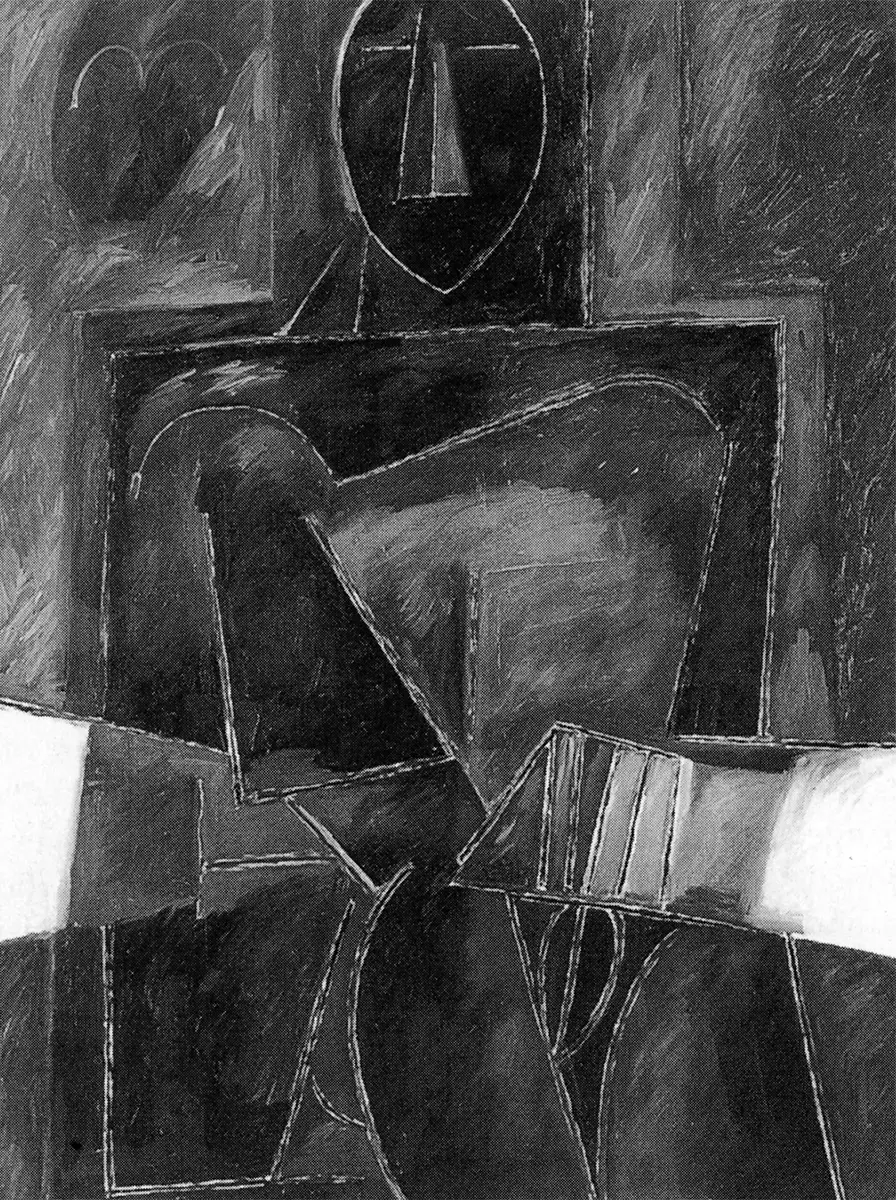
Conscious as he is of the flatness of the picture plane, Quintana has endeavored from his earliest work, to create an ambivalence, a reversible relationship between form and space. The structure and other plastic elements (brushstrokes of color, graphic elements, emblems, among others) act as counterpoints, disrupting or balancing one another within an environment of poetic mystery. The planes are superimposed and juxtaposed, as are the signs and graphic elements which make up Quintana's emblematic. Work is the result of several versions done on the same canvas hence the scratchings and transparencies which give spatial depth to the canvas. There are woven structures in some pictures, like the Heraclitus series, for example, that seem to define the work. But they are simultaneously scratched out or made transparent in other areas of the same work. Through this process of concealment, the compositional unity of the work is maintained.
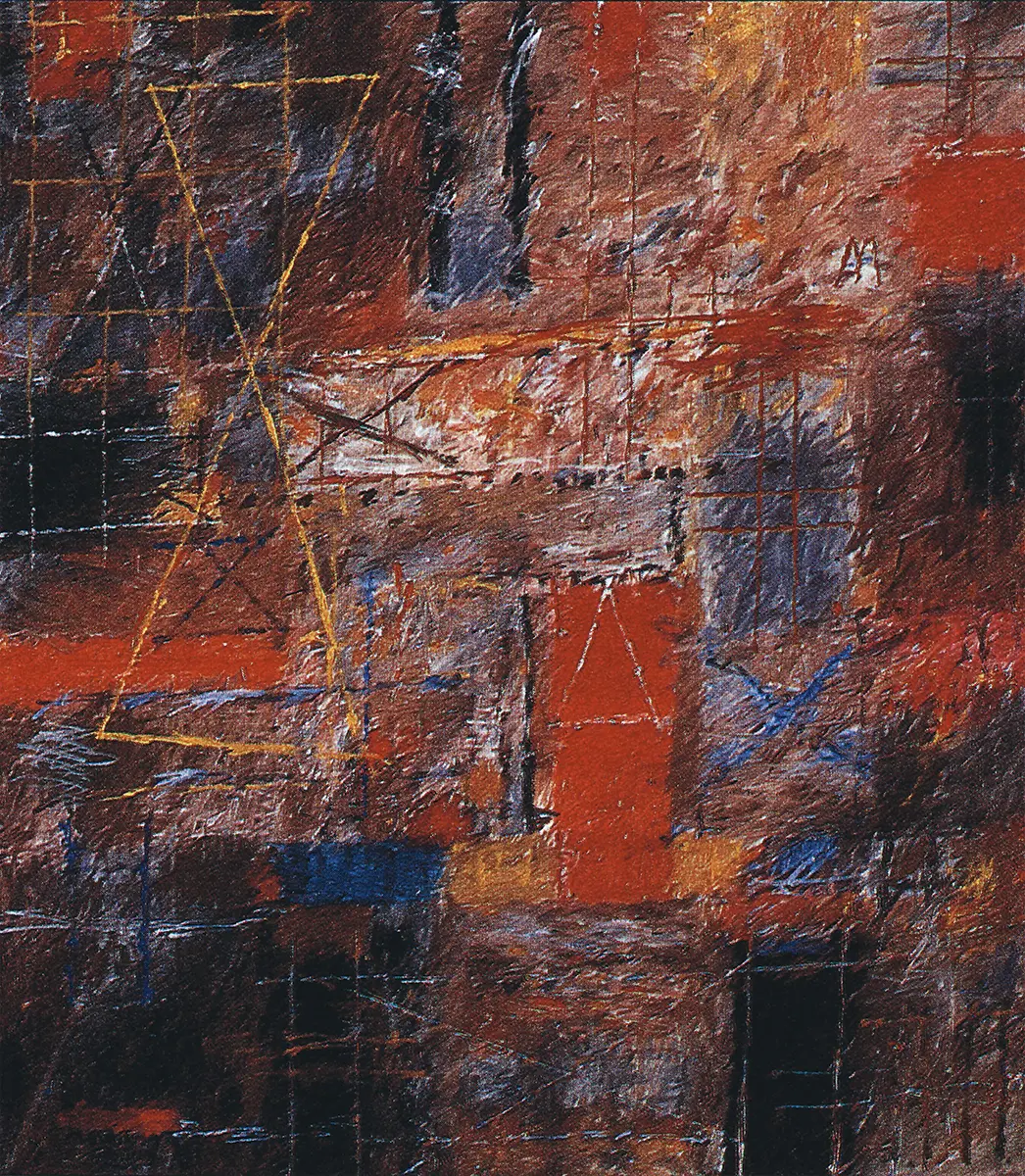
The color assumes primary importance in this process of a work's completion in stages. Its behavior also varies considerably during the various periods of Quintana's pictorial work. There is a chromatic axis between magical realism, the works of the 1970s, and the series from the 1990s: the emphasis is on sobriety and a monochromatic palette, with some important touches of color. However, the sobriety is evident. It is sufficient to note the chromatic richness that Quintana conceals in the dark backgrounds of the pieces in the Heraclitus series. These are colors that suggest and reveal themselves. An opposite attitude characterizes the work of the 1980s, where the colors, in particular the reds, are given greater emphasis. Against a background of grey and chestnut colors, the works create an atmosphere that moves us towards Cúpira and other works.
In Thresholds and Arcanae, darkness dominates almost all the pictures while geometry divides up the space and constructs the figures. In the painting from the late 1980s, on the other hand, it is color that predominates and determines to a certain extent, the various planes of the work. The Heraclitus series is unusual given its two different periods of production. The earlier period is white (The River of Heraclitus, for example) and the other, more recent, black (The Night of Heraclitus, Heraclitan Comet, etc.). The first work was originally done with a dark background. The white brush strokes and color grid were superimposed during the picture's final stage. As he became aware of the intrinsic artistic value of the dark background, Quintana reworked the series using this background for the most definitive version. The process to some extent reverted back — a change which began with the picture entitled Heraclitus Park. Since then, the grid and the superimposed brushstrokes have become increasingly expressive and complex as the artist continues to develop the series.6
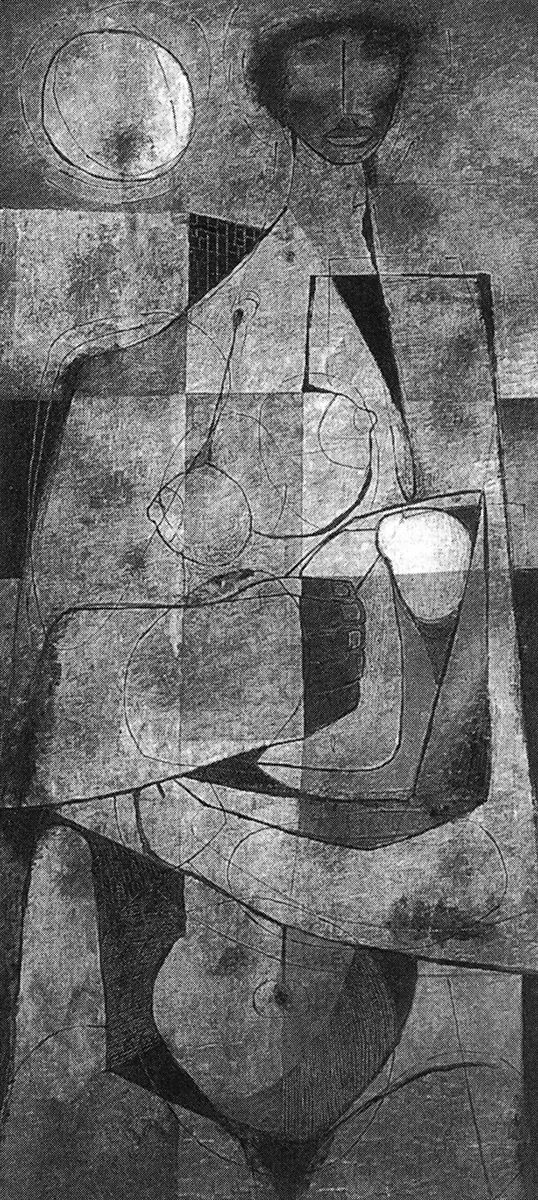
Like the color, the linework changes moving from a "drawing" and delineating function towards other more pictorial values. Expressed in the structure and in the signs, it becomes broken and informal, in accordance with the system's desire for construction and deconstruction and the creation of expressive atmospheres. In the same way, Quintana uses his line work to establish a code of signs (letters, emblems, geometrical figures, etc.). A feeling for mystical and symbolic elements, characteristic of magical figuration, is transferred to this kind of abstract vocabulary which gradually emerges in his work. These elements result from his introspective geometry, like calligraphic forms that simultaneously give constructive meaning to the work. The X, the cross, the H, and the T are some of his symbolic obsessions, forms that the artist loves and which in one way or another are reflections of him. They act like a ciphered code and lead the way towards the sacred dimension. Though this aspect underlies all his work, it is particularly evident in the painting from the 1980s, is highlighted further in the icons or retablos of the same period and again in his current Talismans.
Just as the constructive project is essential to Quintana's work, so too are his more informal plastic elements. The Topological Writings, consisting of annotations made in his notebooks, have an intimate character since they can almost be read as a diary. They consist of drawings and graphic elements which have an autonomous artistic value and have served as the starting point for such projects as his current Topological Painting, the real name of the Heraclitus series.
The artistic development of Quintana's work as a whole is reflected in these paintings though it takes the form of essences, that is, as the artist says, current and contemporary.7 The influence of Cubism persists in the fragments and remains of superimposed and juxtaposed images. The same is true of the stains, the informal gestural brush strokes, and the use of dripping — a Quintanian version of Pollock's practice.
Following the establishment of this system, Quintana explores the relationship between signal space and topological pictorial space, the latter being understood as an outside field that transforms the two-dimensional surface of the picture into a space full of positive energy.8 In this way, he gives a new dimension to what is sacred, although he does so through intensity and positive energy that are the result of his painful and passionate obsession with the search for the truth — his truth, the truth that matches his circumstances and times. Because painting, for Manuel Quintana Castillo, must always have a meaning directed towards the eternal, a transcendence that is both personal and collective.
NOTES
1. Marias, Julian, "Los presocraticos," Historia de ia lilosotia, Alianza Universidad Texlos, Madrid (I985) pp. 26-28.
2. "Anotaciones para los fragmentos de un muro escrito", in Manuel Quintana Castillo. Fuera de juego. Exposicidn Antoldgica, exhibition catalogue, Alejandro Otero Museum Foundation, Caracas (November 1995- March 1996) p. 15.
3. "Hipotésis en torno a su reciente obra," in Manuel Quintana Castillo. La pie! del tiempo. exhibition catalogue, Arte Hoy Gallery, Caracas (November 1990).
4. Marias, Julian, op.cit., p. 26.
5. Quintana Castillo, Manuel, "El río de Heraclito," text published in the first issue of Cuadernos MUC/devoted entirely to the artist, MUCI Gallery, Caracas (October 1995) p. 13.
6. Conversation with Juan Pablo Muci, Caracas, May 1996.
7. Quintana Castillo, Manuel, op.cit., d. 12.
8. Ibid., p.13.
SUSANA BENKO
Venezuelan art critic who lives in Caracas.