
Mariella Agois is an exceptional case in the art of Peru in recent decades. A distinguished photographer in the 1970s, she was one of the promoters of the pioneering Secuencia Gallery, that championed the cause of photography in Peru. In the following decade, she went to the Chicago Institute of Art to study painting. She developed a passionate style of painting which she would exhibit in 1986 at the Gallery of the Centro Cultural Miraflores large-format works full of gestural brushstrokes and some very small pictures that used photography as their basis, and in which the artist utilized neo-expressionism in her search for the essence of identity.
Following her return to Peru at the end of the 1980s, Agois eventually began to study colonial iconography and popular art. She recovered fragments of the past in order to create a kind of postmodern project but did so without the irony evident in other similar attempts. These were pictures in which the situation of her gender was made apparent. They contradicted the long-held egalitarian, asexual tradition of not revealing the artist’s sex.
Exactly the opposite occurred in the case of Mariella Agois. She rejected all that came before through a reaffirmation of her sexuality and through an iconographic exploration of a period in history that had, until well into the 1990s, had remained off-limits - the colonial past. We had usually traced the source of our culture to the pre-Hispanic world. Agois' images oscillated between a feminine symbolism and a restoration of our cultural sources. These elements were fused together in pictures characterized by the emotive power of their brush strokes and their intensity of color.
With a rigor that is evident at both the formal and conceptual level, Agois has not exhibited frequently which has given her the reputation of being something of a "cultured" artist. This is one of the reasons why each of her shows generates considerable interest among those who monitor the development of the arts in Peru. Agois is an artist who has managed to distinguish herself without any modernist of stridency, an artist who invites us to reflect on everyday objects like clocks, tables, and a braid which she transforms into a piece of pre-Columbian weaving, and that she endows with new meanings resulting from the variations in scale and the subjective nature of the chromatic range which sometimes verges on the oneiric.
In this new show, Agois presented some outstanding work. There are very few artists in Peru capable of plunging into the past, popular traditions, or their own intimacy in this way; few who are able to revise concepts in accordance with the times in which we live and produce work that has a real contribution to make to our world. Mariella Agois is one such artist. In ideological terms, her work can be considered post-feminist, in that her project revises the imagery a woman is usually identified with, restructuring it through the fusion of playful and sexual elements. In this way, the mystery of the meaning matches the pleasure deriving from a painting of this kind an art capable of forming part of our repository of memories.
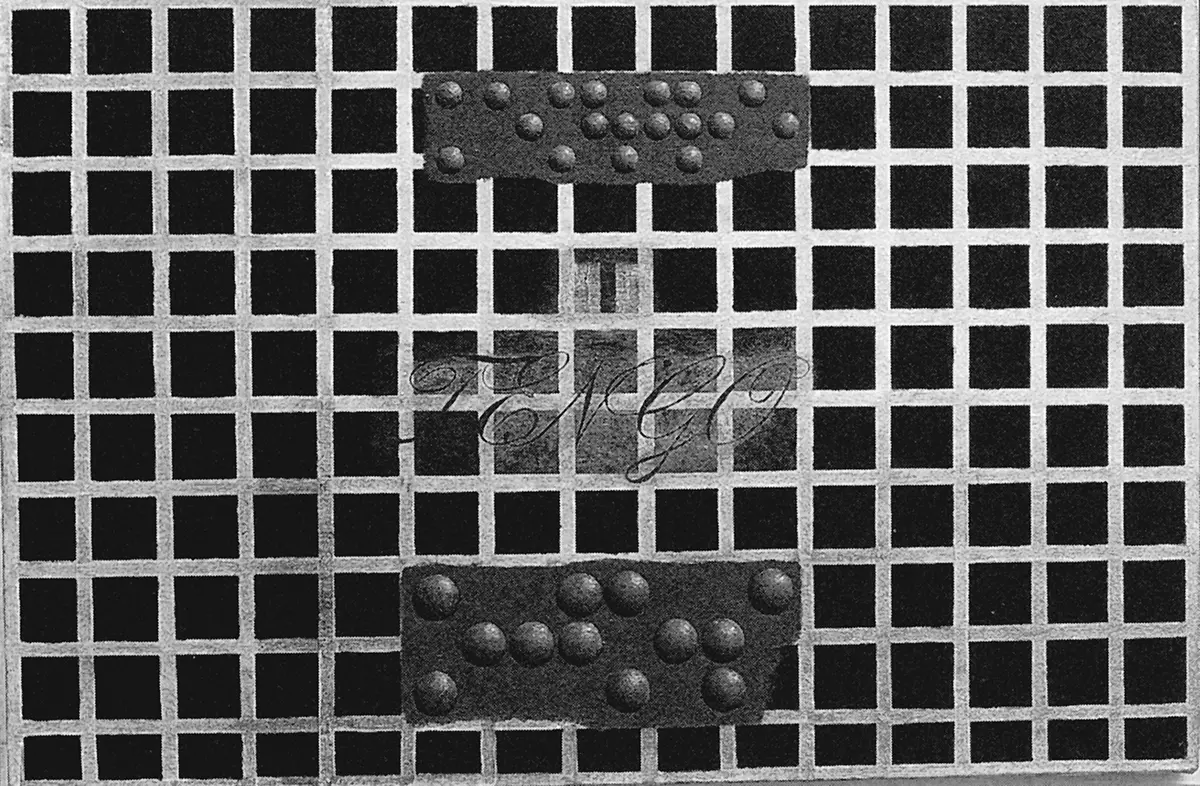
Mariella Agois is not concerned about formal elements; she instead transcends pictorial texture to give her work highly emotive content. Whereas before she would propose new interpretations of historical texts, this time many of her pictures included phrases written in Braille, which appears like large three-dimensional pearls in a horizontal composition crossing the surface. The Braille “pearls" are repeated obsessively until, in the largest picture, they become an enormous abstraction, without any axis to concentrate our vision. As with Pollock's drips, they make the eye move around the surface impregnated with brilliant little white spheres that, upon careful inspection, become an embroidery of circles encompassing the entire canvas.
The constellations of domino pieces, with their black rectangles breaking up the space, might have created the opposite effect. But this solid geometry, which seems to float on the canvas, is gradually diluted into a kind of firmament of transparencies, creating an impressive work leading stylistically to one of the most interesting compositions in the show. Te tengo entre ojos (I'm watching you) is a work whose checkered surface is broken by the red fragments containing the Braille codes and the letters Tengo. The artist uses different typographies to break the ordered nature of the serialized forms, but also creates a poetics that can be appreciated in one of the artist's most beautiful works. This is a small format piece with a background of flowers, crossed diagonally by domino pieces, with the borders containing the words When one falls, they all fall. The letters, like tangled ribbons, elicit a nostalgic reaction. These elements combine to present a vision that at first glance be construed as feminine, but that upon closer inspection reveals the work of an artist who has fused nostalgia with her sexuality —illusion with passion— into an artistic endeavor that is unprecedented in our country.
Don't make waves is a subtle work on tissue paper, stuck on canvas and repainted with transparent layers of oil. It has at its center a brilliant shining glass that captures our attention and reflects the artist’s mastery in creating her own mythology, through visual metaphors based on phrases taken from our popular repertory. The works as a whole were also interesting in their paradoxes and surprises: the use of the Braille to create work of great visual richness; restoring the value of meaning through literary elements and giving new resonance to such commonplace phrases as Out of sight... out of mind. Finally, special mention must be made of the oval-shaped pieces, coiled necklaces resembling the layers of a piece of a cut tree trunk. These delicate works succeed in evoking absences and presences and fragments of memory in paintings which have made Mariella Agois one of the most important women artists in Peru today.
LUIS LAMA