
Since the late 1980s, exhibitions of the younger generations of Mexican painters have been organized with unflagging enthusiasm in Mexico itself, as well as in other parts of Latin America, Europe, and the United States. Beginning around 1987-1988, the art of figures such as Rocio Maldonado, Duke Maria Nunez, JulioGalan, Nahum B. Zenil, and others was featured in shows that examined the phenomenon of "Neo-Mexicanism." Artists who delved, often with an ironic sensibility, into the visual traditions of the past and who revived certain modes with a view to making often scathing commentaries upon national realities, fascinated audiences from Mexico to New York to Frankfurt and beyond. More recently, the visibility of the Neo-Mexicanistas has waned somewhat, as we become more aware of the more experimental conceptualizations by artists like Gabriel Orozco, Abraham Cruz-Villegas, and others.
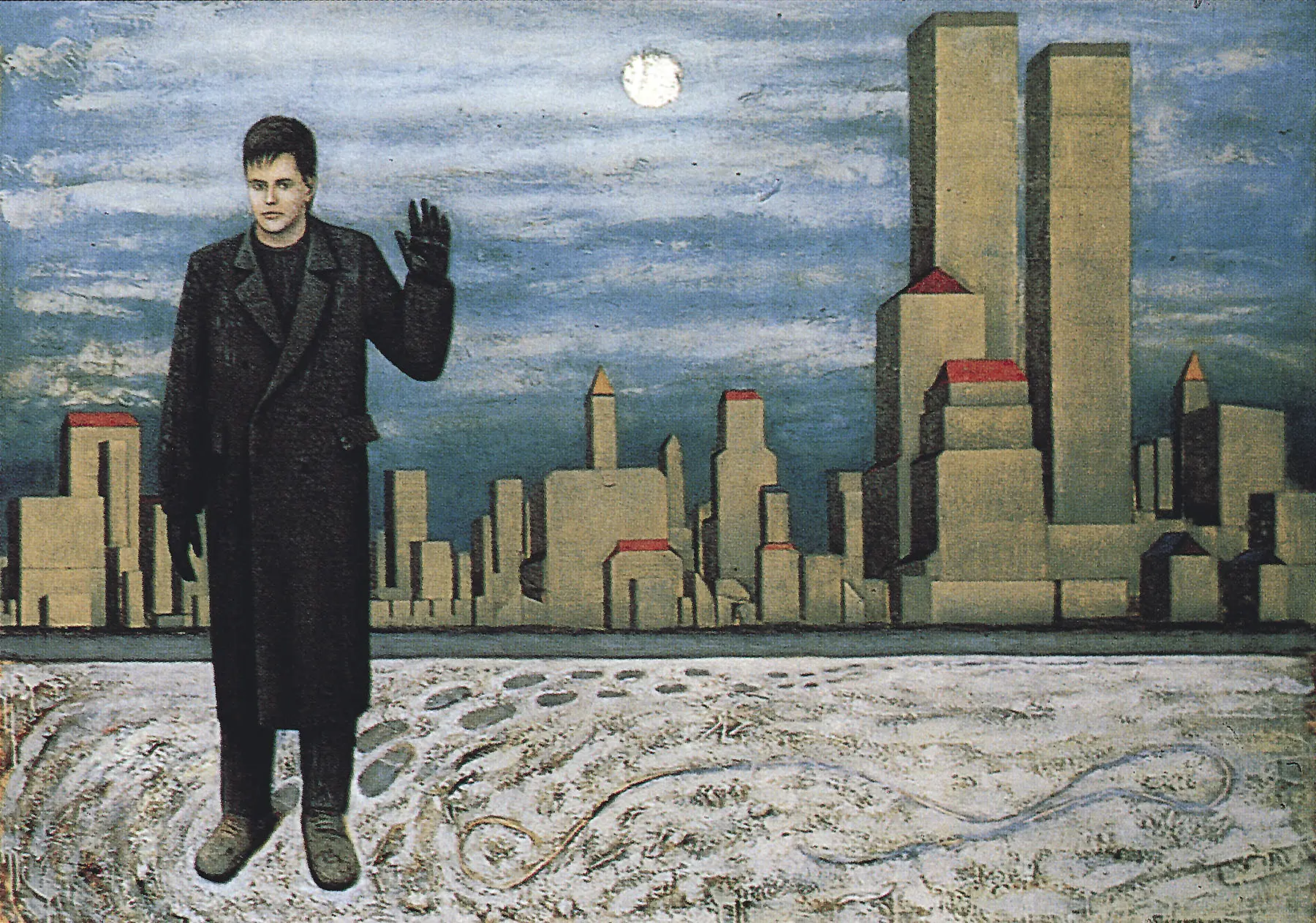
In his classically based paintings, Roberto Márquez has resisted trendiness or engagement with the most current takes on postmodernism, and perhaps, for this reason, something of a cult has developed around the artist. Remaining aloof from much of the frenzy of the Mexico City or New York art worlds (while intimately familiar with the vagaries of both), he has continued to paint in his seemingly hermetically sealed studio in Weehawken, New Jersey, just on the other side of the Hudson River from Manhattan. Indeed, the act of setting himself just slightly apart from the "mainstream" of New York City in a geographical sense might be understood as a metaphor for Márquez's self-chosen marginalization from the central nexus of the art worlds with which he is associated. A painting of 1990 titled Augurio, done just at the time when Márquez moved from Arizona to New York, appears to be an uncertain tribute to his new city. He stands not within the urban space, but rather slightly removed from it, rooted to frozen ground (so different from the warmer places he had left) either saluting the future or waving farewell to the past. The ambiguity of the image and its meaning is typical of the enigmatic atmosphere that invariably pervades this artist's visual metaphors.
For many years, Márquez has shown almost exclusively at the Riva Yares Gallery in Scottsdale, Arizona, and Santa Fe, New Mexico, and recently had a series of exhibitions in Bogota at the Fernando Quintana Gallery. Collectors covet his paintings and often go to great lengths to ensure that they will be the next to acquire the depictions of his particular imagination. His 1994 retrospective exhibition Sojourns in the Labyrinth, at the Tucson (Arizona) Museum of Art, was the first opportunity to see a large number of his impressive canvases and sculptures exhibited together. But the winter-spring 1997 show which runs through April at the Museo de Arte Contemporaneo de Monterey (MARCO), titled Roberto Márquez: Fragmentos del Tiempo, and curated by Clayton C. Kirking provides an even more satisfying and coherent look at the production of Márquez since the early 1980s.
The art of many Mexican painters of Márquez's generation is concerned with the evocation of the symbolic forms, colors, or other elements that would tend to be identified as Mexican. Márquez's work is, in this regard, something of an anomaly. His works evoke at almost every turn, a rootedness in the traditions of Europe's classical and Renaissance past. Márquez is not the product of a lengthy artistic education, although he studied sculpture in Guadalajara and did his degree in architecture there (and, indeed, it is a high degree of sensitivity to architectonic form and structure that is one of the most salient characteristics of his art.) Yet growing up in Guadalajara (Márquez was born in Mexico City in 1959, but came to the capital of Jalisco as a child) left a definite mark upon his artistic personality, and Márquez is intimately familiar with the visual heritage of this region of Mexico. The state of Jalisco, and its capital, in particular, has produced an enormously important "school" of artists, beginning in the nineteenth century with the self-taught portraitist Jose Maria Estrada (of whose work Márquez is profoundly respectful) and, continuing on to the twentieth century with the greatest of the Jalisco painters Jose Clemente Orozco, and including Gerardo Murillo (Dr. Atl), Carlos Orozco Romero, Maria Izquierdo, Juan Soriano, and others. But in Márquez's work there appear few direct references to Jalisco or Guadalajara itself.
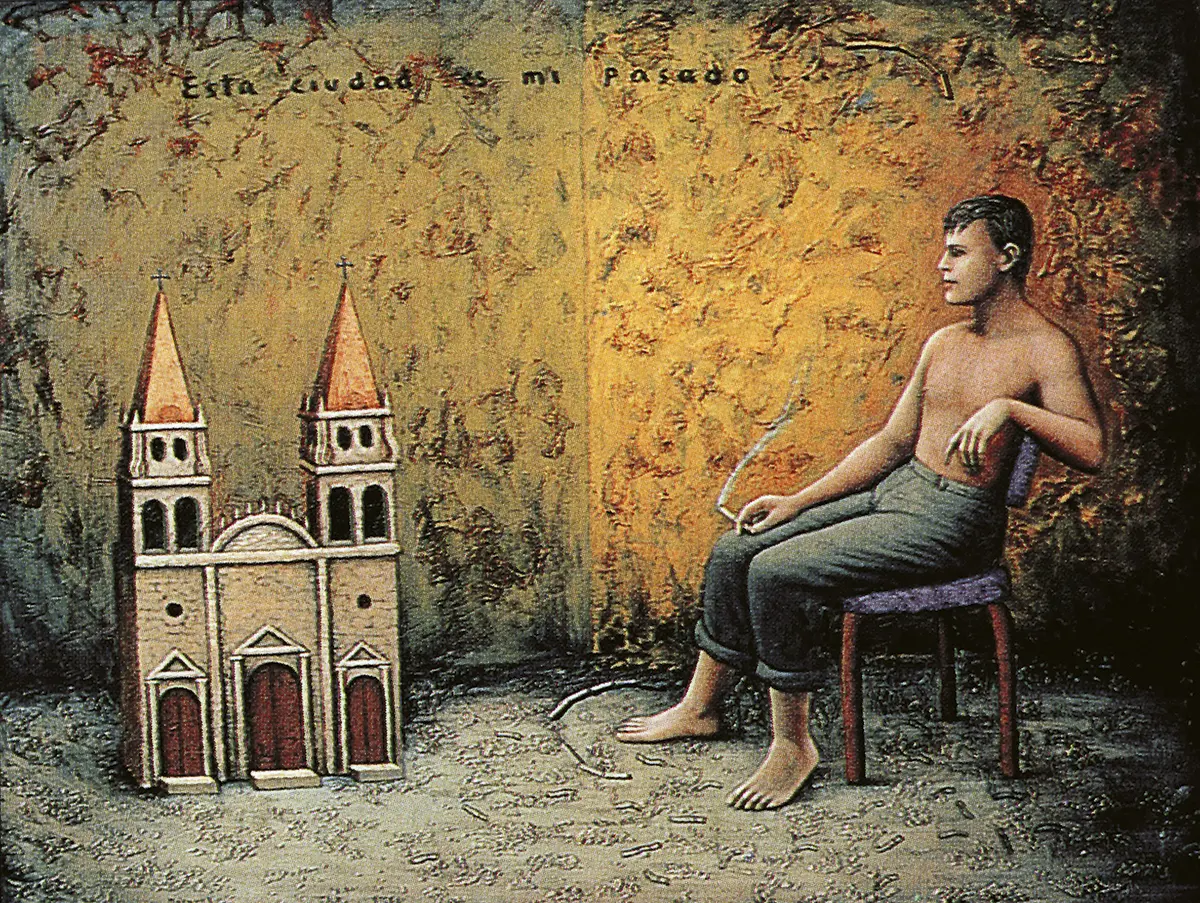
Nonetheless, a 1989 canvas titled The City is my Past is an important testimony to his continued emotional and artistic links to the city that witnessed the beginnings of his career. In this work, Márquez sits within an ambiguous interior space, confronting a model of the Cathedral of Guadalajara. We sense here not simply a nostalgia for the principal architectural landmark of the city, but an almost melancholic contemplation of this symbol of its past traditions. We sense that the artist himself appears to be wondering what paths he will take in the future. Will he diverge from the exigencies of the city's past artistic apogee, or will he ultimately merge himself into the sources from which he has come?
Some critics (such as Edward Lucie Smith) have mistakenly connected the work of Roberto Márquez to the "magic realism" of Gabriel García Márquez and other Latin American writers. While there are often subtle suggestions of narrative in his paintings, Márquez exhibits definitive sobriety in his compositions, in terms of both color and content, that has little to do with conventional definitions of the Latin American "fantastic." The connections between Márquez and literature are unavoidable nonetheless. Perhaps even more than visual sources of stimulus, the impact of literary culture upon the artist has been decisive. While in Guadalajara, Márquez was a faithful attendee at many literary tertulias, and illustrated a number of editions of the participants' works of poetry and prose. He studied poetry with Elias Nandino; and his fellow student in that group, Jorge Esquinca, has remained a constant friend and creator of ekphrasis of the works of Márquez. In addition, those who observe the progress of Márquez's career carefully will see the ever more subtle and sophisticated references to literature in his painting titles — in the phrases written directly onto the canvases and in their rich layers of allusion. Márquez has also illustrated volumes of literary works, such as the Japanese edition of García Márquez's Ojos de Perro Azul in 1990.
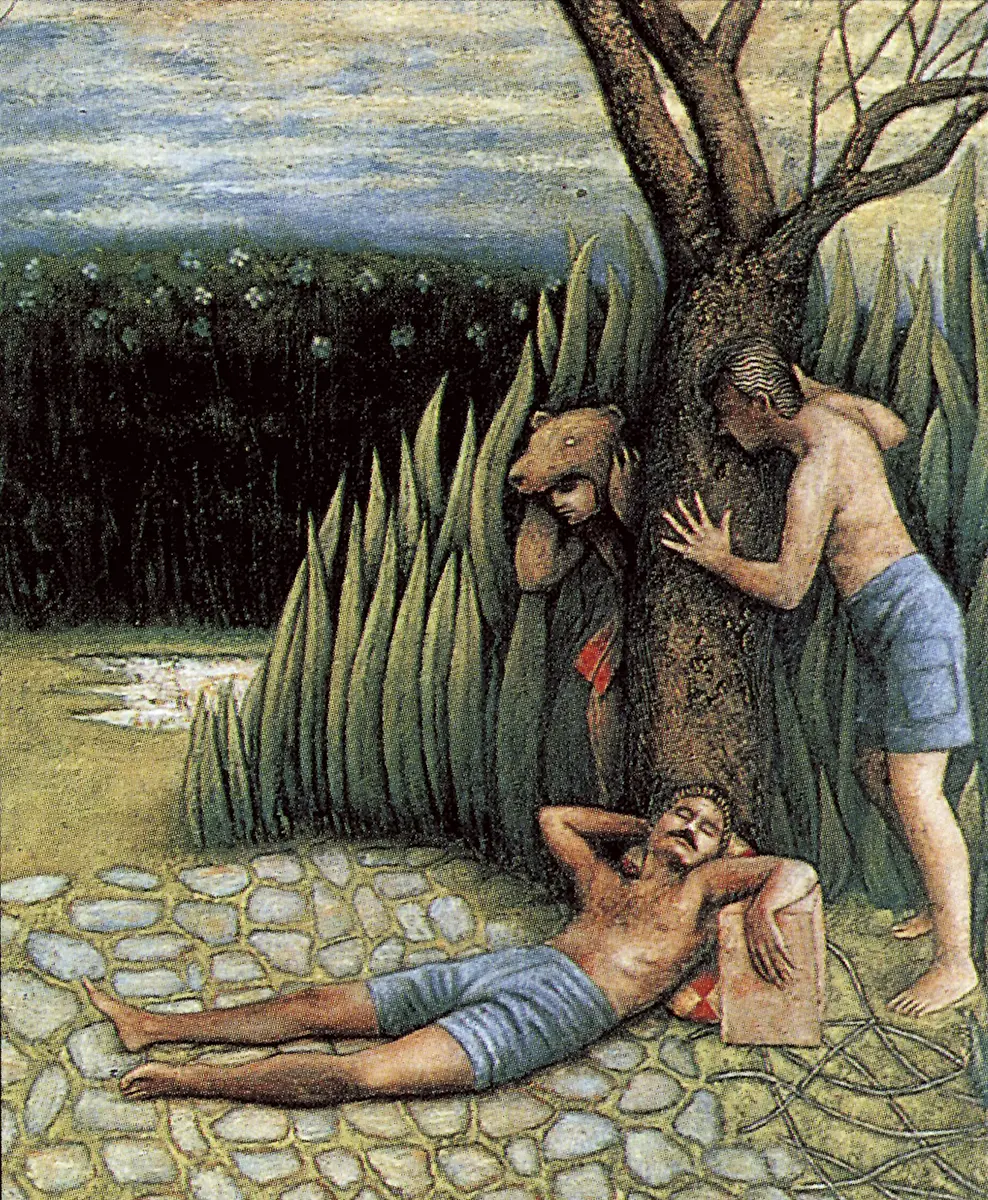
Márquez and his wife Ana Saldamando moved from Guadalajara to Phoenix, Arizona in 1990. They remained there for five years before moving to New York. He did not make his first trip to Europe until 1990, but since then he has become a constant visitor to the museums, galleries, churches, and archeological sites of the continent. He seems to feel particularly at ease within the realms inhabited by painters of the Italian Renaissance. The cool classicism and solidity, as well as the color harmonies of the artistic visions of Venetian artists like Carpaccio, Bellini, and Titian or Tuscan masters such as Masaccio, Fra Angelico, and Piero Della Francesca, seem to form the substructure of Márquez's visual imagination. In some of his paintings, Márquez recalls elements of specific images of the Renaissance masters. In the 1986 Theory of the Bear, for example, the pastoral scenes of Giorgione, Titian, and Dosso Dossi are brought to mind. There is a strange playfulness to Márquez's composition which incorporates a sleeping figure, an iconographic element that becomes common in Márquez's repertory of themes. Several of Márquez's close friends in Arizona posed as models for the work. It is curious that the dramatic landscape and the strong earth colors of the Southwest region of the United States seemed to have had very little impact upon the artist who has remained faithful to a highly personal range of tones and atmospheric suggestions in his work.
Weakness of the Night (1986), like so many of Márquez's paintings, gives the impression that we have been allowed to enter a parable or story in midstream. Here we observe an enigmatic horseman with a torch, riding a white horse in a vaguely defined landscape. Horse and rider pass a man who is either sleeping or dead. The painting titles often give no specific hint to the action, and we are left to ponder endlessly the meanings of the work. The sense of hermetic, a constant force in the artist's work, reminds us of the pleasures and frustrations of reading Jorge Luis Borges, an author who has long been a source of great inspiration for Márquez. The complexities and allusions (historical, literary, philosophical) are seemingly endless. Yet even if we do not capture the ultimate message of a Borges tale, we always come away from our engagement with it enriched by having penetrated, at least in a superficial way, the many intellectual labyrinths the author has presented us with. Our contemplation of the paintings of Márquez offers a similar experience. In the case of this painting, however, we are informed of the precise source of inspiration by the most recent scholarship on the art of Márquez, as noted in the catalog for the current exhibition of his work at MARCO:
Márquez consistently turns to poetry for inspiration and subject matter... in the case of La Debilidad de la noche (Weakness of the Night) it was a poem by Michelangelo that provided the spark. This sonnet, written about 1545, contrasts the power of the day personified in classical mythology by Phoebus (Apollo) with that of the night which is associated with Artemis. 'And the night is so weak that anyone who lights a torch takes life from it at that spot, and it is so feeble that flint on tinder tears and rends it.
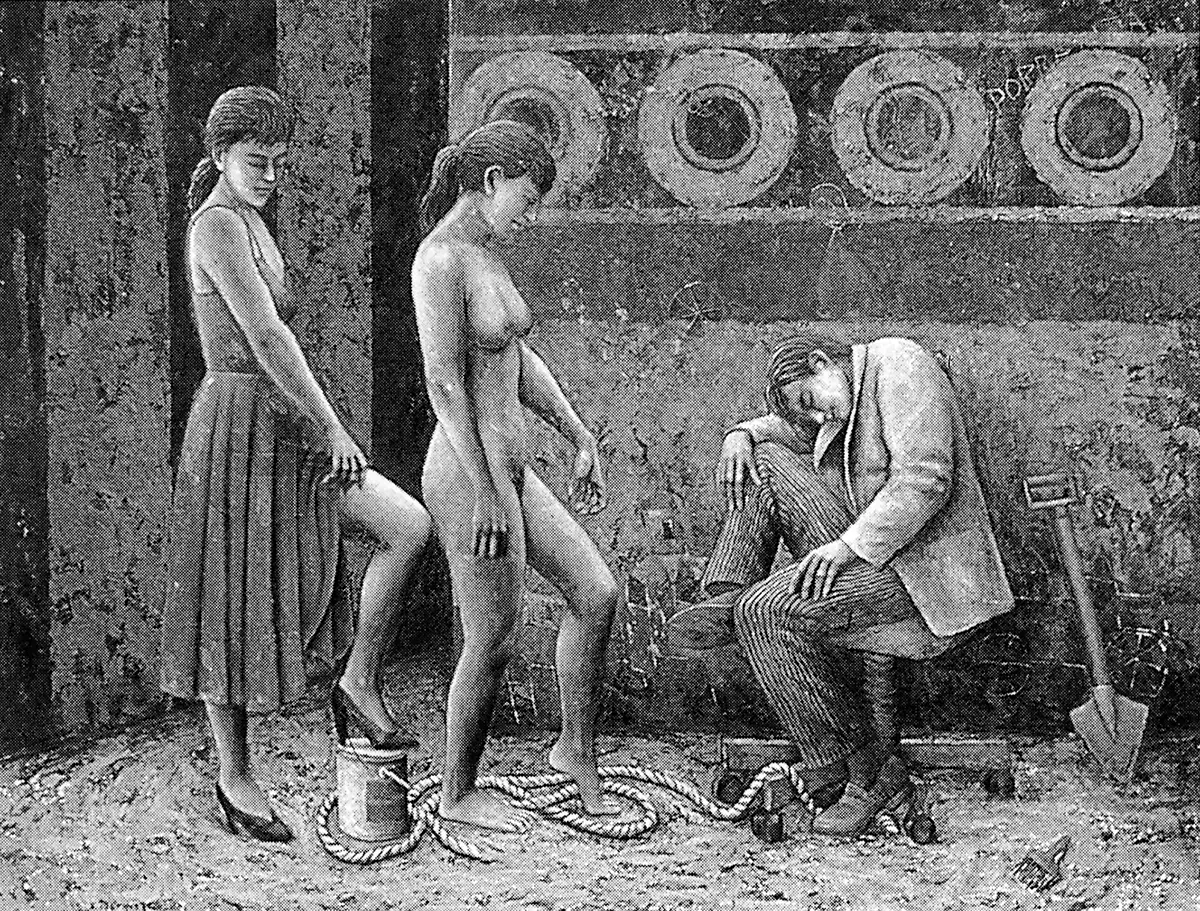
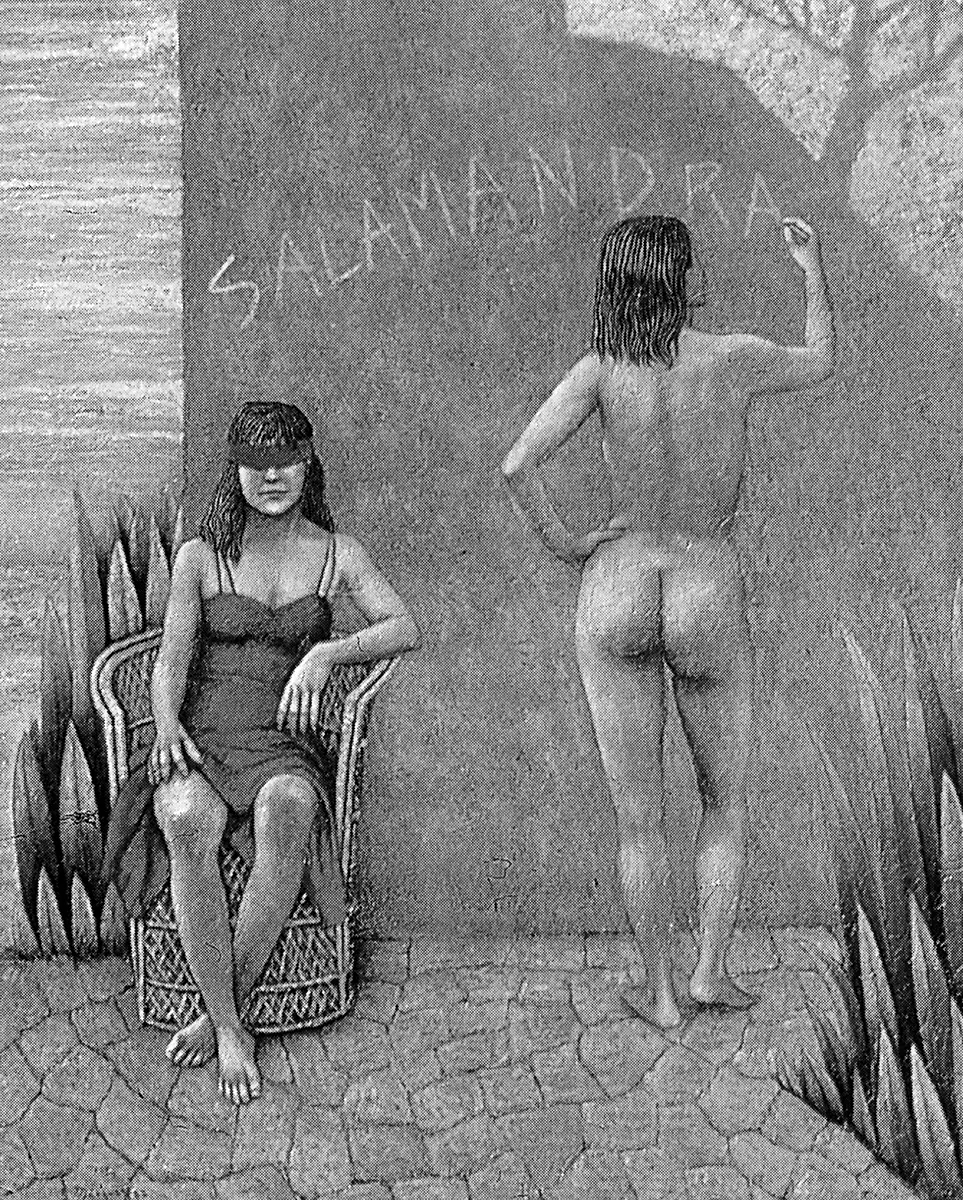
Borges — and Márquez — are both fond of evoking sleep and dreams in their work. In Somebody is Dreaming of a Dream (1988), two women, one nude, the other clothed, confront a sleeping man. The tensions of clothed versus unclothed forms, which Edouard Manet confronted so dramatically in his watershed painting Dejeuner sur herbe, are recalled here —yet at the same time, we are reminded of our own dreams and nightmares of nakedness. An analogous preoccupation is at work in another compelling painting, Dream of the Salamander (1987), which similarly juxtaposes a clothed with a naked figure and a sleeping one with an active one. Though Márquez has never professed to be particularly interested in either Freud or Jung, there are in his art so many recurring (and troubling) symbols whose meanings are just slightly allusive, that the viewer is obliged to make the obvious references to these two giants of psychoanalysis. In considering this and so many other works by Márquez in which sleep is recalled, we must also make the logical connections to two giants of the Spanish literary and artistic worlds: Calderon de la Barca, whose play La vida es sueño has provided thematic inspirations for numerous later artistic creations, and Goya, whose print El sueño de la razón, part of the series, Los caprichos, set a precedent for numerous visual representations of sleeping figures. Thus, analyzing works by Márquez within the framework of art historical references and literary precedents, we are able to understand his links with the traditions of Europe and the Americas from which he has emerged.
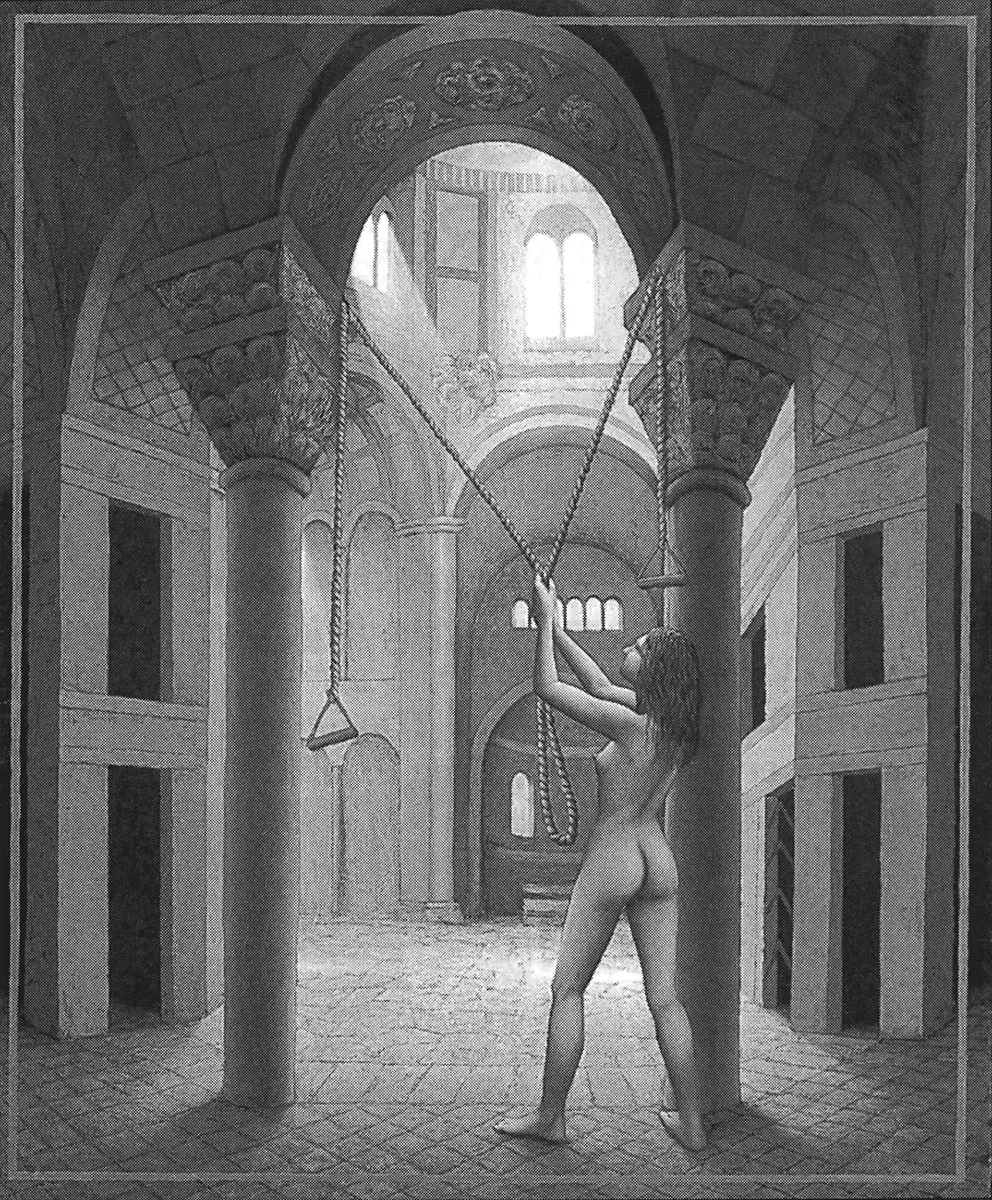
It would be foolish, however, to see Márquez, an artist of great curiosity and a powerful assimilator and transformer of sources, as simply appropriating and reinventing the art of previous centuries in his own work. Among the twentieth-century masters, he most admires are Balthus and Giorgio de Chirico. Balthus's puzzling, dream-like narratives, rife with sexual innuendo and an often-threatening aura, appeal to Márquez's sense of brooding erotic ambiguity, just as DeChirico's mysterious, sinister spaces appeal to him for their capacity to establish a mood of nervous expectation. In some of his more recent works, Márquez has employed space itself as the principal protagonist. Paintings such as the 1992 Salvaggia Pos Para Paolo Uccello and Las bodas de Philidor of 1996, utilize richly theatrical settings as the focal point for the artist's operatic fantasies. Márquez is enormously fond of the opera. In his studio, opera (usually Italian, less often Wagnerian) is invariably playing, and much of the high drama of the bel canto or verismo works that he listens to over and over again find its way into his paintings.
In Márquez's recent work, we observe a new openness to nature and landscape. While a survey of his paintings from the early 1980s to the present reveals a predilection for closed and often nebulous, undefined space (at times causing a certain sense of claustrophobia in the viewer), his newest images have literally opened up to nature, with landscapes, both nocturnal scenes, and daylight vistas, predominating. Márquez is not an artist whose work has witnessed many periods of abrupt change. His art has matured gradually. While Márquez has been nurtured by past traditions, he has carefully calibrated his creativity, giving new life to traditional forms — all the while generating a visual vocabulary that is distinctly his own and which ripens with each new creation.
* Clayton Kirking, Roberto Márquez:FragmentsdelTiempo.Monterrey,MARCO, 1997,p. 10.
EDWARD J. SULLIVAN
Professor of Art History and Chairman, Department of Fine Arts, New York University.