The work of Sacha Tebo has an undeniable Caribbean dimension, successfully reflecting his attempt to synthesize features of the spirituality, geography, and society of the region. He approaches his subjects and highlights their hidden aspects, through a caustic hermeticism that evokes unexplainable situations. His are schematized presences that seem to be related to pre-literacy expressions. Tebo's interpretations require the rediscovery of forgotten situations, whose reappearance surprises us, awakening a sense of intrigue for those who seek to know who they are and from where they have come.
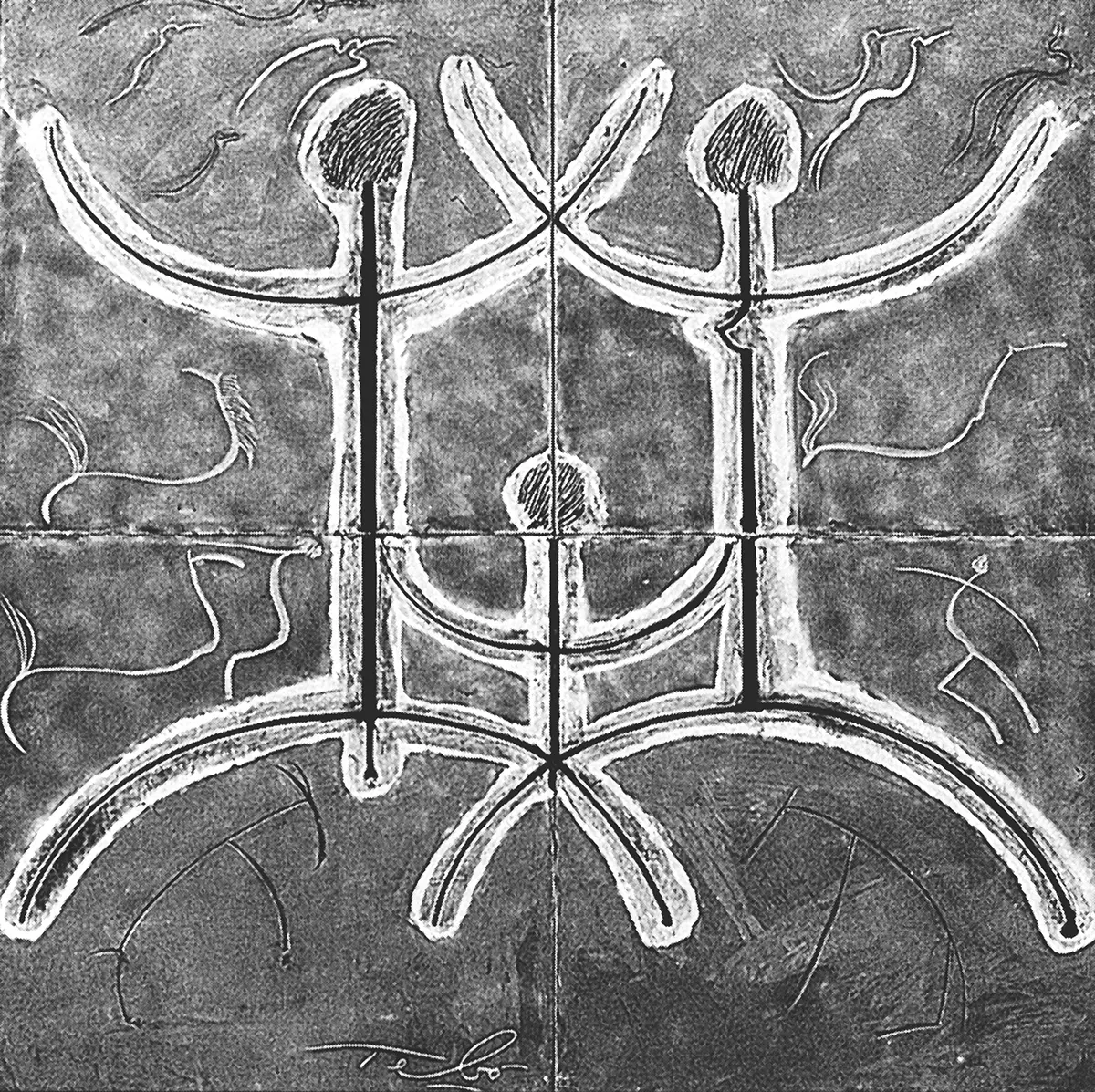
Tebo’s creativity has led him towards an artistic language in which he abstracts the forms bubbling over from everyday life into the essential lines of each being. His representations with their rapid brushstrokes thus seem to share the same characteristics as the wedge-shaped writing. The dilated auras of the forms impressed on Tebo’s canvases constitute a transitional space that facilitates their incorporation into the surrounding sphere. The surroundings of the central characters are full of silhouettes expressed in simple yet tenacious brushstrokes.
Tebo's cosmological vision offers us a pure world. We are in the presence of production that was not intended to be rationalized, because of the work's links with the sacred. The effects achieved in Tebo’s works reflect the ways in which the artist has fought against the ephemeral principles that have dominated the twentieth century, a century dominated by the whims of the avant-garde.
When an artist manages to open up the way to what is essential, the resulting works remain outside the realm of time. They are creations in which several vital levels can coexist side by side. They differ from one another in their use of chromatic elements that represent the state of reality that they embody. Tebo's works are like maps whose superimposed routes seem to be paradoxical, a kind of palimpsest reflecting different cultures that can co-exist in the same space.
We are in the presence of an artistic endeavor expressed in codes which, just when we think we have the ciphers to solve them, offer up new challenges. Any attempt to interpret the enigmas they propose will necessarily involve the constant repetition of the process at different levels. This uninterrupted succession of approachments means that each time we look at the pictures, we are being invited to renew our critical inquiry. The metaphorical counterpoint in Tebo’s work reveals the rare eloquence of an artist who is able to condense an entire discourse within the confines of the frame.
JOSÉ ANTONIO PÉREZ RUIZ