For some time now the work of Silvia Gruner has endeavored to create an archeology of memory in which the unearthing and restoration of the traces of experience have led her to explore, with a certain kind of distancing, the actions and reactions of human beings to their surroundings. Through a frontal gaze at things and bodies, the artist, in a gesture of recognition/knowledge, explore the terrain of individual, personal, cultural, and collective identity. In this way, she embarks on a rather unorthodox approach to a genre comparable to that of the self-portrait, although her objective is not to identify the body with the soul, but to try and decipher the different forms of behavior that makeup identity. In her most recent show, she demonstrates that although appearances have been accepted as a categorical reflection of personality, there exists also an internal struggle, a hidden rebellion against the features that one assumes, consciously or unconsciously, in a tacit agreement with society. In this exhibition, the artist worked with objects in space — not as someone observing from the outside, but rather operating from within, like someone offering up her heart and sharing her intimacy.
Her Architectural Details embraced the walls of the gallery, revealing a kind of reconciliation between the body and consciousness, consciousness with the being — in this case, a woman, reworking the ancient metaphor mentioned by Pablo Vargas Lugo in his text, of the house as a body and the body as a house.
Gruner uses spatial constructions and ornamental elements to conjure up a series of details — minor fragments of a whole which, because of their decorative nature, would normally pass unnoticed. These coquettish details frame and enhance the “incidental" events of everyday life that, as part of an internal structure, become inseparable from the surface of consciousness.
The work titled Frieze reveals, high on the walls of one of the rooms, a series of photographs in which the artist depicts herself with a triangular touchstone decorated with a shell. She manipulates it between her legs with some difficulty, simultaneously revealing and hiding, in a malicious game, what she wants to show. Gruner is perhaps suggesting, as Meret Oppenheim would say, that women not only "have to live their own femininity, but also that which men project on them." However, the fact that these images are not nude photographs alters the project a little, casting a shadow that prevents it from being incorporated into the architectural space.
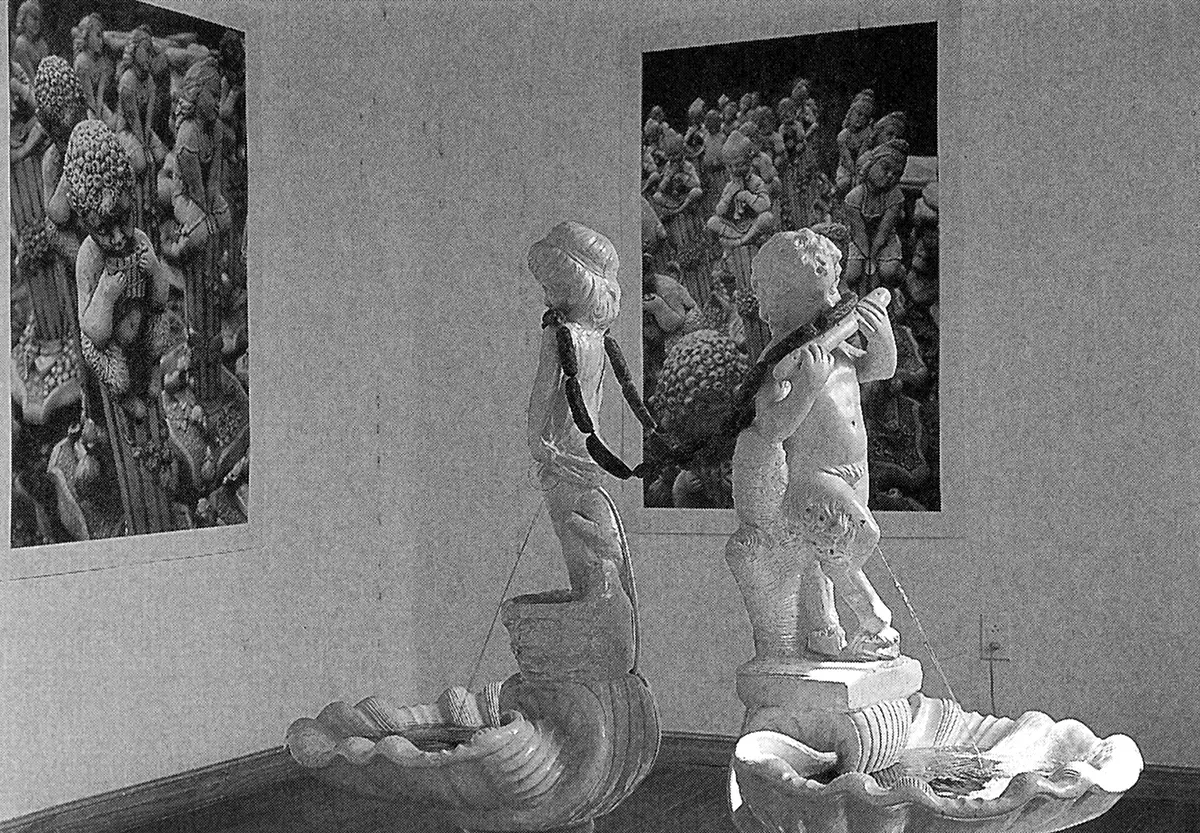
Work with the eloquent title of Fountain (They washed S’s mouth with soap) reveals the standards which govern open sexuality. Gruner once again uses the concave forms of the shell and the number of cultural allusions it conjures up. It is an element which, she says, can be repeated and interpreted in a thousand ways: soap-dish, a baptismal font, Botticelli’s Venus, or a sexual metaphor. In this case, the shell as a receptacle offers up its depressions and volumes. It extends in a horizontal line along the walls, abruptly interrupted by a photographic close-up of an extended mouth that holds a pearl necklace in its teeth. While this central piece revealed with reluctance the promised reward, the other works in the show proposed an apology of desire and fertility, the generosity of aesthetic experience: the floral motifs, the green and white, the girl and the faun, reproduce their innocence and pleasant sensuality through the multiplication of their images and effigies. In the fountain entitled Faun and Nymph (Make a Wish), the creatures associated with water and vegetation are placed back to back and linked together by a chain of green chorizos—green like the liquid expelled from their bodies. The work seems to be a rather tired and feminine version of Duchamp’s readymade urinal. As in the photographs of the fauns and nymphs — like mythological Lolitas complementing the show — the effigies do not hold the promise of eroticism or any nostalgic paradise; their image evokes a gaze full of enjoyment, while at the same time provoking a sense of censure and castration.
By emphasizing what is artificial and extraneous, Silvia Gruner not only restores the details forgotten by our visual schizophrenia but revalorizes the sibylline eye in its wanderings, highlighting the complicity between the interior and the exterior, between prohibited identity and licit appearances.
MAGALÍ ARRIOLA