The second one-person show by Williams Carmona, a Cuban living in Puerto Rico, at Brewster Arts Limited was marked by the introduction of several new devices. His first exhibition in November of 1995 was followed in April of 1996 by a show at El Museo de las Americas in San Juan, Puerto Rico. A clear progression can be seen in this series of exhibitions. In contrast to the oil paintings in his first exhibition in 1995, the works shown here were all painted in acrylic on canvas. This change in medium, allowing for more precise, harder edge drawing, and resulted in a tightening of style. The crisper lines, more distinct edges, and flatter surfaces represent an explicit technical change from earlier paintings. These material changes are mirrored in the subject and content of the current work.
The artist employs in his art a company of surrealistic personalities. In the months that have passed since the winter of 1995, Carmona has refined this group both in number and potency. This development of a highly personal and more finely tuned iconography has allowed him to construct paintings whose stories are told by "characters" that rapidly become familiar to the viewer. The experience is similar to viewing a painting by Leonora Carrington, where the characters become familiar and hold a recognized place in the pantheon of ethereal personae and symbols that populate her paintings. A gray-haired woman, a round-faced gnome-like male figure, ashen nude figures, as well as fish and eggs, appear time after time. The artist seems more confident with this cast of characters now, more able to use them to express complicated sentiments. With this vocabulary available to him, he has begun to produce pictures that are implicitly charged with personal symbolism and nostalgia. These emblematic images can be interpreted as narratives, concise statements, or perhaps as dreamlike memories infused with a sense of the surreal.
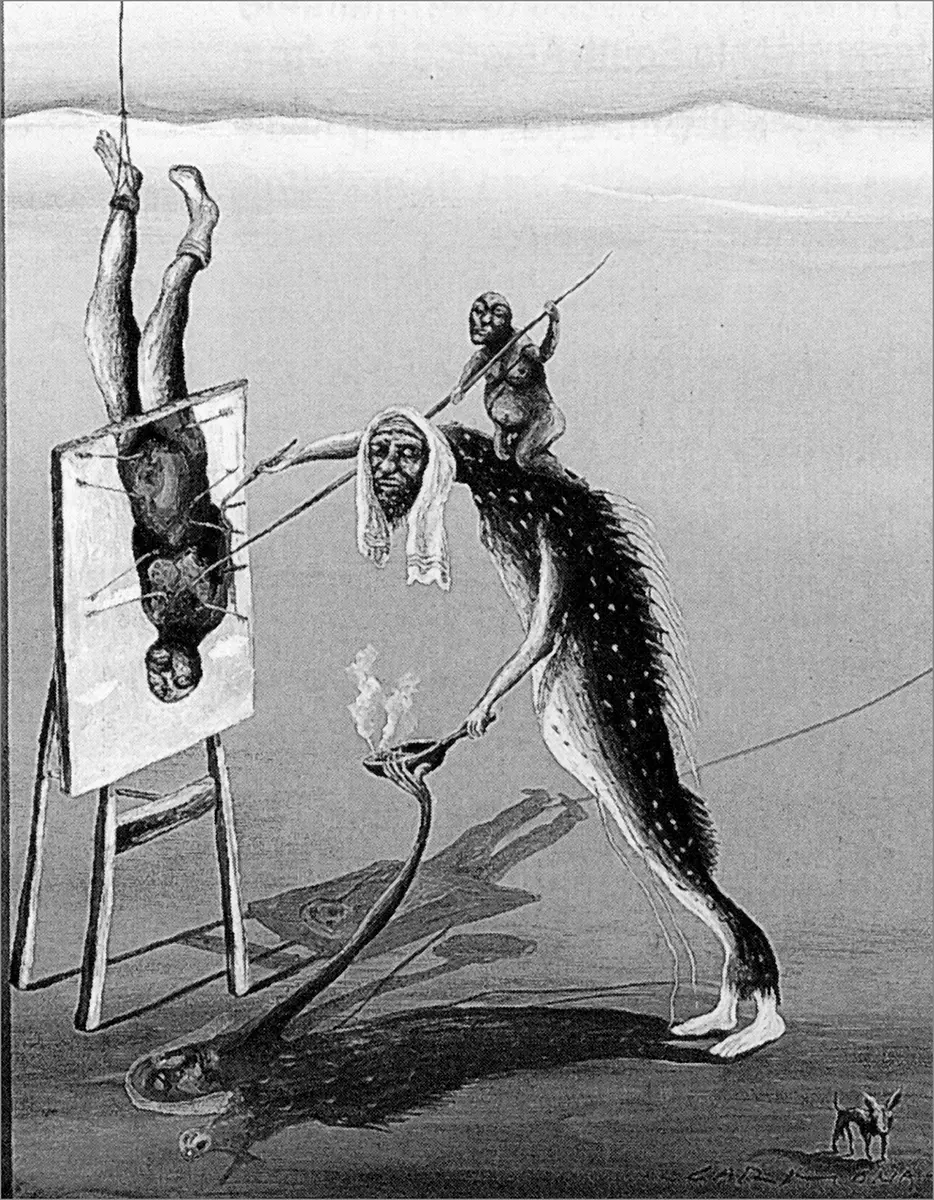
These pictures are seen in this show — all of the modest scale — suggest layers of existence that are interconnected with one another. In Mi vida es peor que la de San Sebastian (My Life Is Worse Than Saint Sebastian's), a dialogue is established between the main figure who paints an image of St. Sebastian on a canvas held on an easel, and the saint himself who seems to exist simultaneously in two and three dimensions. There is a second instance of spatial and metaphysical dialogue between the artist in the picture and his shadow which reaches out from the flat ground into the third dimension occupied by the other figures. A small rotund figure sits on the shoulders of the artist guiding his brush, another connection among the players. This entire scene is further connected by the extended shadow of San Sebastian in the space outside of the painting as it trails off of the edge of the canvas. Carmona uses these methods repeatedly. Certainly, this imagery is based on the psyche and history of the artist himself.
Nearly always set in bleak, flat landscapes it is possible to interpret these scenarios of isolation and inter-connectedness as metaphors for the condition of exile: a situation that recognizes separation as a fact but tenaciously holds onto connections with the past and to the hope of a future reconciliation of both. While there is a very little overt reference in Carmona's work to contemporary politics, these paintings can be read as ruminations on questions related to politics both international and personal. They are peopled with beings that possibly represent absent friends or family, separated by death, physical, or humanly imposed boundaries. Fish, for example, are not bound by the limits of national borders in Apagalo con nada, que mi casa se quema (Put it Out With Nothing, My House Is Burning) but are depicted as airborne, carrying riders away from a burning house. More than a representation of fantasy transportation, they could be seen as a means of flight to safer ground.
This exhibition, which occupied the entire gallery, spilled over for the opening reception into an installation constructed in the elevator. In this piece, a ghostly shadow figure painted on the wall was connected to an I.V. bag filled with blood-red paint that hung from the ceiling. A larger-than-life counterpart to this figure greeted viewers as they entered the gallery. Black Flemish-inspired picture frames were similarly connected to I.V. apparatuses throughout the exhibition. This unexplained element of the show, while imparting a certain amount of drama and shock, significantly detracted from the works themselves. It would have been a more satisfying experience to view the paintings on their own, some of which were draped by black velvet that had to be lifted for viewing, without the confounding presence of ambiguous medical equipment. This element weakened what was otherwise a strong exhibition.
CLAYTON C. KIRKING