
Recently, the Westwood Gallery in New York presented an exhibition of over fifty works that were the basis for the well-known series of advertisements for Absolut Vodka. The show coincided with the publication of a catalog documenting the Absolut advertising campaign.1 It does not really matter who accompanied who, however, as the whole premise was so transparent that there was no need to raise any objections to it. Indeed, this merging of art and commerce was looked upon kindly. The series of Absolut advertisements are already well known, and the use of "real" art to further publicize it was to be applauded.
It can be said that Absolut fairly earned the right to market the exhibition. The company had crossed an important frontier by commissioning works by artists without demanding any stylistic concessions. Indeed, the strength of the campaign was based on the freedom of the artists to maintain their own signature styles. Another frontier was crossed by promoting vodka in an art gallery — a gesture of thanks offered by the show's organizers for Absolut's artistic "patronage."
With its first advertisement in 1980, Absolut, or rather its U.S. distributor, attempted the difficult task of promoting in the United States market a product strongly identified with Russia, and manufactured in Sweden. A group of employees from Young & Rubicam, who left to found the TBWA Agency, was commissioned to launch the campaign that is now considered a landmark in the history of twentieth-century advertising. The group borrowed strategies from conceptual art—metonymy and tautology — and appealed to the wit and humor of the reader through the hint of an enigma to be resolved. The campaign carefully established a synthetic iconic image of the kind (commented on in ArtNexus) prefigured by Meret Oppenheim. The promotion of the brand name allowed Absolut to at least equal the sales of Russian vodka and, to become a status symbol among Vodkamaniacs.
The Absolut campaign essentially comprised two elements: advertising in the traditional sense, and advertising as art. As a publicity success story, it is the first element — notably absent from the show — that was the most effective. Among the examples of "pure" advertising art are images that have become classics, such as Absolut Brooklyn and Absolut Venice. In most cases, these advertisements feature a sort of simple riddle (such as finding where the bottle is hidden within the picture). The campaign has, for the most part, had the good sense to credit the reader/consumer with a modicum of intelligence by letting him or her in on the joke. The reader thus is made an accomplice in a game, rather than simply a passive consumer. Where Benetton exploits "political correctness" and tries to provoke mild indignation vis-a-vis racism, violence, and various cultural taboos, Absolut restricts itself instead to eliciting humorous reactions and an appreciation of the wit involved from its audience.
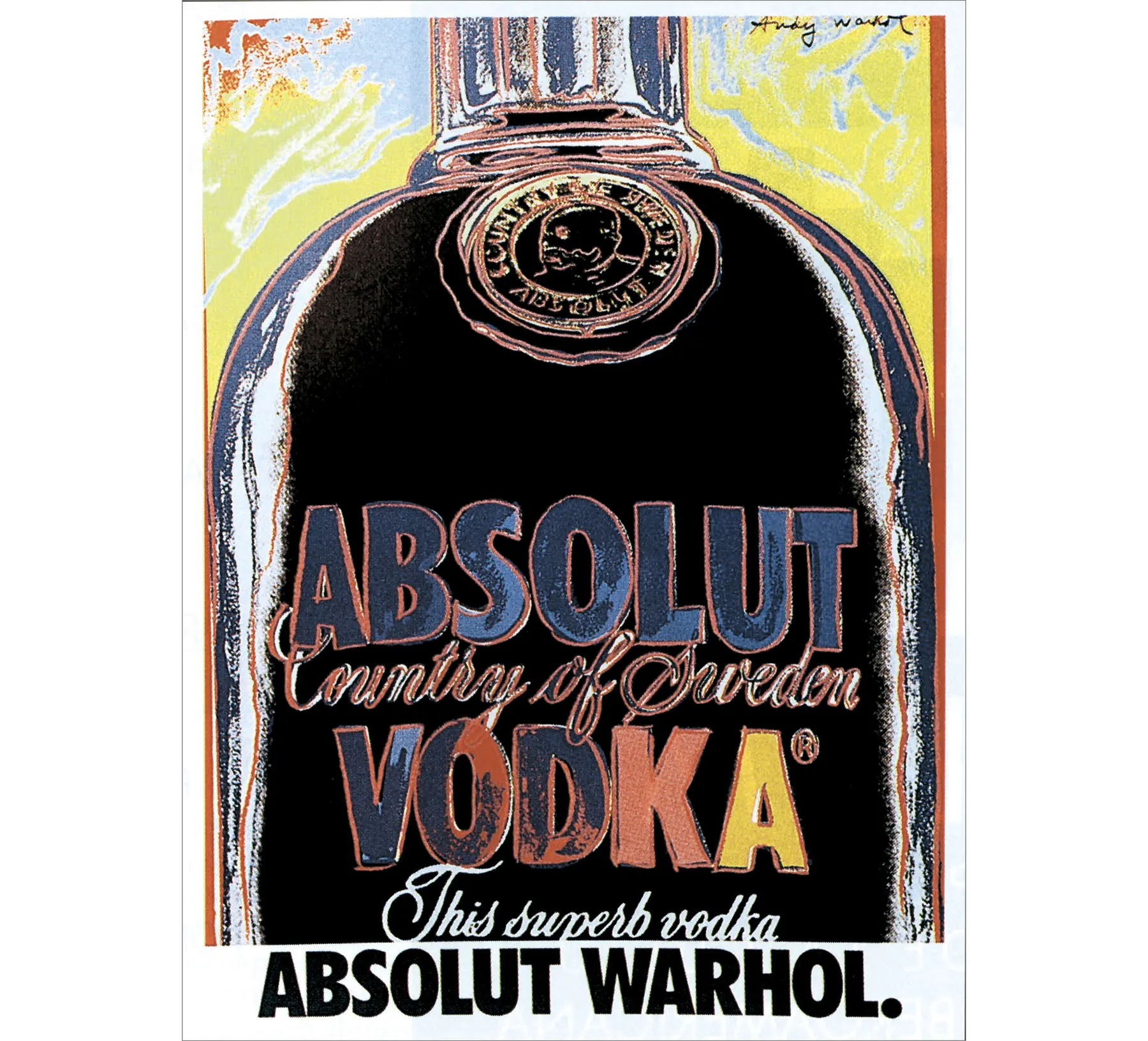
This is where the idea of the distributor Michel Roux's idea of playing with art comes in. During a dinner in 1985, Andy Warhol told Roux how much he admired the Absolut bottle; although he himself did not drink vodka, but used it as a perfume. As a result of that conversation, the first artistic advertisement was created in exchange for $65,000 (a bargain for Absolut, since Warhol's picture, became their property). The work by Warhol is still, after over ten years and two hundred advertisements, the most successful of the series and, in a sense, the boldest. Warhol, like the Absolut campaign itself, moved from advertising to art. His version of the liquor bottle shows his artistic mastery and manages, by using black instead of the traditional transparency used in the reproduction of the bottle, yet again to reinforce his own image without detracting from the advertisement. Indeed, the picture could be used as a paradigm for the study of Warhol's artistic career. His dream of taking the commercial product to the field of art and recycling it commercially here appears to have succeeded perfectly at all the desired levels.
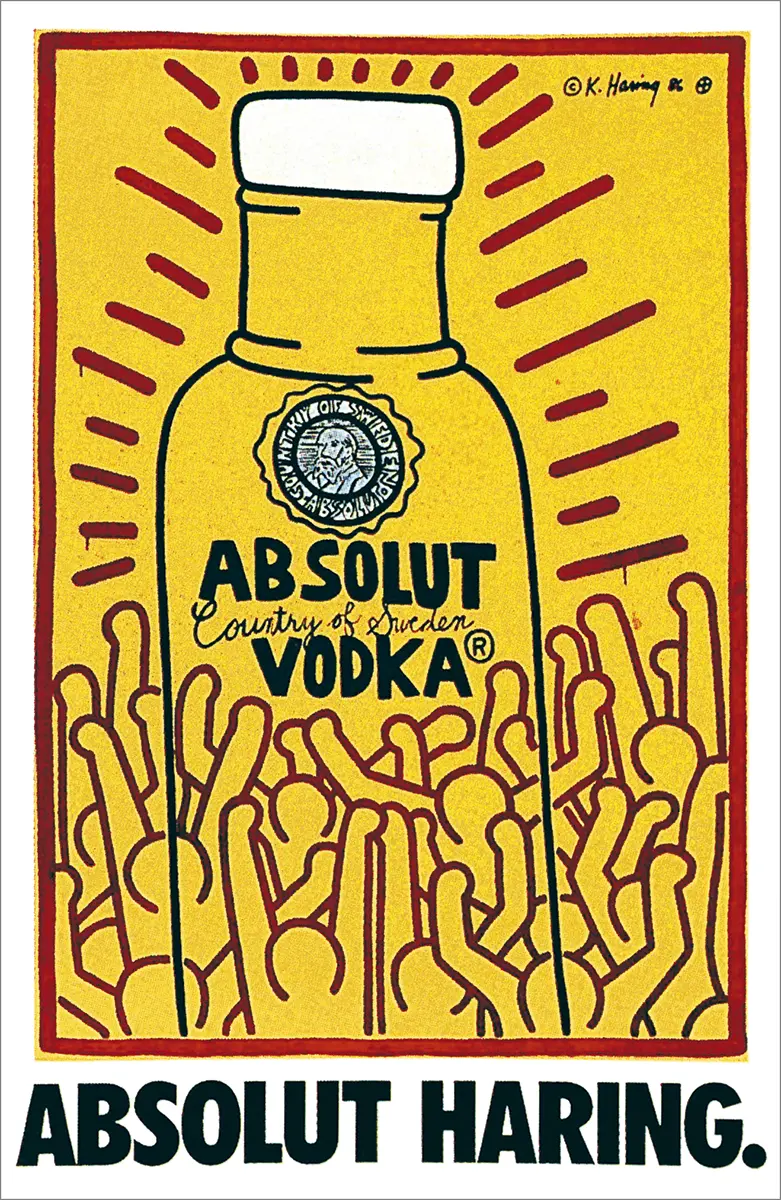
Warhol paved up the way for the graffiti artists (and his friends) Keith Haring and Kenny Scharf, whose artistic contributions helped move the campaign towards its current incarnation: an excuse for publicizing individual artistic styles in the guise of creating an advertisement. The focus is on the artist's creation, with Absolut remaining only in the form of the bottle and as text. Since the ad requires only minimal text — Absolut and another word — and the premise of the game allows for the product to be hidden or relegated, the artist is given plenty of freedom to do what he or she pleases without any fear of damaging the campaign. But given the autonomy granted to the artist, it is surprising that the gallery show was not better.
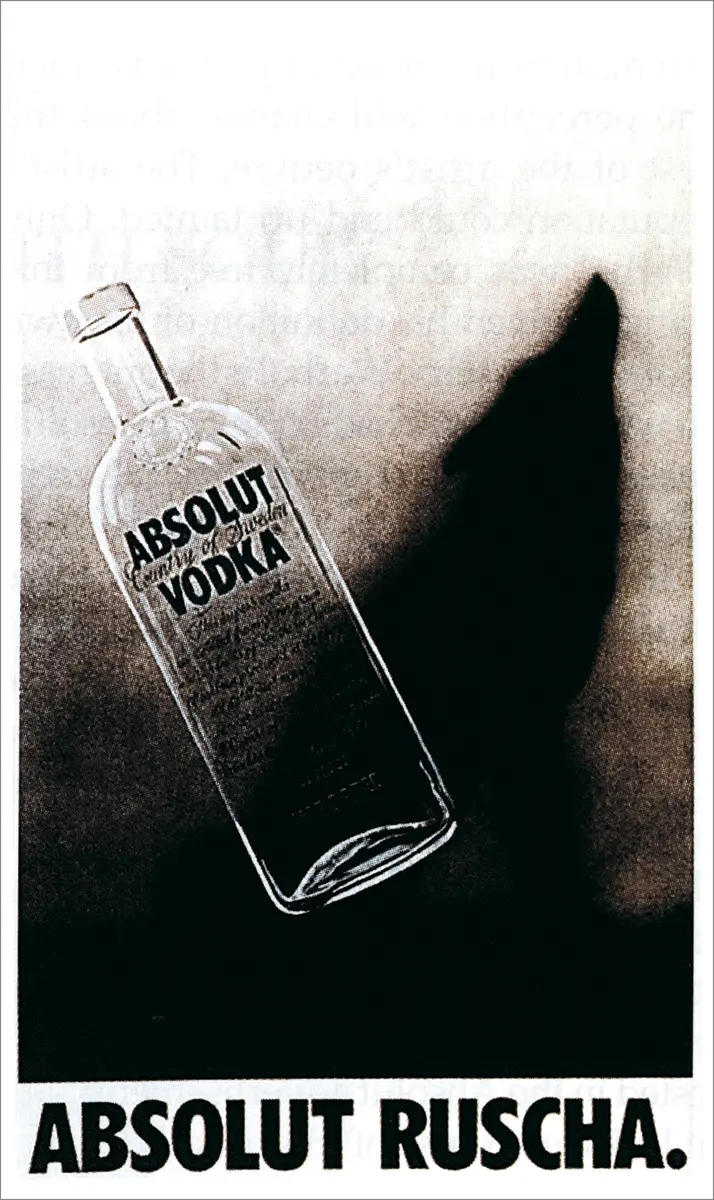
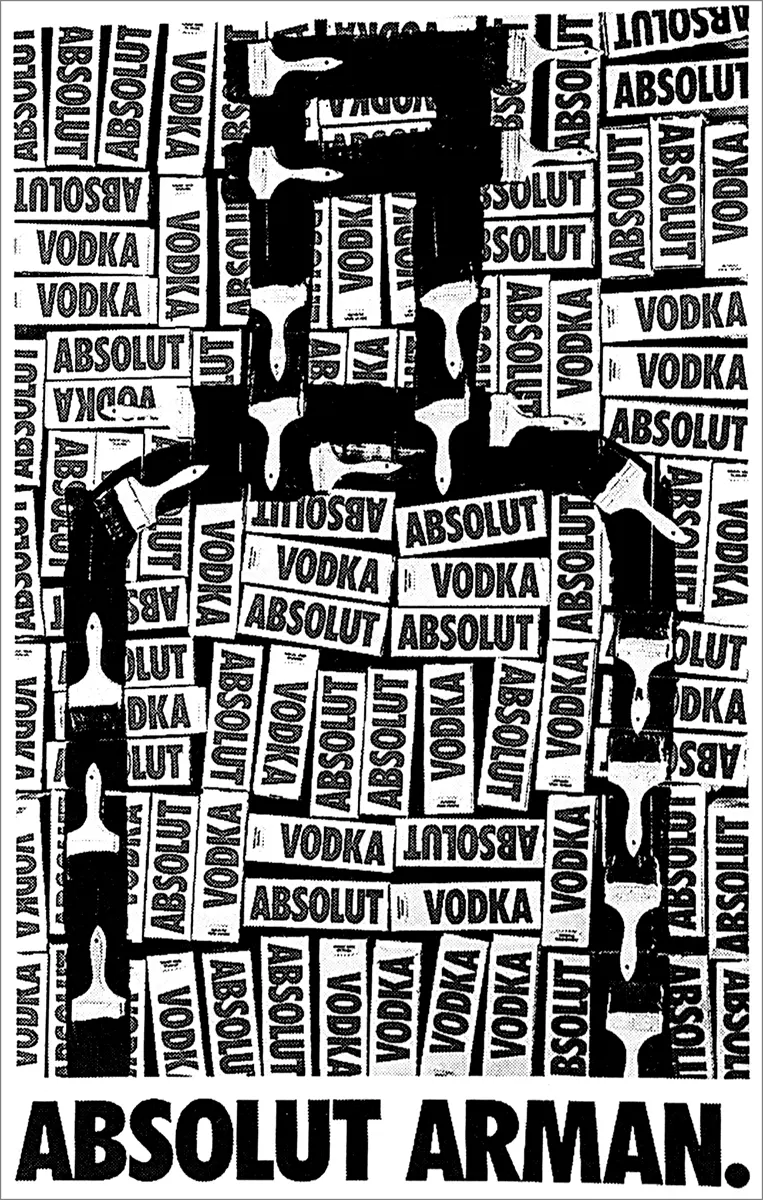
Some blame can be attached to the not always rigorous selection of artists asked to contribute to the campaign, and probably some to the selections made by the gallery curators. Then there is also the lack of imagination on the part of the artists themselves. Well-known figures like Edward Ruscha and Arman contributed acceptable, though unexceptional works. A picture by the Swedish artist Yrjo Edelman, reminiscent of Claudio Bravo, distinguished itself not just in its execution but because it offered a good solution in terms of advertising. There were also some surprising inclusions, such as that of Reverend Howard Finster, a North American "outsider" artist who communicates religious sermons through the medium of his pictures. His divine messages warn, among other things, that "cocaine can kill." He does not say the same thing about vodka, however. His contribution to Absolut will not help to save his soul, and it also seems to have ruined his naïveté.
Absolut does not have to take any major financial risks with this advertising campaign. According to Lewis, the author of the catalog, the payment made to Warhol constituted the maximum fee paid to artists, thus creating a hierarchy of fees determined by the artists' respective ranking in the market. The typical fee is between US$2,500 and 5,000. The advertisements are published selectively, often in small-circulation magazines with specifically targeted publics. Some works that have been commissioned and paid for are never published. There is a tendency to avoid political subjects or things that might be deemed offensive.2 Meanwhile, the collection is increasing, as is its monetary value. For the artist, the transaction constitutes a sale and some free publicity.
What makes the campaign interesting is that Absolut has managed to perfectly adapt the Renaissance practice of patronage to the late twentieth century. It seems to be only a matter of time before their strategies are adopted by stronger and more important companies. When the Chase Manhattan Bank or IBM form their art collections, or when Philip Morris or Mobil sponsor major shows, they are simply recreating traditional acts of patronage. The corporations try to establish an image for themselves synonymous with the refined nobility of the past. The advertising of their product is transformed from a sales pitch into a favor bestowed onto the consumer. Absolut, on the other hand, has managed to create a democratic and "worker-friendly» system of patronage, in which the patron's activity merges with that of the artist, in order to attract the consumer and share the benefits of his or her attention.
Part of the credibility of this process lies in the quality of the non-artistic campaign preceding it and which has accompanied the picture campaign. The artist appears as a guest participant in a task with previously established parameters of excellence. The artist is not asked to create good publicity, but to contribute to a respected institution that will remain respectable even if the artist's contribution is mediocre. The only risk run is that if the work on the vodka bottle is really good and derives its strength from the act of publicity, then the perception will change about the rest of the artist's oeuvre. The artist's reputation could end up tainted. Only Warhol was completely free from this danger, given his definition of his own work. In this sense, Warhol is the only case in which an artist has exploited Absolut, instead of being exploited by the commercial product.
In light of all this, it is possible that the Absolut art show might be more important than its initially frivolous premise suggests. The book written by one of the members of the advertising agency describes the collection and the campaign. The writing style is informative, explanatory, and deliberately gossipy, free of any controversial analysis.. As such, it is an indispensable reference for anyone interested in Absolut advertisements. But it lacks any sense of the critical distance and anthropological perspective this enterprise merits, which could help us understand better the enormous problem of hidden frontiers with which we are confronted today.
Not long ago, Oliviero Toscani, the photographer and publicity director of Benetton, asked sub-commandant Marcos to pose with his guerrillas for a Benetton advertisement. The letter written by Toscani to Marcos requested permission to photograph him with the men, women, and children of his group. It was an idea that illuminated the eyes and faces of those who were fighting to achieve their goal, Toscani explained. He went on to say that Benetton did not believe in the myths about beauty promoted by consumerism.3
What was offensive in Benetton's campaign over the years was not the social and political subjects used — at least not for those in the center and to the left of the ideological spectrum — but rather in the elimination of the boundary between ideological causes and consumerism. By using moral indignation to sell clothes, it was the indignation that became contaminated and not the clothes that became enhanced. The business has always had more power than ideology. With its campaign, Benetton managed to make one of the very few bastions of real activity left to the consumer, the faculty of expressing indignation — whether against the massacres in Bosnia, racism, religious dogmatism, or indifference to AIDS — into yet another product of consumption.
The oft-touted possible end of ideologies seems to be encapsulated in this act.
Although any discussion about Absolut necessarily involves another about Benetton, there is a rather large difference between the two. Absolut eliminates the distance between art and advertising, creativity, and applied creativity, by extending the one towards the other and vice versa. The quality of the advertising act makes it artistic and the artistic act becomes an instrument of publicity. Benetton, on the other hand, seems to transgress an ethical taboo by blurring the hitherto hermetic separation between corrupt consumption on the one hand and moral indignation on the other. Although another border is erased here, it is not by mutual expansion, but rather by invasion. The paradox is that to a certain extent, one of the desires of many artists of this century is thus being achieved: the elimination of the separation between art and life, the object and behavior.
The strategies of Absolut and Benetton are only a symptom of a more widespread breaking down of barriers that are forcing us to make a radical reassessment of how we look at what we call reality, and how we place ourselves not only in art but in life itself. Our ideas of nationality, for example, are being usurped by corporate multinationalism. One day we will have passports issued by Microsoft, Coca Cola or General Motors. The distance between the imaginative concept and its physical materialization is disappearing, thanks to the computer. Art is now reaching the point of becoming pure vision, without any need for support and without any artistic errors. Painting, sculpture, and other media are rapidly achieving the level of crochet: anachronistic impediments that slow down the imagination.
Virtual reality, for its part, is replacing, if not usurping, the reality that we consider as everyday and experiential. Coca-Cola's advertisement showing an elephant swimming underwater to steal a can of coke from the beauty sunning herself on a rubber float changes our whole conception of what we understand about elephants. The image is so "real" that we end up accepting it. Rejecting the image requires an investigation which most television views are not willing to undertake.
Many of the correlations we take for granted, such as the links between documentation and reality, reality and space, space and experience, experience and ethics, no longer function with their accustomed clarity. The points of reference formerly used to make decisions are out of focus or have ceased to exist, and an unanswered question arises: how can we reach ethical conclusions if the reality that serves as a reference for such an objective disappears? The real name for Absolut Vodka (nobody knows it) is Relativ Vodka. This is a piece of information that cannot be published. It would be an absolute statement and thus a contradiction.
NOTES
LUIS CAMNITZER
Uruguayan artist. Professor in the Department of Visual Arts, New York State University, College at Old Wesbury.