
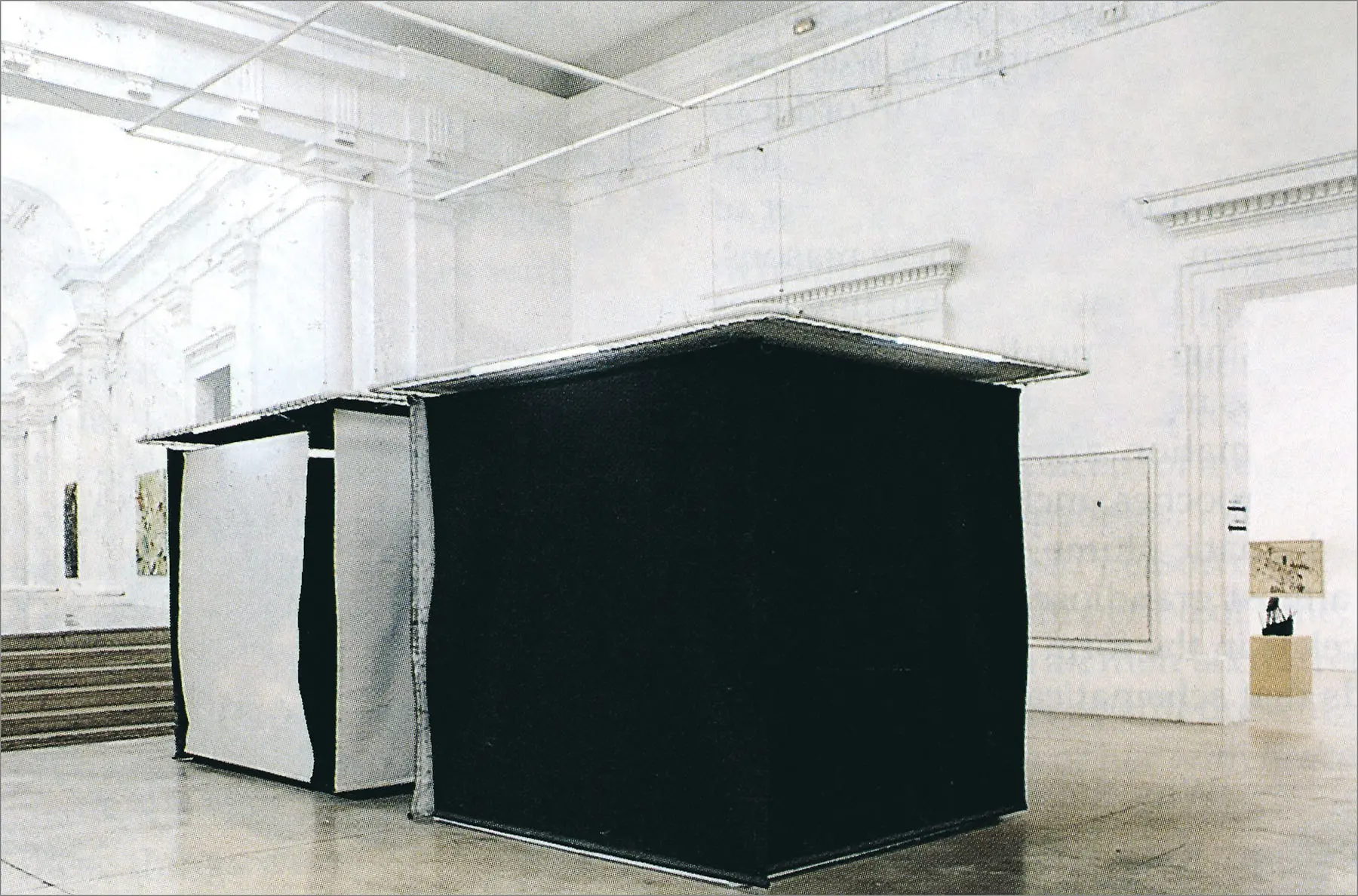
The first retrospective in the United States of Brazilian artist Cildo Meireles, opened at the Institute of Contemporary Art in Boston on January 29. Organized by IVAM and curated by Nuria Enguita and Vicente Todoli, the show traveled from Spain to the Fundagao Serralves in Porto,
Portugal, and completed its tour in Boston. The number of installations presented and objects showcased was reduced when the exhibition traveled from Europe to the United States.
Upon entering the exhibit, the spectator encountered some of Meireles’ landmark pieces, that are, by now, well known to Latin American audiences. Insertions into Ideological Circuits: Banknote Project and Insertions into Ideological Circuits: Coca- Cola Project, were radical gestures that in the early 1970s reconfigured the logic of the ready-made. Instead of inserting the commodity object into the gallery space, the banknotes and Coca-Cola bottles used by Meireles to write political messages that subverted the limitations of speech of the then dictatorial regime were returned to their original system of circulation. The artist thus pushed Duchamp’s gesture further, thoroughly questioning conventional modes of production, circulation, and reception of the art object. Enclosed in cases at the ICA the logic of the Insertions pieces was hard to grasp. The bottles of Coca-Cola resembled pieces of Pop Art, a movement that goes against the critical project of the Insertions given the celebratory dimension of the system that it initially may have sought to criticize.
Walking past these introductory pieces, the spectator had to go up a few steps to enter what should have been a space of great impact. Instead, Glove Trotter, 1992 a beautiful and poetic large piece by Meireles, made of a steel mesh that covers balls of different sizes and materials, was presented in a poorly lit space that did not allow for the subtle reflections of light that the metal mesh is meant to produce. Moreover, the openness of the piece, horizontal, radiating in terms of light and structure, was marred by the close proximity of another installation: Grey/Ash, 1984-1986.
In a way, it seemed as if these environmental pieces, which address issues of space crucial in Meireles’ work, were exhibited instead as objects. Grey/Ash, for example, consisted of two cubicles constructed of canvases painted with acrylic ink placed side by side. The canvases and floor surfaces within the two cubes were covered with black charcoal and white chalk, respectively. The floor was thus marked by a mixture of chalk and charcoal footprints when the spectator passed from one cube to the other. The desired effect of this passage was limited, however, due to the grey color of the floor and the mixing of materials which made the footprints difficult to see. Still, one marveled at the simplicity, and at the same time, the profound meaning of the piece which addressed the relativity of systems, of structures, of concepts, and of limits.
Two more installations were on view in this gallery. One could retrace one’s steps and go down a level to encounter a series of works titled Virtual Spaces: Corners I, II, IV (1967-1968), or one could go up a level to enter a gallery installed with a series of objects and yet another installation. The Virtual Spaces are stretched canvases mounted onto wood structures that imitate corner spaces and defy the conventionality of utilitarian architecture. The irregularities that these "abnormal" spaces celebrate have to do with the absence of a ninety-degree angle uniting the two "walls" represented by the stretched canvases and by the constant breaking of the straight line that constitutes the moldings of standardized architecture. As Meireles himself has commented, "The cantos (corners) were places where there was no action..". And indeed, away from the instrumental structure of conventional architecture, Virtual Spaces become a locus of reflection. Unfortunately, though, the way this work was installed precluded a dialogue with the surrounding space.
The upper gallery offered the most satisfactory work in terms of installation and effect. Volatile, designed in 1980 but not produced until 1994, consists of a closed room whose floor has been covered by a one-foot layer of talcum powder. As one entered the dark enclosed space, barefoot and smelling what seemed to be a gas odor, a subtle reflection coming from an adjacent space became apparent. One walked toward the reflection through the cold and soft talcum powder to encounter, at the end of a rather large room, a small candle from which a vaporous light emanated. The effect was extremely sensual, although some critics prefer to emphasize the violence suggested by the false natural gas smell and the presence of fire. This piece was carefully installed and its powerful environmental quality contrasted with the individual objects exhibited outside the room. In contrast to the Insertions pieces discussed above — works whose inadequacy in the white cube seems to be the consequence of their rejection of the exhibition system — the pieces are shown in this upper gallery seemed to be nostalgic vestiges of a once radical practice. Their scattered quality (and installation) may be read as a refusal of coherence, continuity, argument, and narrative, of western desire for control and obedience to the logos — an aspect of Meireles’ work that one would have expected to be conveyed to the spectator through a more sophisticated installation.
Finally, at the Carpenter Center of the Department of Visual and Environmental Studies Harvard University, one could see the impressive piece Missäo/Missões (Howto Build Cathedrals) from 1987. The installation was composed of a thick layer of coins placed on a square area joined to a ceiling structure from where 2000 bones hang on a column of altar hosts. The three layers of the structure create a clear connection between economic power, religious power, and the genocide of Indians prompted by the colonialist missionaries deployed on the American continent after the "discovery." In the flesh, the piece seems to lose a bit of the mysterious quality that it conveys in photographs. However, the poetics of this theatrical space was strongly felt once the spectator stepped onto the floor of shiny coins illuminated by the light coming from the hanging bones.
Ultimately the show is a welcome event for those interested in surveying Meireles' oeuvre. For American audiences and academics so fond of the rhetoric of “institutional critique" the show provides examples of alternative critical practices that respond to geopolitical situations different from those of the United States and Europe. Meireles' complex questioning of the epistemological structure of a rationalized social system is refreshing in the face of a pervasive trust in the referentiality of the object among contemporary artists.
MONICA AMOR
She is a candidate for the Ph.D. Program in Art History at the Graduate Center of the City University of New York. She is Editorial Advisor for ArtNexus in the United States.