Most European and North American histories of modern art ignore the presence, not to mention the contributions of Latin American artists and artistic movements of the first half of the century. These artists and their work, that which they produced in Europe during extended stays in Italy,
France, and Spain and the one they made upon returning to their native countries, are practically invisible in all metropolitan narratives of "international" modern art. Although the reasons for this state of affairs are complex, there are two arguments often cited for excluding Latin American modernisms from histories of modern art. One is that the art produced in Mexico City, Buenos Aires, São Paulo, or Havana stands literary on the periphery of Western civilization as seen from its modern center in Paris. The other related argument is that the modern art of Latin America is just a derivative of European paradigms.
The theme of my paper is a reevaluation of the relationship between Latin American modernisms and European modern art of the first half of the century. (Although there are certain similarities in the art of some Latin American countries from the 1920s through the 1940s, there is no such thing as a homogeneous Latin American modern art given the differences of these nations' cultural traditions, histories, and political systems. Thus I refer to Latin American modernism or vanguards in the plural). I approach the subject through a review of the traditional formalist concepts of "center-periphery" and "influence", specifically in the context of twentieth-century European- Latin American cultural relations.
The traditional art historical approach of mapping out a period in terms of an art center or metropolis in which artistic styles and practices originate and then radiate to a peripheral or regional outpost is a rather simplistic model of cultural colonialism. The concept of a "...linear contraposition between a center that irradiated light and a periphery", as framed by Chilean critic Nelly Richard, is a formula made in Europe for controlling exchanges of value and power between it and the rest of the world.1 This metropolitan formula does not fully explain the complex relationships between European and Latin American modernisms (c. 1920-1950). At least two major flaws with this theory of cultural dependency: it assumes that Latin American artists were strangers to the metropolis and that they merely re-created derivative versions of the School of Paris.
I
To begin with European culture lies at the origins of Latin America and is not something completely foreign as it may be in Asia or Africa. Due to centuries of all-out colonization, Latin American cultures are part of Western civilization, although they are also modulated from within (Amerindians) and without (Africans, etc.) by non-Western civilizations. The contact of Latin Americans with Europe has been extensive, and since at least the nineteenth century the former have engaged in that contact aware of their difference from Europeans. With independence and the rise of nationalism, the sense of being different from Europe increased. Thus when early twentieth-century Latin American artists interested in innovation went to Paris, they may have been paying homage to the concept of that city as the metropolis of modernism with all of its colonizing implications, yet they went there highly conscious of their identity as Mexicans, Argentinians, Brazilians, or Cubans. It was an identity that implied not only difference but familiarity. Both the fact that they were there in the metropolis and that it was not totally foreign to them, upsets the orthodox sense of distance and otherness implied in the contact between center and periphery.
For over three decades —from Diego Rivera's arrival in 1911 to Wifredo Lam's in 1938— Latin American progressive artists kept a presence in Paris, studying fraternizing, making, and exhibiting art. The pioneers of Latin American modernisms lived in the center, were in direct contact with the Parisian avant-garde, and were artistically active in that city.2 Artists such as the Argentinean Emilio Pettoruti (1892-1971), moved easily from Futurism to Cubism and then to Purism in contact with the leading figures of those movements. The Brazilian Tarsila do Amaral (1886-1973) studied with Andre Lhote and Fernand Leger in the 1920s; her drawing titled Black Woman, a synthesis of modern aesthetics and Brazilian content was used on the cover of Blaise Cendrars Feuilles de la Route (1924), and in 1926 she had a successful one-person exhibition at the Galerie Percier. The Cuban Amelia Pelaez studied with Russian Constructivist Alexandra Exter, participated in the Salon des Tuilleries and the Salon des Independents, has a well attended one-person show at the Galerie Zak (1933), and illustrated books like Leon- Paul Fargue's Sept Poèmes (1934). The exhibition of these Latin American artists was reviewed by leading critics of the day and often in favorable terms; Andre Salmon wrote in the Parisian journal Gringoire (May 12, 1933) that Amelia Pelaez del Casal was a painter who from the start belonged to the ranks of those whose careers are worth following. Departing from Picasso's inventions, this painter has found the expression of her own personality. The color and tonality (of her paintings) are absolutely hers. These are just a few cases of the active presence of Latin American artists in the center of high modernism. A landmark of that collective presence was the Exposition du Groupe Latino-Americain de Paris at the Galerie Zak in April of 1929, which included twenty artists.
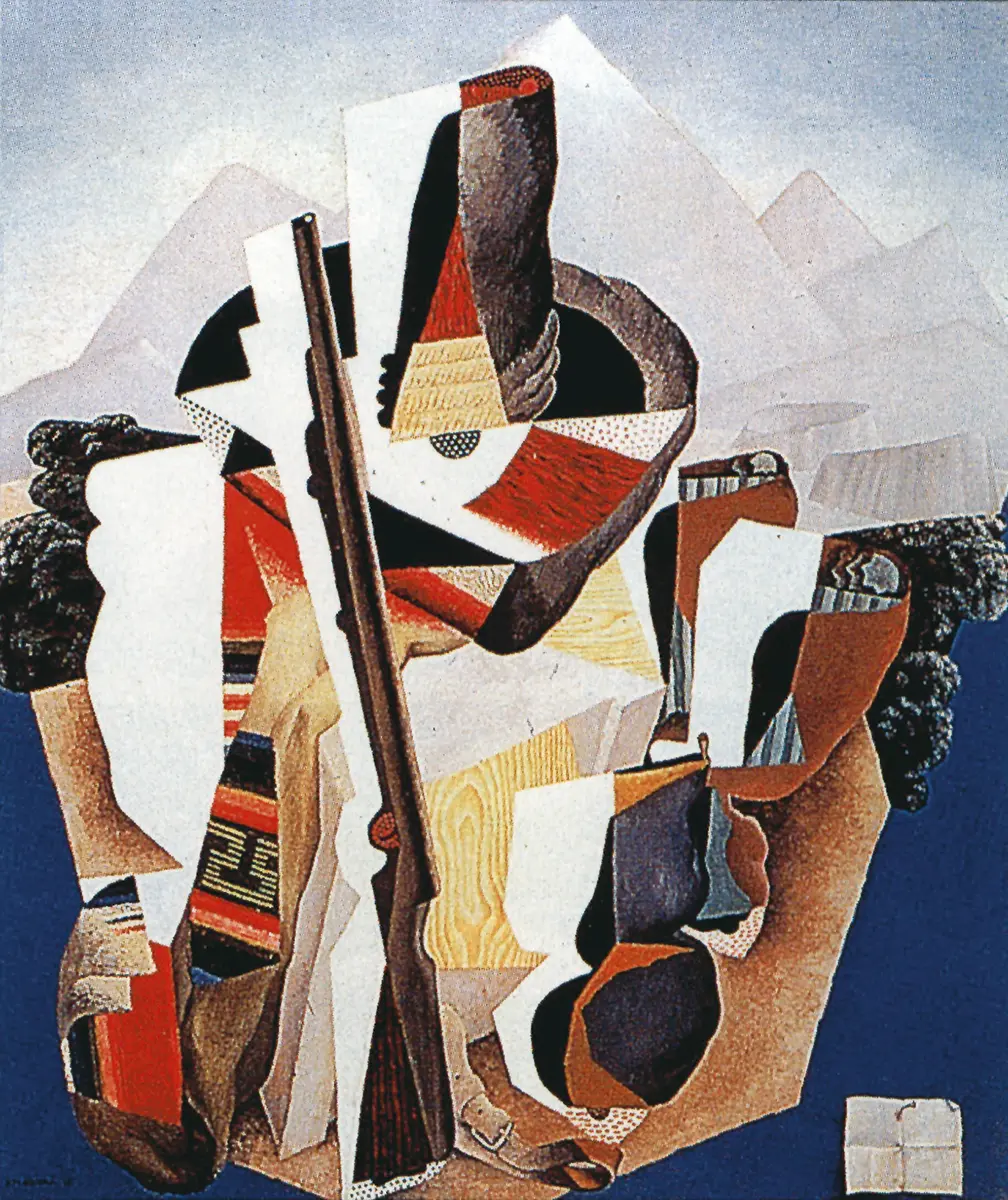
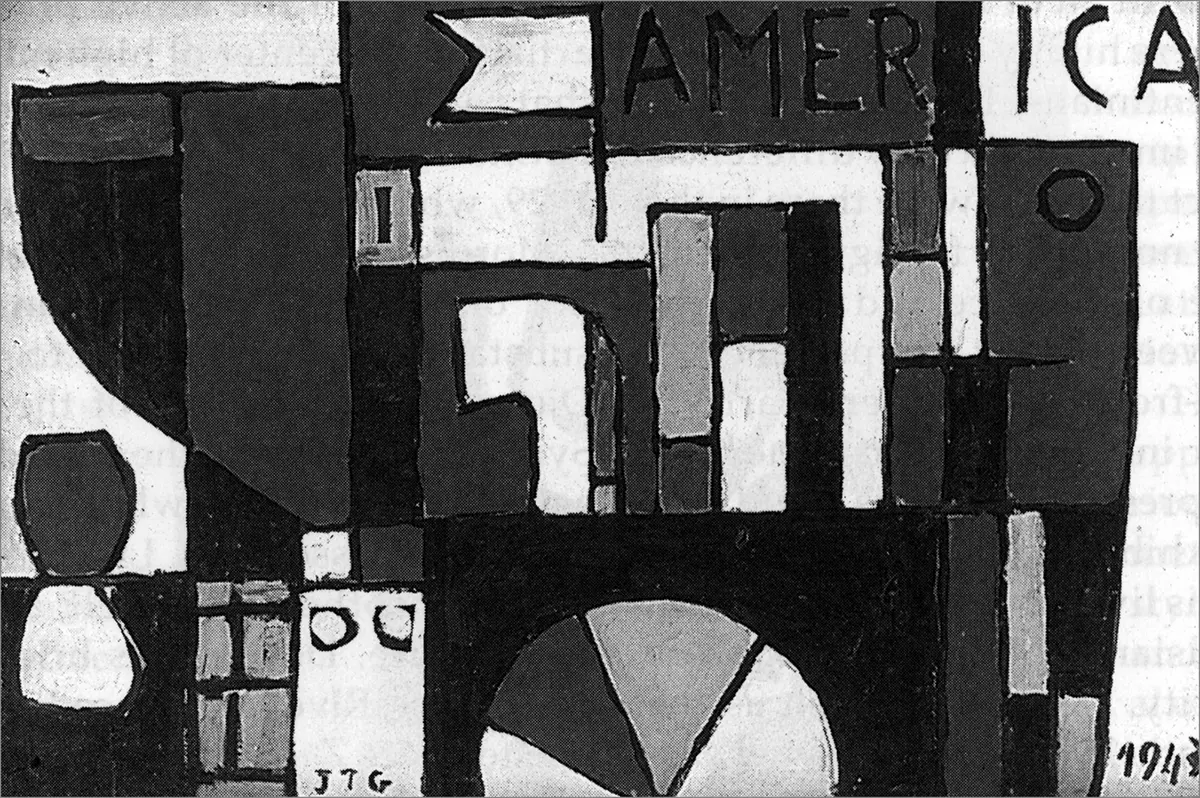
More significantly some Latin American modernists not only joined the Parisian avant-garde but made substantial contributions to European modernism/. Diego Rivera was one of the leading practitioners of Synthetic Cubism in the period of 1912 to 1917, when he associated with the whole range of Cubist artists including Picasso, Gris, Lipchitz, Delaunay, and the Duchamp brothers, as well as their champion critic Apollinaire. During this brief, but the intensive phase of this career, Rivera produced over 200 works. His Cubist masterpiece Zapatista Landscape (1915), inspired by revolutionary events happening in his homeland, expanded the parameters of Cubism at that time to include significant content in the symbolization of nationalist Mexican ideology. Also, Rivera's break with Cubism in the spring of 1917 and his return to figuration anticipated shifts by other artists away from cubism after World War I. Another pioneer of Latin American modernisms who had an impact on abstraction was the Uruguayan Joaquin Torres-Garcia. He, along with the French artist-critic Michel Seuphor, founded the review and group Cercle et Carre (1929- 1930), which in April 1930 organized one of the largest international exhibitions of abstract and non-objective art. It included the works of Arp, Kandinsky, Le Corbusier,
Leger, Mondrian, Ozenfant, Pevsner, Schwitters, the American Joseph Stella, Sophie Taeuber-Arp, Torres Garcia, and Vantongerloo. Torres Garcia's own version of Neo-Plasticism developed around 197-1928, expanded the limits of this modernist aesthetics to include symbolic figurative ideograms, borrowed mostly from Pre-Colombian art.
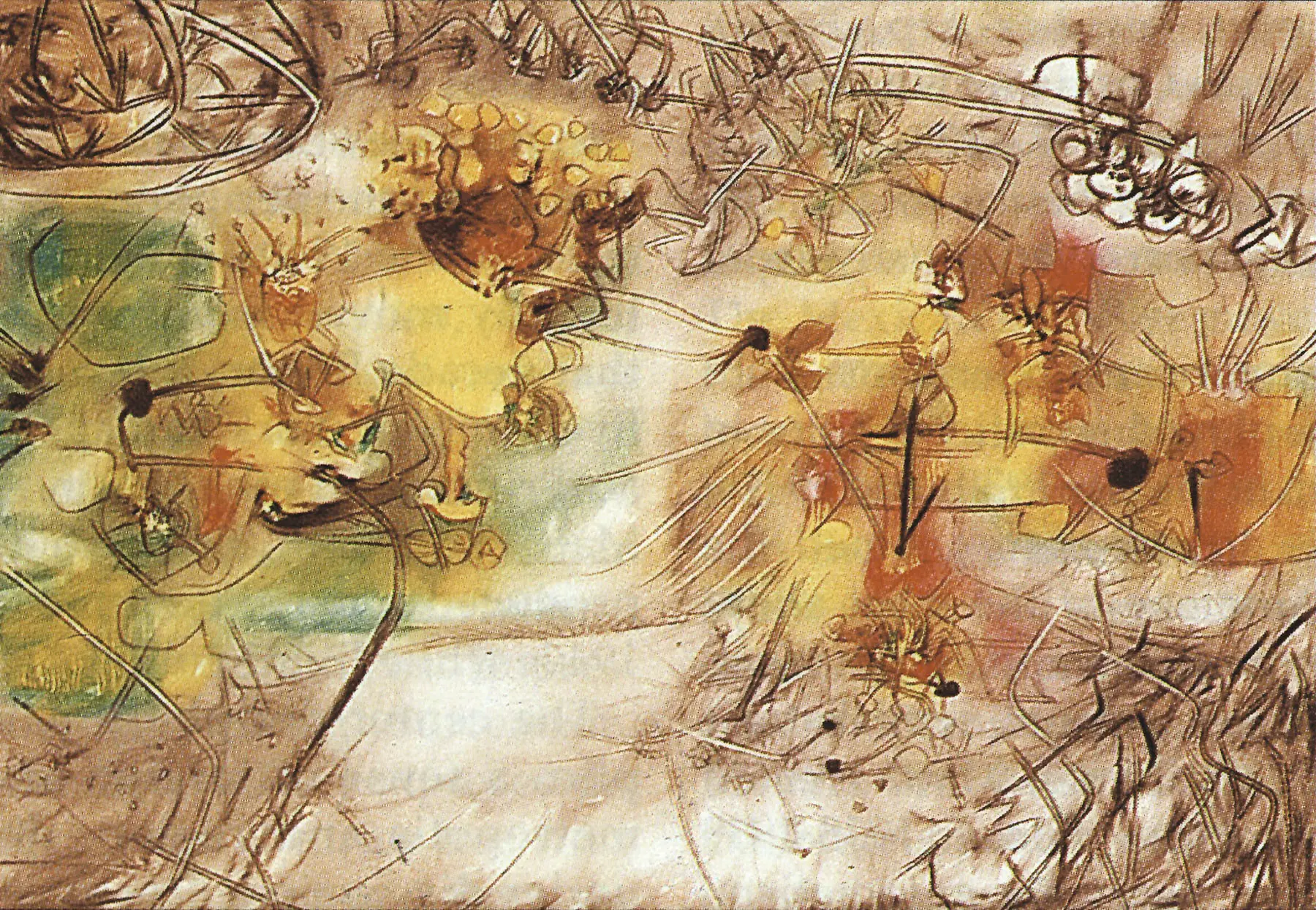
Two other pioneers of Latin American modernisms, Roberto Matta and Wifredo Lam, played significant roles in the development of Surrealism in the late 1930s and 1940s. The Chilean-born Matta (his artistic name) joined the group in 1937 and soon became one of the most adept practitioners of Surrealist biopharming and automatism. Departing from Arp's and Miro's organic, semiabstract shapes and Tanguy's desolate landscapes Matta created luminous, burning, liquid "inscapes," which in 1938-1939 brought new life to the practice of psychic automatism. Because of the worsening political situation in Europe, Matta went to New York in 1939, where the Surrealists had already formed a significant group, during the New York period (late 1939- 1948) Matta created some of his most important works and played a crucial role in the evolution of Abstract Expressionism.
Charismatic and able to communicate in English, Matta shared the Surrealist method of psychic automatism with William Baziotes, Arshile Gorky, and Robert Mother well.
These and other emerging United States artists made automatism a pivotal technique of action painting. Matta also kept a presence in New York through regular individual shows at the Pierre Matisse Gallery.
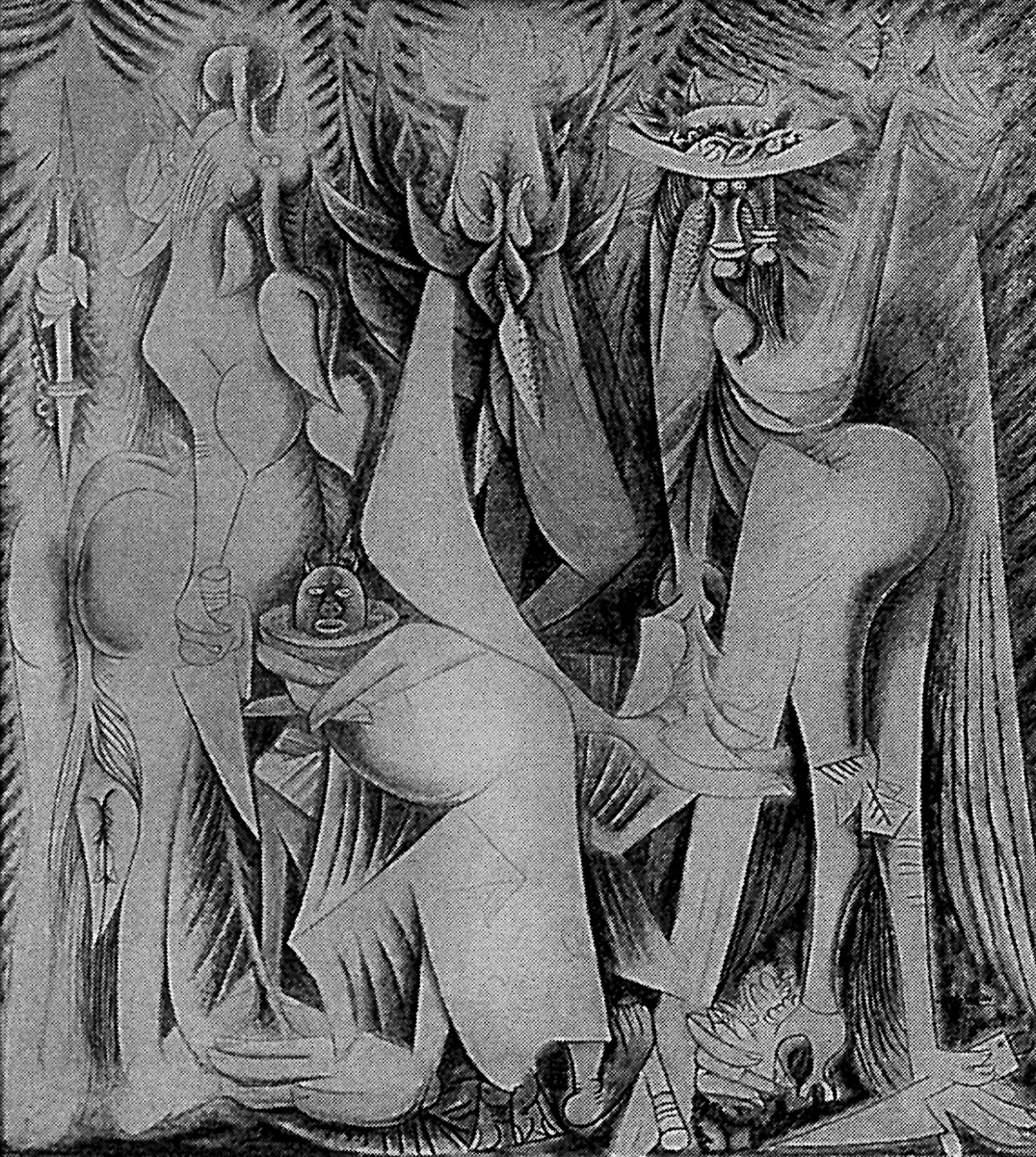
Wifredo Lam was the last of the historical Latin American vanguard artists to arrive in Paris in 1938. He came with a letter of introduction to Picasso, who befriended Lam and introduced him to the Parisian avant-garde. In 1940 Lam joined the Surrealist group in Marseilles, where he illustrated Breton's Fata Morgana, with other refuge intellectuals, Lam fled Europe in 1942 and returned to his native Cuba. There he developed his mature vision inspired by the rediscovery of his Afro-Caribbean heritage and the region's tropical vegetation, as seen in one of his masterpieces, The Jungle (1943). Lam's affirmation of Afro-Caribbean culture, encouraged by Surrealism, introduced a viable non-Western ethnic identity into European art. Lam kept a presence in New York during the 1940s through regular one-man exhibitions at Pierre Matisse Gallery and visits after 1946 to that city and Chicago. Although Lam did not participate directly in North American artistic developments, his work of the early 1940s has intriguing affinities with that of Pollock and other New York artists searching for an American art incorporating primeval myths.
In the case of Surrealism, the relationship between the center and the periphery is particularly problematic because in the 1940s, due to World War II, the movement literally moved from Europe to the Americas. During that decade Breton and many of his close collaborators lived in New York and spent time in Mexico City, Port- au-Prince, and other Latin American capitals. Not only Matta and Lam but also Ernst, Tanguy, and Masson produced some of their most important paintings in the 1940s while living in the Americas.
The center-periphery paradigm, in so far as it implies a sense of foreign and distant contact between metropolis and region, does not apply to the case under discussion. The artists who comprised the historical Latin American vanguards were for the most part of at least partial European descent, were raised in a culture which through colonization was partially or mostly European, and themselves lived for a period of time in the center. Furthermore, although they did not "invent" any new styles, they did transform those that they appropriated. In some cases, artists such as Rivera, Torres Garcia, Matta, and Lam transformed their European models to such a degree in the direction of expressing their own cultural and personal perspectives, that they created new definitions for international modernism.
II
When the pioneers of Latin American modern art returned to their native countries and challenged the still prevailing academic art, they did not replace it with mimetic versions of the School of Paris, but with non- submissive movements integrating formalist aspects of European modernism with Latin American content. One of the most problematic issues relating to the center-periphery model is that of "derivative" art. According to modernist formalist cannons, modern Latin American art or any other peripheral modernisms are derivative because they were influenced by European art. Such a methodology values, or rather devalues, Latin American modernisms founded on a purely aesthetic basis, emphasizing static notions of influence and its corollary, the sterile practice of source-hunting.
The "influence" of Europe upon the United States culture is an issue being revisited today. Its complexity and dynamism have been aptly framed by the Americanist art historian Roger B. Stein:
"The student of American and regional culture knows that measuring the impact of 'Europe' —what we have borrowed, what e have created anew, how and in that waps we have accepted, rejected, or modified both the content and the form of our parent culture —has been a continuing question, one that is always ideologically loaded, and frequently a self-conscious process."3
The most significant aspect of the process as suggested by Stein is that it is not passive or mimetic, but rather an active and selective strategy. The Latin American historical vanguards encountered modern art from Post-Impressionism to Cubism, and in some cases through Surrealism, all of a sudden, and mostly after de fact. They explored the whole gamut of modernist styles and theories free from the perspective of historical development and from the strict parameters artistic movements follow in their initial stages. For instance, with the exception of Rivera, all of the other Latin American artists interested in Cubism, like Petorutti, Amaral, and Pelaez, came to it long after it was an avant-garde style. Rivera himself upon breaking with Cubism went "back" to the study of Cezanne. Torres Garcia developed his version of Neo-Plasticism in the late 1920s, over de decade after the movement's inception. Both Matta and Lam made their most important contributions to Surrealism in the 1940s, well after the movement erupted in Paris in 1925. In this way, the relationship of the Latin American vanguard to the art of the Metropolis cannot be dismissed as a provincial imitation of the latest fashions. These artists often borrowed from artists and movements that were no longer fashionable.
The active and selective approach of the Latin American vanguard artists to European modernism is best exemplified, however, by the fact that they "accepted, rejected, or modified both the content and the form" of the art of the center. As noted earlier, Rivera introduced Mexican themes into his cubist paintings. At that moment he accepted cubist aesthetics and rejected its customary content of Parisian bohemian life. He modified that European style to serve his purpose of expressing a Mexican sense of place and identity. He negotiated a balance between the Latin American and the European, the periphery and the center. A painting such as Zapatista Landscape (1915) creates a new space for the periphery in the center. Rivera's work after his return to Mexico in 1921, goes further in tilting the balance towards the regional or national, positing its value above or at least on a par with the metropolitan and international. The Mexican muralist movement of the 1920s, as represented by Rivera, Clemente Orozco, Alfaro Siqueiros, and others, is far from a derivative of European modernism. In fact, it represents a return to illusionistic-figurative painting as well as to public-social art. It is not, however, an antithesis of the European avant-garde. It took advantage of the lessons of cubist composition (Rivera) and expressionist distortion (Orozco and Siqueiros), and it was a socialist art with a utopian vision. The Mexican muralist movement, the most influential of the Latin American vanguards, was highly successful in locating the national and regional within the larger context of international art and ideas.
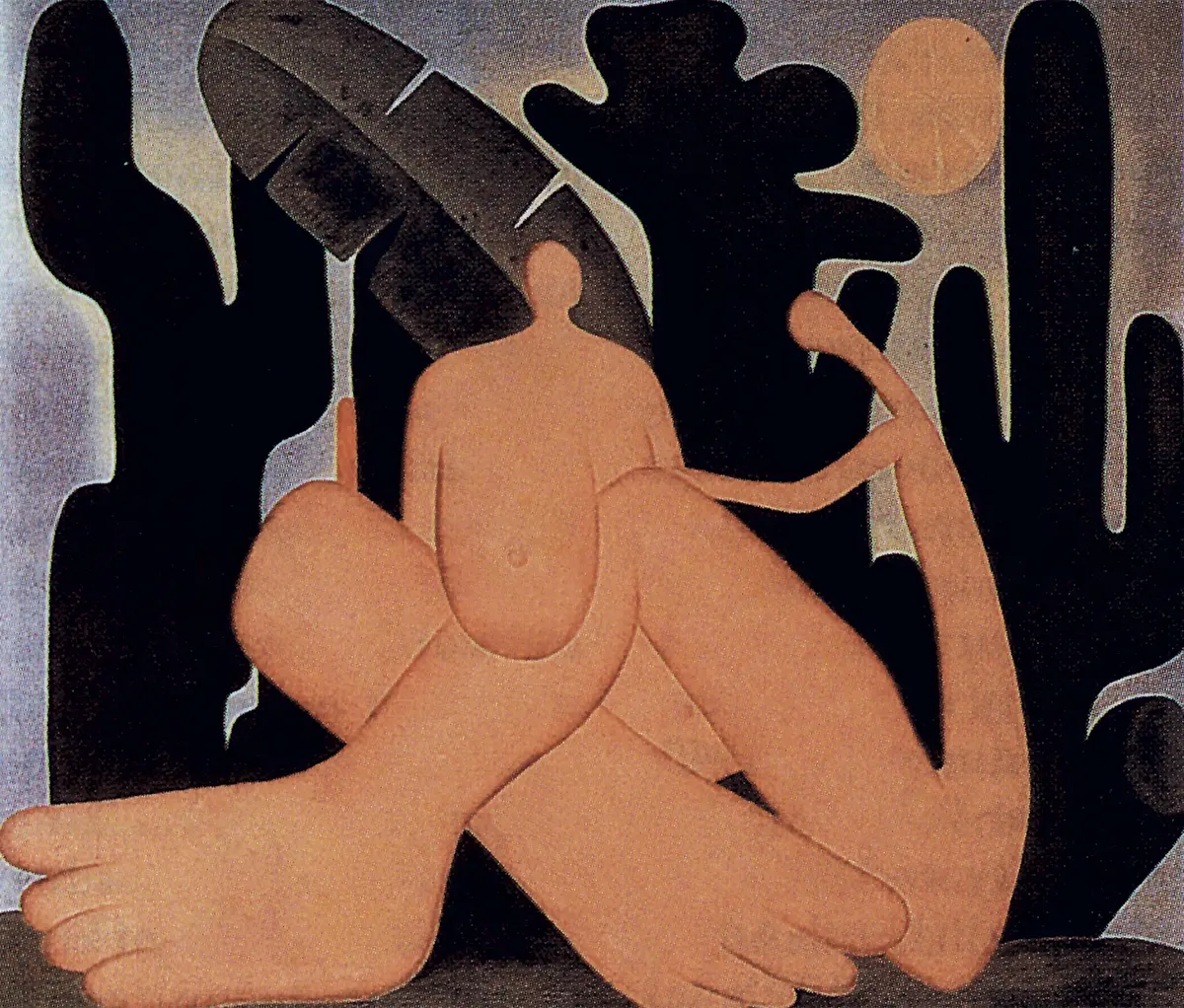
In the cases like Brazil and Cuba, where the Parisian avant-garde had a greater effect in regard to formal influences, the relationship was still not a mimetic one. A complex modernist movement emerged in Brazil with the Modem Art Week of 1922 in São Paulo, which included exhibitions, poetry readings, concerts, and lectures. A group of wealthy intellectuals, artists, and poets developed an aggressive mix of the national and the European for an elite audience. The poet and leader of the group, Oswald de Andrade, wrote in the Pau-Brazil Poetry Manifesto about a mixed national identity: "The Carnival in Rio is the religious outpouring of our race. Pau-Brazil. Wagner yields to the samba schools of Botafogo. Barbaric, but ours. Rich ethnic mix. The richness of vegetation. Minerals... On the other hand, there is ...the learned side. The fate of the first white colonizer, the political master of the virgin jungle. The graduate. We can't stop being learned. He then concluded:... We have a dual heritage the jungle and the school"4. This complex version of Brazilian nationalism acknowledges the problems of colonization and the tensions within a mixed culture. In the early 1920s Amaral, the leading painter of the movement, grave visual expression to these ideas by accepting the aesthetic language of the colonizer and modifying its content to express the dual heritage of her native land: the "jungle" (Black Woman, 1923) and the "school" (Central Railway of Brazil, 1924) Later in the Anthropophagite Manifesto of 1928, Andrade proposed a selective "cannibalism" to devour the colonizer "in order to transform him to the totem."5 This more transforming attitude to hegemonic European culture is also given a visual dimension in the art of Amaral, whose paintings of the late 1920s, such as Antropophagy (1929), are fresher and more independent in form and content for having consumed and digested its European sources more thoroughly.
The wave of political and cultural renovation that swept Latin America in the 1920s and led to the emergence of the different Latin American vanguards was represented in Cuba by a generation of middle-class intellectuals, writers, and artists who in regard to culture, aimed for a definition of the national and its integration into the international/. Like their Brazilian counterparts, they realized that the Cuban identity was a mixture of Europe/Africa, modern/premodern, center/periphery elements. To the large extent that this complex identity was a result of the interaction between the regional and the metropolitan, the Cuban vanguard's motto was, in the words of the Cuban poet and communist leader Juan Marinel- lo, "to view the indigenous (Spanish-African popular culture) with the eyes of foreigners and to view the foreign with Cuban eyes."6
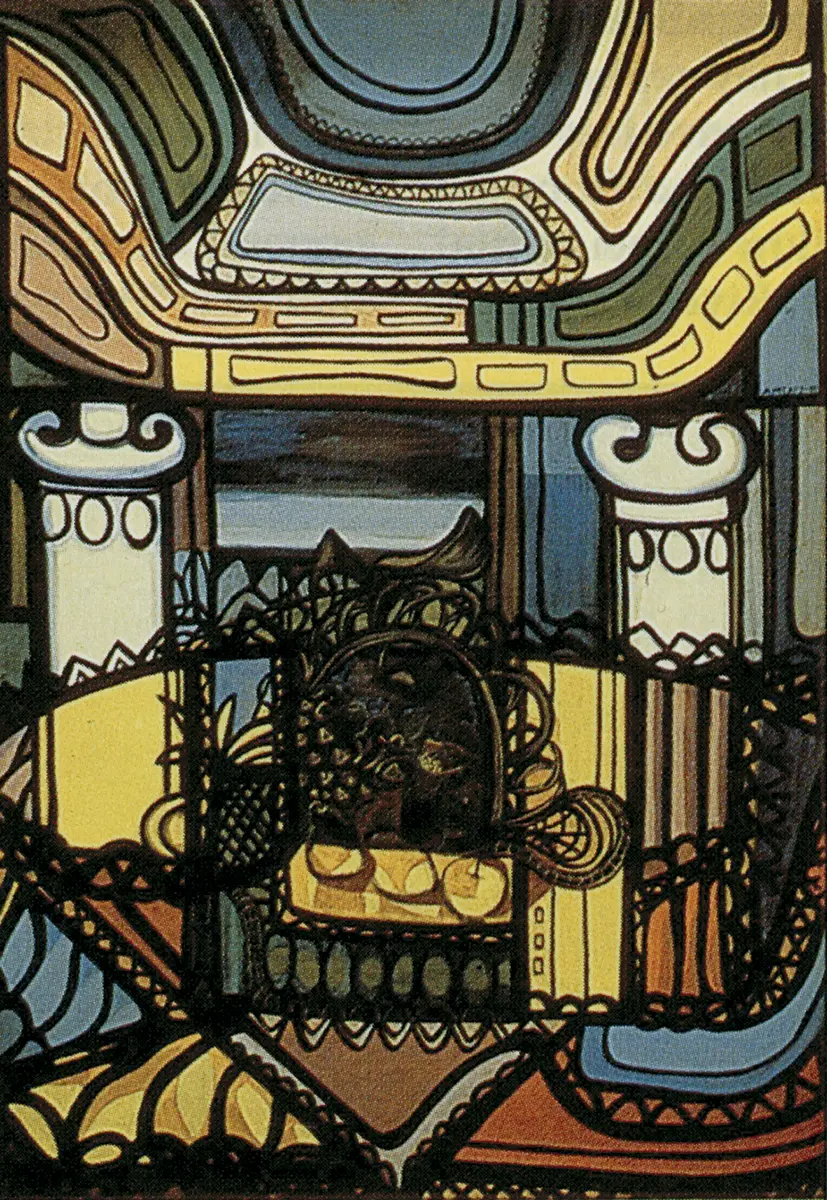
In the visual arts, for instance, in the works of Pelaez and Lam, this translated into the selective appropriation of European forms and views to make Cuba and the Caribbean visible and knowable (beyond the exotic playground and sugar plantation) to the rest of the world. Pelaez's paintings of the 1940s are inspired by Cuban domestic interiors and architectural decoration signifying an upper-class creole space and a way of life different from Europe. The images of her mature paintings are actually a subtle integration of the regional and the metropolitan on the same level. She viewed Cuban traditional architectural decoration, such as the combination of stained-glass windows and wrought-iron grilles, through the eyes of Synthetic Cubism and Matisse's decorative style. Yet she also saw these Parisian modernist styles through the eyes of Cuban architectural decoration, which was a part of her daily experience since childhood. The successful coupling of the regional and the metropolitan also holds true for Lam, who emphasized the African side of the Cuban identity. Lam appropriated Picasso's forms and Surrealist metamorphoses to signify the African presence in Cuba, the Caribbean, and the Americas. As noted by the Latin Americanist art critic Gerardo Mosquera has noted, Lam is "... the first artist to offer an overall vision of the African element in the Americas in the history of gallery art". Moreover, his art represents "the first vision ever in modern art from the standpoint of Africa within Latin America".7 Lam used his intimate contact with Surrealism and the Afro-Cuban world, seeing each with the eyes of the other, to make known and habitable part of the Americas in Europe. Surrealism's strong interest in non-Western cultures (questions of exoticism aside) encouraged Lam and provided him with a space in the center for the expression of his own ethnic Afro-Caribbean identity.
The historical vanguards from Latin America, of which only three are discussed here, are anything but derivative of or passively influenced by European culture and styles. The pioneers of Latin American modernism played an active role in receiving, selecting, and adapting European modernism to new ends.
Furthermore, as it has been shown in anthropology, and for that matter in history, any intercultural relationship, even one based on domination, is a give and take. Modern art from Latin America is neither imitative nor original, but, in the words of the Argentinean- born cultural critic Nestor Garcia Canclini, a "cultural hybridism."8 A mix of the traditional and the modern, the regional and the metropolitan, the popular and the elite, the Western and the non-Western.
Ill
Octavio Paz's definition of a Latin American as "a being who has lived in the suburbs of the West in the outskirts of history," is precisely the case with the Latin American vanguards and the history of international modernism.9 Actually, the only modernist movement from Latin America to be on the outskirts of North American and European modern art histories is the Mexican Muralist movement; the others lie invisible somewhere beyond suburbia. Postmodernism postulates that there is a crisis in centered modernity and a tendency to decentralization under the pressure of the peripheries that live within it. This position offers an opportunity to correct cultural imbalances and historical amnesias. It is about time that histories of international modern art acknowledge the contributions of Latin American artists to the School of Paris and the fact that the early Latin American vanguard movements are more and less a part of Western modern art
NOTES
1. Richard. "Postmodern Disalignments and Realignments of the Center/ Periphery", Art Journal (Winter 1992) 4: 57.
2. There is little published in English (and for that matter in any language) on the pioneers of Latin American modernisms the historical vanguards, see: Dawn Ades Art in Latin America (1989): Valerie Fletcher at al. Crosscurrents of Modernism (1992); and Waldo Rasmussen ed. Latin American Artists of the Twentieth Century (1993).
3. Stein, "Packaging the Great Plains: the Role of the Visual Arts", Great Plains Quarterly (Winter 1985) 1:8.
4. Andrade, "Pau Brazil Poetry Manifesto", reprinted and translated in Ades, Art in Latin America, (310-11).
5. Andrade, "Anthropophagite Manifesto", reprinted and translated in Ades, Art in Latin America, 312-13.
6. Marinello. "Nuestro arte y las circunstancias nacionales". Cuba Contemporanea (April 1925): 298.
7. G. Mosquera. "Wifredo Lam", Art Nexus (March 1995), p. 74.
8. Garcia Canclini, Culturas hibridas (1990).
9. R. Guibert, Seven Voices (1972).