Perhaps we should accept that an installation is like a musical score, an operational schema which, in the absence of the artist, should be interpreted by the instrument(s), orchestrated for the occasion. It is obvious that an installation does not have the same degree of autonomy as a traditional painting or piece of sculpture. To show such works means basically arranging them in a suitable room, with appropriate lighting, and although risks may be taken in a correct context, there should be no intervention in their intimate materiality. To exhibit an installation, however, implies first of all making a decision about its materiality. And such decisions become increasingly dramatic in the absence of the artist.
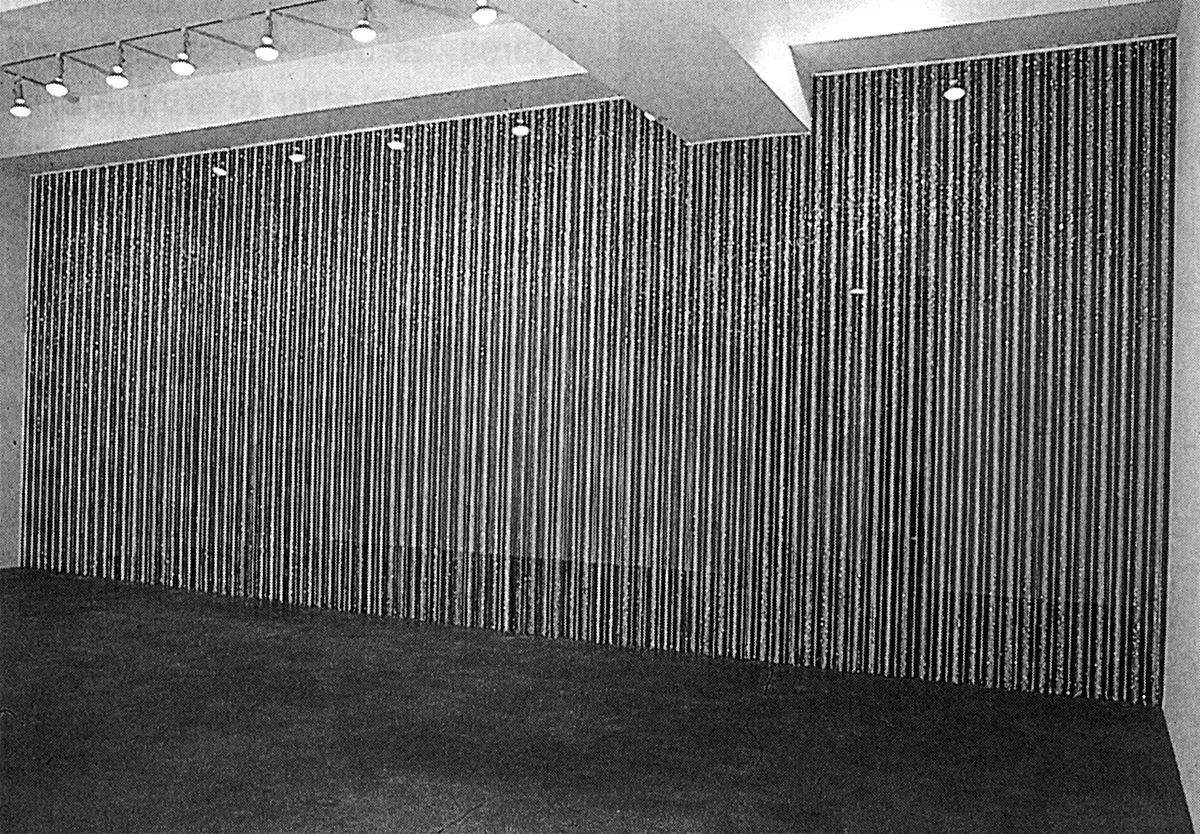
It might be said that this simple fact was very evident in the show of work by Félix Gonzalez-Torres presented recently at the Andrea Rosen Gallery — so much so that it was perhaps even one of the most interesting aspects of the exhibition. The problem was a simple one: to present, in the artist’s absence, the work Untitled (Beginning) (1994), one of the handsome "curtains" designed by the Gonzalez-Torres, originally commissioned by ArtPace, a foundation for contemporary art based in San Antonio, Texas. In general, Gonzalez-Torres's ■•curtains- are arranged in the upper frames of relatively narrow spaces, such as the empty frame of a door. In this case, it was decided to let the curtain across the entire gallery, from one end to the other, dividing the space literally down the middle. The degree of freedom undertaken in the installation of the work was comparable only to the effectiveness of the result: crossing the gallery like an enormous metallic mesh, the oscillating and iridescent extension of the green and silver curtain made the spectator feel as if he or she was in the presence of some caressing breeze or gentle sea. Crossing the curtain was like venturing into some unknown part of one's own body. The Beginning of the title returned us to some marvelously banal and metaphysical time. It was not simply a matter of crossing one space and entering into another - an effect which would have been inevitable had the work been placed in a more conventional manner. But installed as it was here, it replaced the communication between two previously delineated spaces in favor of inventing with the body the space which was being penetrated. It was, at the same time, like experiencing the unveiling of the being to which contemporary philosophy refers —like seeing Bambi jump over a cascade in an enchanted forest. The installation reduced the clarity of the work's references—already fairly clear to South Americans— from the classic green curtains usually found in the doorways of houses in the country (thus making more complex the wink to popular culture) to the readymades and minimalist art so prevalent in Gonzalez-Torres’s work.
Gonzalez-Torres was an artist concerned with such questions as the legitimacy and validity of the conventional concepts of author, authorship, and, of course, authority. His work, like that of few other artists, seems to offer a generous scope for being interpreted, re-read, and transported intellectually from one context to another. But these operations, which are all of a mental kind, should be accompanied on some occasions by their physical counterpart since, at the curatorial level, a re-reading necessarily implies a certain modification of the work’s materiality. This recent show at the Andrea Rosen Gallery was a felicitous demonstration of the efficiency of an operation of this kind, and of the literal scope of its many theoretical implications.
CARLOS BASUALDO