
For those who are accustomed to visiting major international events such as the Biennials of Venice or São Paulo or the Documenta of Kassel, the Cuenca Painting Biennial is undeniably something much more modest, a kind of popular fiesta.
It is exactly this lesser status that gives Cuenca its undeniable importance. The major events tend to consecrate the art object, with the institutional aspect imposing its truth, along with the provocation that exists in contemporary art. When seen in Cuenca, however, art loses its authoritarian character and proposes a permanent dialogue with the spectator. It is evident that such a situation inevitably gives rise to other problems since it calls excessive attention to the presence of the setting. But this does not invalidate the action of art and it is always pleasant to wander through a city as small and delightful as Cuenca and discover spaces presenting different works from the Biennial.
There is no doubt that the organizers of the Biennial deserve all our congratulations. This is one of the rare opportunities we have to present a selection from the contemporary production of our continent - and this merits the support of us all. However, there are a number of points that require analysis and debate. The discussion of art through techniques is an anachronistic practice. Cubism already set out to destroy the barriers which made each artistic technique into a kind of romantic altar to idolatry. To limit the vision of contemporary art to painting is a simplistic and ineffective solution. The Fifth Cuenca Biennial decided to devote a section to draw, but this merely reaffirmed the initial affirmation. A large number of the drawings were in fact paintings, just as many of the paintings were in fact drawings. Thus the classification of contemporary art in terms of technique is an ineffective strategy. Artistic action is carried out in space and on a flat surface. It would be useful if the Biennial gave specific attention to the problems of two-dimensional representation by opening its door to all techniques and materials.
Another point of controversy concerns prizes. Political interests are always at work in international events, creating an exaggerated sense of expectation about who the winner will be, which is detrimental to the placing of the event in its proper context. The prize money would be better used for conferences and debates to complement the exhibitions. These are matters which should be addressed by the organizers in the next edition of the Biennial.
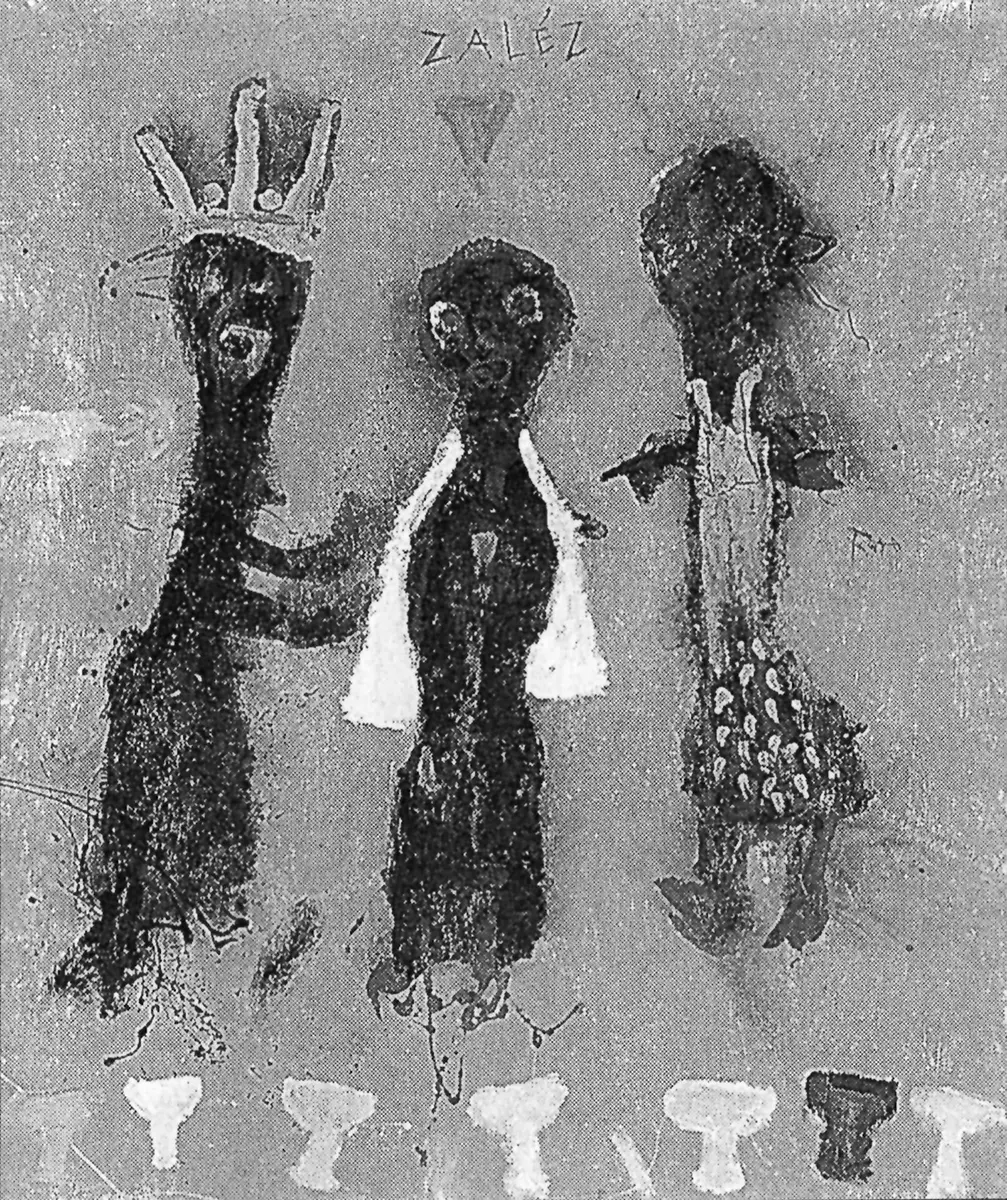
Notwithstanding these criticisms at the general level, the jury members of the Fifth Cuenca Painting Biennial worked objectively and coherently. In the drawing section, the first prize was awarded to Celso Rojas, from Ecuador, with the second prize going to Ernesto Leal, from Cuba. In the painting section, a special mention was awarded to the Ecuadorian representation and to Alexandre Nobrega, from Brazil. The third prize, worth 10,000 dollars, went to José Morales, from Porto Rico; the second prize of 15,000 dollars to Marcos Restrepo, from Ecuador, and the first prize of 30,000 dollars to Ernesto Zaléz, from Venezuela. At the prize ceremony, the jury recommended that prizes should no longer be awarded at future editions and that a larger number of artists, historians, critics, and curators should be invited to participate. It is also important to organize parallel exhibits by significant Latin American artists, as Brazil did this time in its show of works by the well-known artist Tomie Ohtake. The resulting relationship between works by well-established artists and the younger generations is essential to our reading of Latin American art.
Inaugurated in November last year, this edition of the Biennial resented many young artists from the continent. In the drawing section, the Brazilian exhibits were outstanding in their coherence and objectivity. In the case of painting, despite some good isolated work from Argentina, Brazil, Colombia, and Ecuador, it was the Venezuelan representation that proved most interesting, with a homogenous group of artists who were able to fuse with precision certain regional features and international interests.
The repetition of a late and reiterative kind of ingenuity characterized a good part of the work from the Caribbean, while "Fridakahlization" seemed to be the cornerstone of the Mexican paintings on show. Yet the worst was the North American work, full of anachronistic and unforgivable naturalism, although presented in a kitsch kind of way. These are, in summary, the dangers of art in our continent: the naif as a form of condemnation, the exotic as a strategy of difference, and the slavish use of nature as a form of blame and punishment.
Fortunately, most of the contemporary artists in our continent are able to handle these impostures with clarity. The Cuena Biennial presented work by such artists as Roberto Bethonico, Paulo Monteiro and Alexandre Nobrega, from Brazil, Guillermo Londoño, and José Antonio Suárez, from Colombia, Ernesto Leal and Jorge Luis Moreno, from Cuba, Tomás Ochoa, Marcos Restrepo, and Jorge Velarde, from Ecuador, Javier Bassi, from Uruguay and Luis Romero, Natalya Critchley, Ernesto Zaléz and Laura Stagno from Venezuela who use the reality of the Americas like a filter, recycling it and making it into a subject of debate at the international cultural level. This is still the main task for the cultural producers of our continent, and events such as the Cuenca Biennial are a useful means of receiving and exchanging information within this process.
MARCOS DE LONTRA COSTA