
The most recent exhibition of work by Juan Antonio Roda last December at the Garces Velasquez Gallery was an emphatic reaffirmation of Roda's credo of art and life. As I already noted on the occasion of his previous show in 1993, titled No-man's land,1 his career confirms that his work emphasizes above all the value of sincerity and the search for total freedom. These features have been present in each of his periods in different forms, but in this new exhibition, which is part of an intense dialogue that Roda has established with painting over the last decade, they have become much stronger and can now be seen as the raison d’etre of his painting.
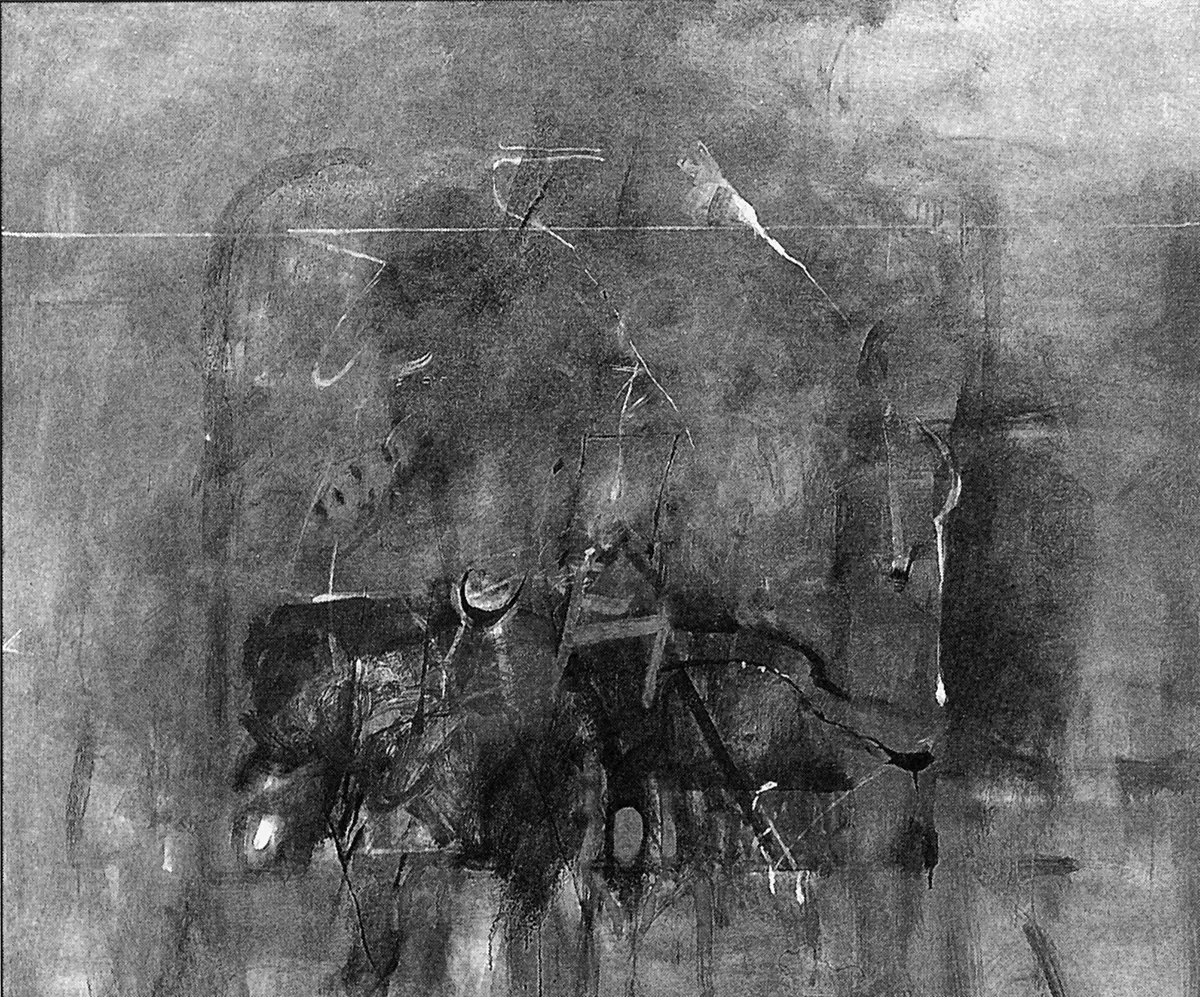
In the exhibition catalog, Beatriz Gonzalez makes two apposite remarks about this connection: "In their external appearance, these paintings recall earlier periods in his work: they are conceived as a series, with graphic elements, vibrant colors, accents, insinuated forms, and the superimposing of calligraphy and pictorial layers. However, Roda's current attitude to his work evokes the importance he attaches to sincerity in the act of creation and his distaste of sophistication in art."
A sure-handed draftsman, a major colorist, and a disturbing printmaker, Roda approaches the canvas without any prejudice, aware that he is neither figurative nor abstract, that he belongs to no avant-garde movement, and that to bring to conclusion a work conceived in freedom, he must take it to the very edge of chaos. This concept of chaos as a consequence of a free act takes us back to an important aspect in approaching the pictorial and chromatic process of this new series, in which Roda opts for large-format canvases in which sometimes red dominates, sometimes yellow and sometimes blue: all reveal a form of work in which the successive layers of color make up a relatively smooth surface but one that is visually very deep. As Roda himself says, the material, in this case, oil, searches for its own expression.2 This emphasis on the monochromatic element highlights the forceful power of communication and expression of each color, as well as the sense of struggle or delight which the artist feels as he works "with the colors he wants, for emotive reasons and which express an idea that although not very clear is indeed there, such as joy, melancholy or the sense of struggle, in other words, characteristically human feelings."3
In this way, Roda emphasizes the expansive and vibrant dimension of his yellows and the warmth and intensity of the reds, while in other canvases, there is the endless depth of the blues — chromatic dimensions that allow each of his pictures to affirm themselves in terms of the pictorial surface, and as fields where the artist wages an emotive battle where everything consists of a free and sincere act in which brush strokes and color reach the very frontiers of chaos. Hence the different layers of transparency, the nervous scratching, the free brush strokes, and the graphics which are like focal points of light engender various forms that evoke the presence of the objective world, the graphic aspect so important in Roda's enormous production. All these elements that make up his painting co-exist within an emotive kind of disorder, vehemently reaffirming the artist's credo: the search for absolute freedom and the most authentic form of sincerity.
NOTES
1. Art Nexus. No. 20.
2. Diana Lloreda, "Cuadros románlicos de
Roda: Interview with the artist," Magazín Dominical, El Tiempo, Bogota, December 15, 1966.
3. Ibid.
MARTA RODRÍGUEZ