
A generation of new sculptors has emerged in Puerto Rico that distinguishes itself from the quality and intelligence of its work. One of these artists is Linda Pintor whose work was recently exhibited at the Prinardi Gallery. Her preferred medium is metal, the expressive potential of which she uses to combine her creative resources in an intelligent and unusual manner to create sculptures that have little to do with any hackneyed reworking of conventional procedures. Pintor does not respond to the demands of a market that continues to be characterized by projects that triumphed in the past, but which now are nothing more than examples of aesthetic anachronism.
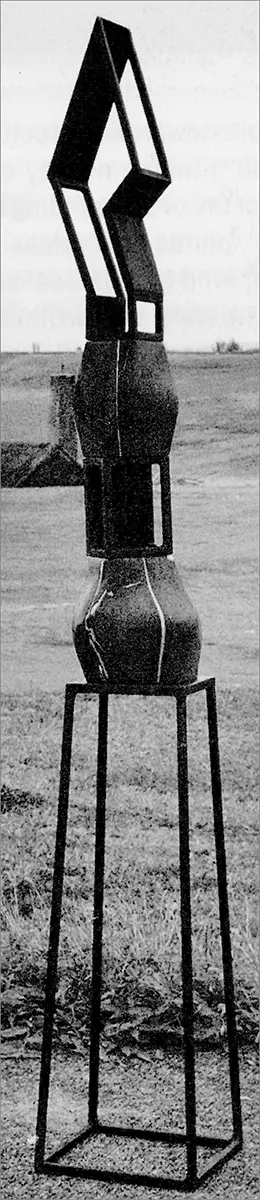
Pintor’s work is abstract, with a number of perspicacious ambiguities that enable the spectator to place himself at a point on the border of reality and the non-objective. Just when we think we have identified a reference to the surrounding world, this perception suddenly vanishes like a mirage. Her sculpted pieces seem to evoke in our minds the presence of mythological references which generate a variety of interpretations. Pintor knows that imagination is the source of stimulation in the arts and manages to create a sense of what lawyers would term "reasonable doubt." She uses the visible world as a basic structure for enclosing invisible nuclei, conceived at intellectual levels, to take us towards a sense of the inviolate. In general, this structure gives body to each piece, which becomes transformed into a metaphorical construction that includes the void, and in the process, neutralizes the horror vacui characteristic of so many other artists.
Pintor exploits the balances and imbalances inherent in life, associating them with her work, which can be seen as a serious analysis of the resources of memory, an exploration of the conjunctions and disjunctions which enhance our visual sense. Her work reflects a clear desire to establish initial schemas that point towards structural essentialism that in no way disrupts the ductility of surrounding nature. Her sculptures also refuse to pursue any kind of rhetorical and precious twisting and writhing; this schematic approach reflects the artist's desire to discover things that cannot be seen with the eyes. There are references to things that oscillate between the recent and remote pasts, a simultaneity of times emblematic of postmodernism. The artist surveys her surroundings, posing questions through the asceticism of her effigies which rise up like pure signs in which time is compressed to isolate and enhance the idea.
Each of Pintor's works embodies concepts that seem to float like sources of fluid energy, infiltrating the spectator's sense of memory — metallic images which seem to plunge us in a ritual dance. Their movement recalls the rhythm of certain primitive cultures, with representation becoming almost skeletal in an interplay between remote prehistoric art and the present. At this point, it becomes essential to know where the artist situates the demarcation line between the real and the unreal.
JOSÉ ANTONIO PÉREZ RUIZ