Since its establishment in 1976, Havana’s Higher Institute of Art (ISA) has created a program of student exhibitions that has become something of a tradition. Most of its students present their work throughout the city and gradually acquire a curriculum vitae that gives them the status of the artist and the social recognition which that implies. The ISA’s recent promotion of students includes the painter Luis Enrique Camejo. His recent show at the Luis de Soto Gallery, in the Faculty of Arts and Letters of the University of Havana, titled The Obsession of Art, was his fourth one-man show (he has also participated in many group exhibitions).
In his new show, Camejo continues the investigation which he began some years ago and which, he explains, is directed towards reconstructing the aesthetic paradigm of painting, based on the exacerbation of the discourse of the pictorial surface. Establishing a balance between the motifs of the surface and those of representation, with the intentionality of an open message, and illustrating the theory of contemporary culture and how it fits into the context of Cuban art.
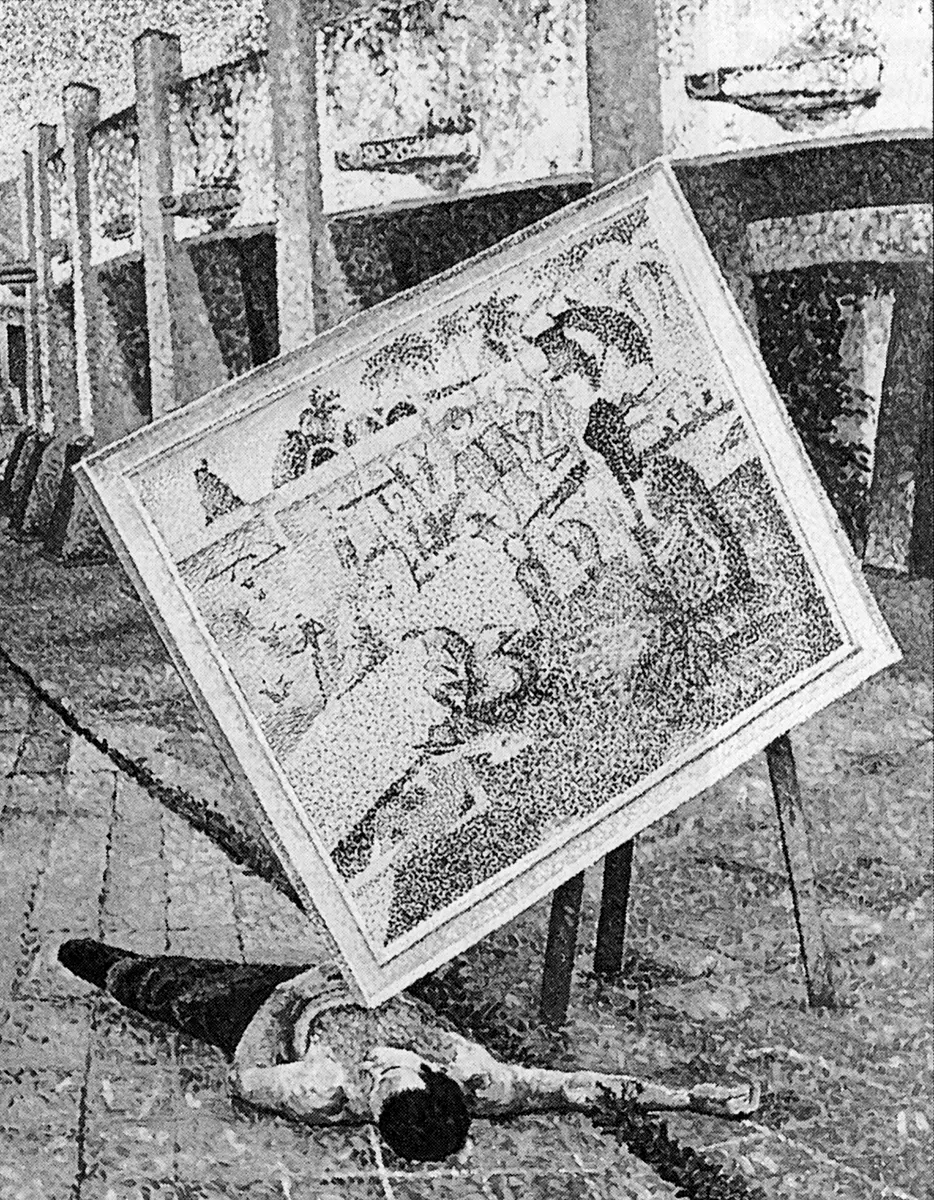
To achieve such ambitious objectives, Camejo refers back to Impressionism and Post-Impressionism —pointillism and the preoccupations of Cézanne, for example— which he synthesizes very well in his work. But Camejo is not interested in the photographic and scientific operations which inspired that movement. Rather he uses the style as a form of personal identification and as a means to construct a metaphor of the idea of dispersion, the instability of what is real, the fragmentation of discourses, showing the image as a mosaic, sweetening the surface with ordered and dispersed brush strokes in order to highlight the sensitive element of the painting which moves on the surface and acquires form through the particularization of the colors.
The school, seen as a cultural ghetto, is the main representational motif in his work. He is concerned about the precarious nature of the spiritual relationship between subject and object, artist and artwork — the result of the new order of things in Cuba and a renewed interest in economic matters there. Artists, even though they may be students, are anxious to gain recognition in institutions and the market.
This mentality rooted in material interest —formerly inconceivable in the erstwhile utopia— is reflected in Camejo's pictures, where artists are shown devouring the National Museum of Fine Arts of Havana, or with their eyes fixed on the MoMA and other legitimizing institutions in Europe and the United States.
The first contact with Camejo’s new form of pointillism is rather disconcerting. Once its visual attractions have been digested, there emerges the specific weight of the ideas which his pictures embody. In general, Camejo works with large formats, in which he appropriates the history of art and the iconography of contemporary Cuban artists. Sometimes, the dispersion of unrelated images placed ex profeso in mosaic fashion, makes them lose their original meaning. Since it is impossible to recompose them into a coherent whole, they create the sensation of art as a schizophrenic experience, where, as the artist himself has observed, it becomes impossible to recognize one’s own identity.
ERENA HERNÁNDEZ