Mesótica II is based on the concept of using a semantic hybrid to name a geographical space within a specific time ...[it refers to] the place, the support, a gigantic geopolitical wall., where various expressions, this time from the region itself, come to establish a dialogued.1 Virginia Perez Ratton
The exhibition Before America2 arrived in Costa Rica in 1994 at the end of its tour. The exhibition curators,3 Gerardo Mosquera, Rachel Weiss, and Carolina Ponce de Leon, participated in a discussion with the Costa Rican public in a forum organized by the Museum of Contemporary Art and Design (MADC), where Before America was presented. When the question was raised about the absence of artists from Central America in the show, Mosquera referred to the lack of communication and the difficulty of any cultural exchange in the region. As a result of this discussion, the idea arose to organize an exhibition that would redefine the image of Central American art. This exhibition would have nothing to do with the survey approach, the blockbuster exhibit, or other choices based on local paradigms.
Mesótica 11: Central America: Re-generation was curated by specialists in the area — the director of the MADC, Virginia Perez-Ratton, and its curator Rolando Castellon, and was based on the precedents established in Before America. This helped to explain the decision not to use the hackneyed nationalistic format of presentation by country,4 and the preference for showing the multicultural nature of the region and its diverse influences in works that examined the problems of reality from the perspective of the individual artist in a contemporary language with regard to concepts, aesthetics, and media. The show was dedicated to Gerardo Mosquera.
Mesótica 11 also proposed a dialogue between nations that have many things in common, though they remain isolated from one another for economic and political reasons. Perhaps this explained the relationship between the works, which complemented one another despite the absence of any specific identification with any given country. Three linguistic elements determined the curatorial focus of the show: the works functioned at symbolic and suggestive levels, evoking collective or individual memory; there was a transcendentalist vision that avoided any direct or rebellious commentary, and a range of colors without the garishness or "folkloric" tone in stereotyped visions of "representative" Central American art predominated.
Displayed in three rooms in the museum (one very large and two smaller rooms), the works were installed with an awareness of the relationship between supports and colors, clearly syntactic values which sometimes disrupt the semantic dialogue established between different works. The visitor had the impression of reading different comments on various shared ideas, perhaps because of the content of the works and the major themes related by their common motivation or existential condition, although they explored different paths and experiences.
Thematic guidelines
The problem of the diaspora —the exiling of human groups in recent decades of this century— has resulted in new processes of transculturation. At the individual level, these physical and psychic displacements of countries of the so-called First World have led some artists toward a reexamination of the problem of identity. They have done so from the standpoint of their own culture vis-à-vis the dominant culture, one that simultaneously excludes and integrates them into the system. These artists try to resolve the resulting dichotomy by proposing a conscious dialogue of super impositioning, in which linguistic elements coexist whose referents have already been elaborated in the collective conscience of the two opposing cultures: their own and the one they have adopted.
Patricia Villalobos Echeverria (the United States, b. 1965) raises the problem of suspended identity, the fact of not belonging to any spatial geography given her nomadic status. The daughter of Salvadorian parents, and a resident of Nicaragua, El Salvador, and more recently the United States, she consciously reflects her hybrid origin in her art. In the closed and semi-obscure setting of her work, the visitor heard manipulated sounds and words in English, Spanish, and Nahuatl akin to the rambling digressions of some absent body. Heavy curtains made of different bits of fabric — like her identity — showed an image of a new kind of cross-breeding in the transcultural representation of elements that synthesized life and death in Cuatlicue5 placed next to the stars of the United States flag. In contrast, Luis Paredes (El Salvador, b. 1966, resident of Denmark) does not rework transcultural symbols but instead uses memory to find his place within a torn and diffused image. In his unmounted photographs, hung on the wall with rusty nails, memory arrives like a revelation, luminous, but out of focus and transfigured. The human body is a metaphor-figure, halted in the middle of a transformation process, blurred and without any facial detail. It evokes primitive forms, ritual objects of a pre-Columbian past, angels, virgins, and beings in postures suggestive of violent acts, whose mixture is the recovery of something that time and destruction have passed. The sepia color Paredes uses thus acquires a dramatic resonance which, coupled with the manipulation of the film, the aggressions, cuts, scratches, indefinite splicing, and roughly assembled nature of the negative, evokes the fragility of memory and the painful act of prodding deep in the human conscience.
Another theme of the show was the absent body — specifically the divided and disappeared body that has left a special trace on the history of a present-past — which emerges as a commentary on a situation of social violence. In the series entitled Parallel Histories by Luis Gonzalez Palma (Guatemala, b. 1946), the corpus fisicus is absent or symbolically depicted. Evoking a series of cinematographic frames, Gonzalez Palma constructs a complex historical meta-narrative that involves an interplay with simultaneity and the capturing of an instant. The objects are referents that have a meaning in the collective memory that evokes associations within the narrative context of his work. Almost all the material comes from documents, old photographs, fragments of religious books, popular catholic iconography, and another miscellany from the country's history. The sepia tone used (typical of the artist's photographs) and the lightboxes in the form of multiple sequences, acquire the pathos of a timeless and reiterative history, whose connotations go well beyond the geographical limits of the images. Gonzalez Palma speaks of disappearances and absences in disturbing images — such as the birthday cake, a metaphor of the passage from life to death; the continuous presence of clocks, and a rose manipulated to mimic the movement of a helicopter propeller.
This archeological sense was dramatically and clearly present in the work Besieged History by Isabel Ruiz (Guatemala, b. 1945). The artist uses a real event to refer metaphorically to Guatemala at war. A series of chairs burnt ex profeso presides overprinted images that suggest the remains of animals and humans. Arranged in the form of a cross, they lie on a dark charcoal mantle emphasizing the drama of the ritual carried out with the marked absence of its protagonists. A posthumous homage or an act of accusation?
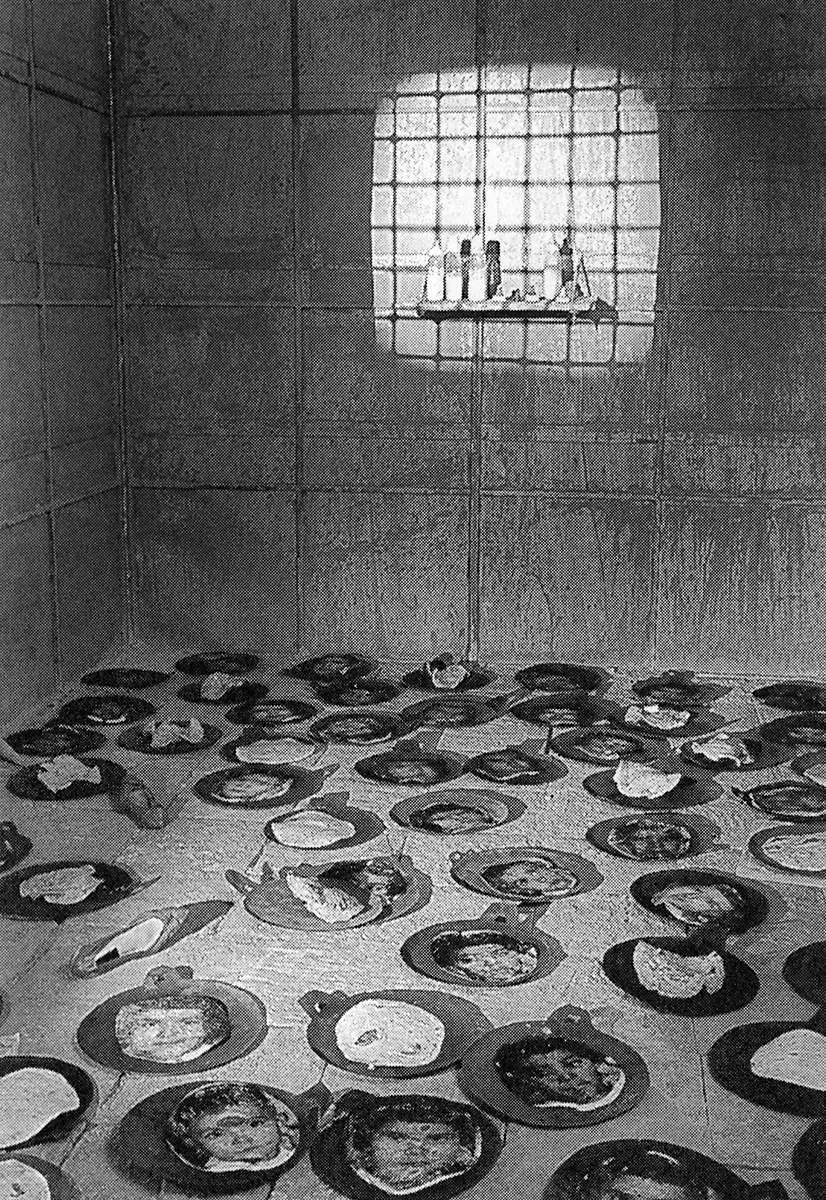
Xenia Mejia (Honduras, b. 1958) was more direct. In her installation titled Memories, she constructs a powerful metaphor using simple, everyday materials. Her discourse is not afraid of being rhetorical or politicized when it points out how our societies emphasize differences from the time of childhood. Putting the faces of the children imprinted on wheat tortillas placed on the flat earthenware pans found in the kitchens of all common households in Central America condemns them to a previously determined fate, and thus perpetuates an unjust "tradition" — a term that calls for a questioning of its own meaning by having as its basis a state of things which makes it conflicted and contradictory. This was further emphasized by the placing of baby bottles above the tableau, with the shadow of a grid projected onto them, reaffirming the inability of specific population groups to satisfy their basic food needs.
The differences between these societies had a dramatic effect in the Skin Books by Pablo Swezey (Mexico,b. 1959, resident of Guatemala). Made of latex, the books simulated human skin and include fragments of hair and materials suggestive of organic parts. The discourse dealt with the classifications made on the basis of the pigmentation of the epidermis and the type of hair, historically used as a means of establishing social differentiation which takes no account of the individual and merely leads to prejudicial exclusion of a racial nature. The unoccupied clothes suggested the outline of an absent body that was alien to them, with scars that revealed the marks of cross-breeding.
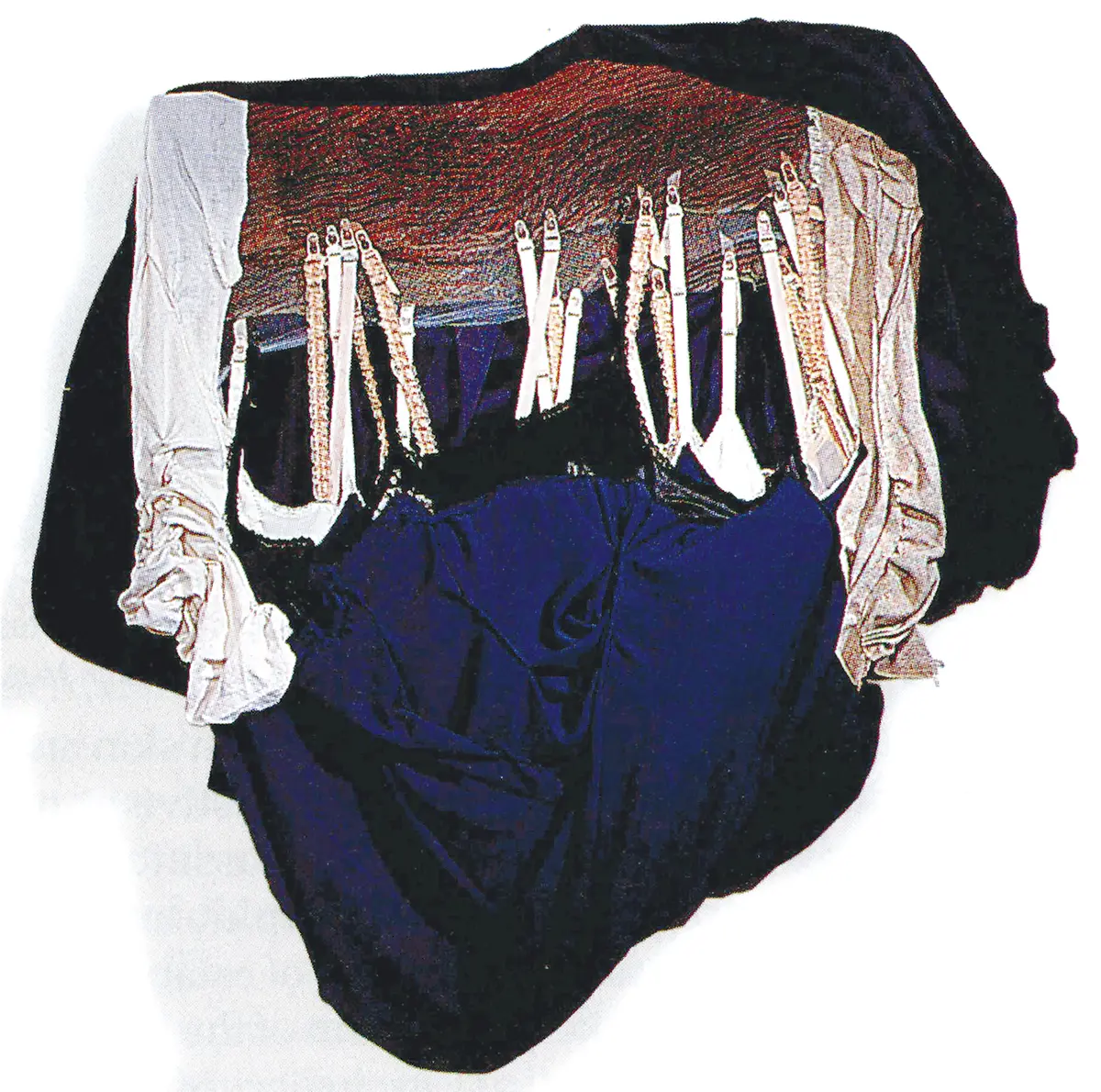
Another kind of scar was present in the works by Patricia Belli (Nicaragua, b. 1964). Textiles that suggest skin were pierced with thorns and sewn in places where there had been a wound. Belli makes human abstractions from women's clothes made from fabrics used for underwear and others, which seem to be excess materials. There is here an implicit critique of the use of certain erotic stereotypes. Garter belts and the stitching used to make them, for example, suggest existential and painful situations which, although healed with time, have left their mark. Belli uses sensual colors and textures, which she works like paintings. Despite the unconventional nature of her materials, she continues a tradition that reflects her training in the plastic arts. Marta Eugenia Valle (El Salvador, b. 1962) uses textiles in a different way. Her piece Encounter between two worlds is a refined metaphor of the Conquest. Three broadsheets of hanging opaque linen suggestive of the sails of a boat are crossed by a metallic bar, around which the artist has embroidered the edges like furling waves. On the floor, pebbles lie as if on a tranquil beach. Her other works in the show lacked the impressive simplicity and synthesis of this piece.
Priscilla Monge (Costa Rica, b. 1968, resident of Belgium) proposed a more complex discourse that went beyond the referential reading of textiles and female manual tasks. Her exploration of violence through the exercise of power, that affects every individual, is related to the questioning of the authorship of the work, the disappearance of the signature, and the danger for the artist herself who remains its executor. Beautifully embroidered in linen are images of numerous death sentences and punishments from the last century. The body, destined to suffer, appears as a brief reference in the anonymous record. The actions are made to disappear before the public, an ironic and subtle reference to the death to which we are exposed every day, and the questioning of the ingredients which give artistic originality to a work. Marisel Jimenez (Costa Rica, b. 1947) also referred to the violence brought to bear on the body, but in her case, it was psychological violence — which has a devastating effect on the mind of a child within the repressive family environment — and the loss of innocence. Dramatic and evocative of a small Catholic retablo — the reference clearly indicated in the title of the work, Eighth Sacrament — little feet stand on tip-toe on a pedestal under the stage light that represents the absent body. A metal door suggests imprisonment, vividly highlighting the melodramatic dimension of the representation of human problems.
The discourse centered on the body reflected the need of the individual — in this case, the artist — to re-situate himself or herself within a social context from which he or she can re-interpret history on the basis of his or her own subjectivity and experience in order to construct some alternative narrative. Establishing one's presence means affirming one's identity in a world which is becoming increasingly fragmented given the multiplicity of ideologies and the supposed opportunities for participation in the global village.
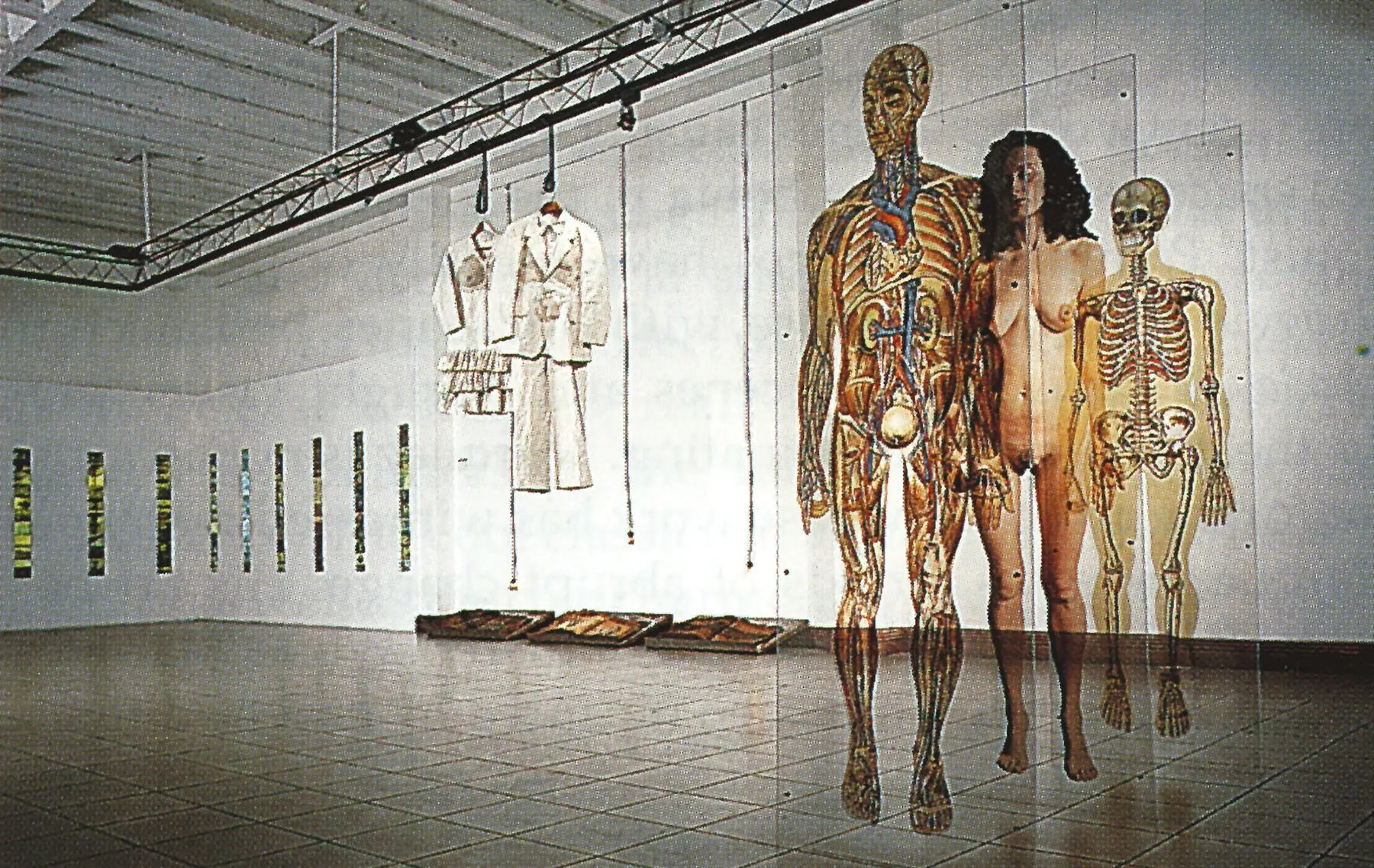
In the work of Miguel Hernandez (Costa Rica, b. 1961, resident of the United States), the body appears in full or is suggested through its internal organs. A less dramatic and more human touch appears in his approach, one that is centered on sexuality and eroticism. The search for an identity in the re-evaluation of sexual pleasure, eschatology, and anatomy, humanizes the body. Drawn with the precision and detail found in anatomy books, his work makes a clear reference to desire, through the voluptuous provocation produced by its association with what is repulsive and forbidden. The interplay of perspectives and the use of foreshortening on the two-dimensional surface refer to historical precedents that recuperate the transcendental meaning of man in the painting.
Karla Solano (Costa Rica, b. 1971) uses photography to show and denude her body, including its internal anatomy, in a certain effect-seeking challenge to Costa Rican society. The body is sacrificed to remind us of What we are made of and to make us less vain. The installation allowed the spectator could experience from the distant and emotionless perspective of the artist.
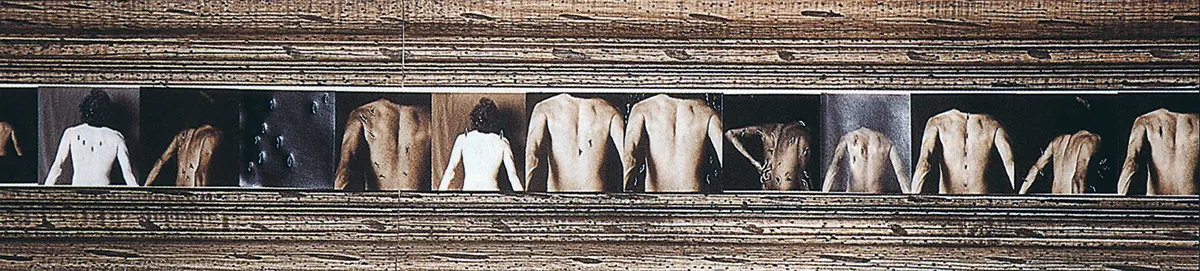
On the other hand, Irene Torrebiarte (Guatemala, b. 1970), without lapsing into any obvious self-referentiality, showed an important part of the body — the back — to comment metaphorically on the pain of existence. Her photographs work repeated images in sequences that reproduce the same gesture, the same scene.
In Life, Your Thorns, and Labyrinth she identifies the plants which share this defense with human beings — these small arms which we all have and with which we hurt one another deeply.
The human silhouettes by Emilia Vargas (Costa Rica, b. 1967) in the triptych titled Making us, Grasping us, Roasting us make up a sequence on the existential problems individuals are confronted by in contemporary society. The high degree of elaboration in Vargas' work reduces its freshness and takes it towards a modernist discourse that is reaffirmed by its theme. Left untitled, it would have been a very good piece. Finally, there was another group of artists who updated certain referents of the pre-Columbian tradition. This reflected the need to re-elaborate new identities within artistic discourse, from the standpoint of the social imagination of a collective in the light of contemporary circumstances. The objective here was not to show identifying elements of culture as gift-shop souvenirs, or to see languages that come from the "center" as the dernier cri. The reasons are deeper and are part of a process within the history of Central American art.
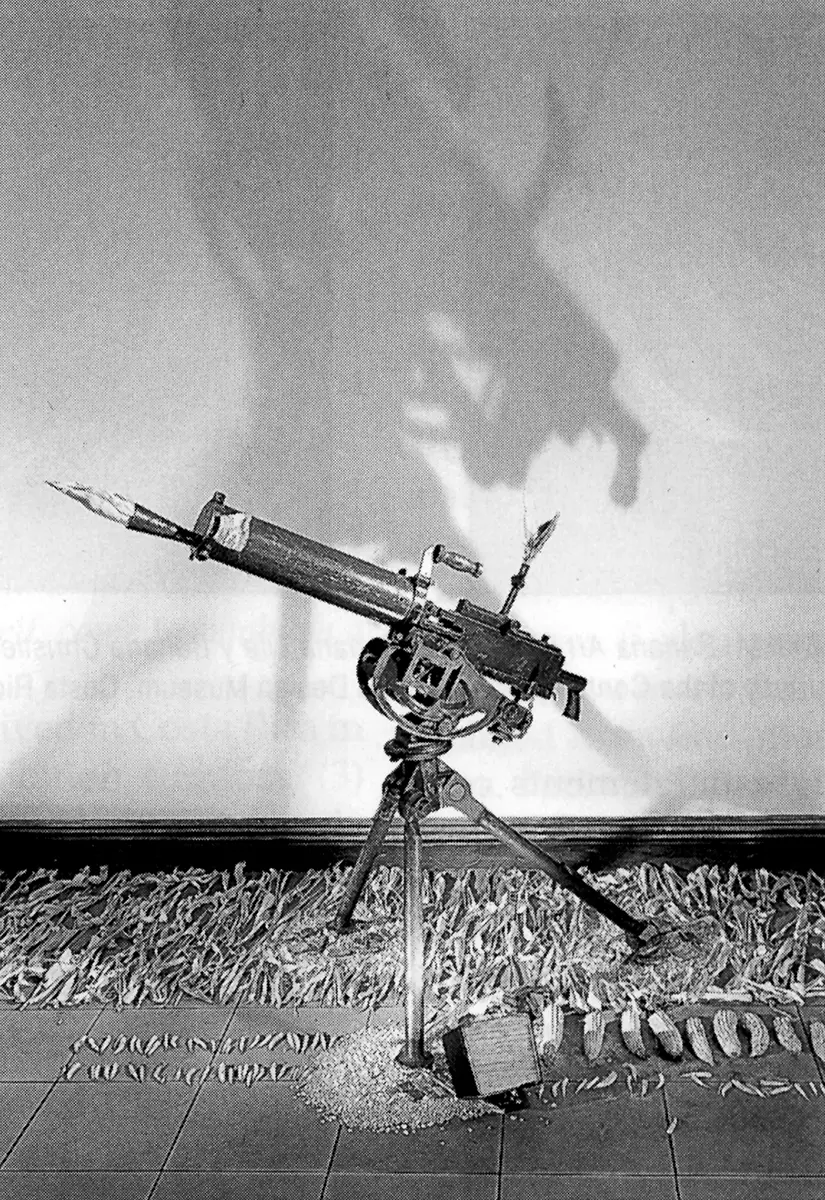
To construct a new visuality from "within" using traditional materials and forms is the expression of true resistance-based culture. Orlando Sobalvarra (Nicaragua, b. 1943), a former member of the Praxis group, constructs a language with a sober palette influenced by Amerindian ceramics. His forms rework pre-Hispanic hieroglyphic symbols. Raul Quintanilla (Nicaragua, b. 1954) is a cultural guerrilla. In his work, clay and corn go on the defensive — a machine gun fires ears of green corn and becomes an authentic arm of resistance. Forms and archeological remains reflect with irony on colonization and war, the reality of the past, and the present of Nicaragua. Regina Aguilar (Honduras, b. 1954) is less "aggressive" visually but her work has more heart. Her installation Requiem for wasted hours pays tribute to a traditional form of female work which is still practiced in some regions of the country — the grinding of corn with a stone mallet. Without any explicit commentary, the presence of the stone and the bleeding hand juxtaposed with old machinery evoked the shared pain of a group that maintains its identity from the past.
Cross-breeding has a repetitive value in the work of Bayardo Blandino (Nicaragua, b. 1969, resident of Honduras). Using as his reference the colors of pre-Columbian ceramics, he restores an ancestral image based on the warmth of clay and the discretion of its hues. It is an abstract cross-breeding that glazes the human body with transparencies, like a mark in time reproduced in the image of an X-ray plate revealing organs and bone structure. The use of large format and repetition, along with the glazing, suggests a sense of the infinite, of plunging the spectator deeply into the mystery and space of remembrance.
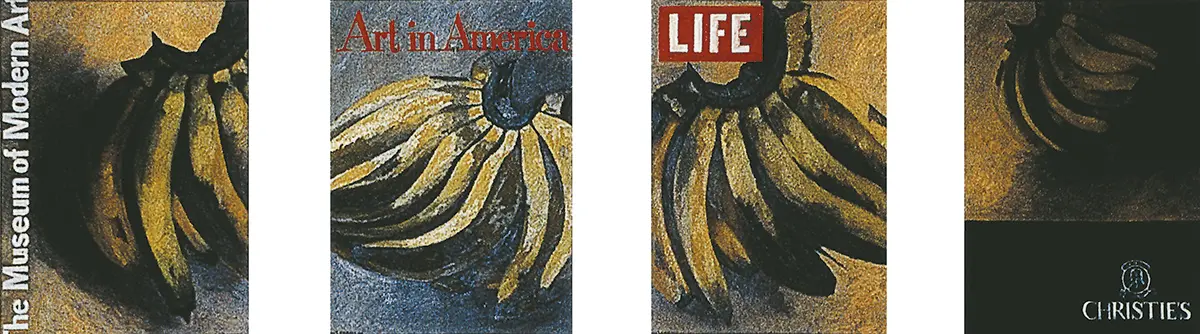
The landscape painting of Rodolfo Molina (El Salvador, b. 1962) examined the contradictions between the ideal of wild, untamed nature and the actual reality of contamination and waste products. A counterpoint is thus established between the developmental idea of modernity and the utopia of paradise which inspired European man to cross the seas to our lands. For his part Moises Barrios (Guatemala, b. 1946) offered an ironic analysis of the term Banana Republic and the legitimation paradigms representative of the hegemonic artistic centers. The images circulating in the mass media have imposed on us a kind of art that has been reaffirmed by the power of well-known art auctions. The artist returns sarcastically to the theme of our acceptance of this stereotyped image, and of seeing ourselves as others see us in their new policies of otherness — simply another way of perceiving us as something exotic.
Mesótica ll was a first step towards the establishment of a Central American dialogue and the dissemination of certain artistic practices without the mediation of any political cause, as often occurs in such cases. It was the first show curated by and for professionals in the region, and it thus set a precedent for organizing exhibitions from our own points of view. We can only applaud the decision to take this exhibition to other countries.
NOTES
1. Presentation text of Mesótica II by Virginia Perez Ratton.
2. Before America, an exhibition was organized on the occasion of the fifth centenary of the discovery of the Americas. Its many objectives included that of subverting the established map and presenting it on a south-north-south axis.
3. Gerardo Mosquera, Rachel Weiss and Carolina Ponce de León.
4. Of the 20 participating artists, 6 produce their work outside their countries of origin. Eleven of the artists are women.
5. Aztec figure evoking the duality of life and death.
DERMIS PÉREZ LEÓN
Costa Rican art critic. Lives in San José.