Using the suggestive title With Open Eyes, the Mendoza artist Nora Correas (1942) recently presented in the Cronopio Room of the Centro Cultural Recoleta an exhibition of works from the last seven years, made up of five installations and eight series pieces in which sculpture objects predominated. The show was conceived as an enormous installation that the visitor could explore as a non-continuous whole. This was due to the lighting, with emphatic use of a unifying penumbra from which each work emerged. This dramatic and poetic mise en scène offered an ontological and ethical reflection on the relationship between man and nature. The starting point was the integration of opposites in Asian religions and myths and the research of the alchemists. A conceptual sort of entrance to the show was provided by verses from a poem by Olga Orozco, "nights and days with open eyes under the unbearable flickering of the sun," that highlighted the painful sense of vigil in the search for truth beyond appearances.
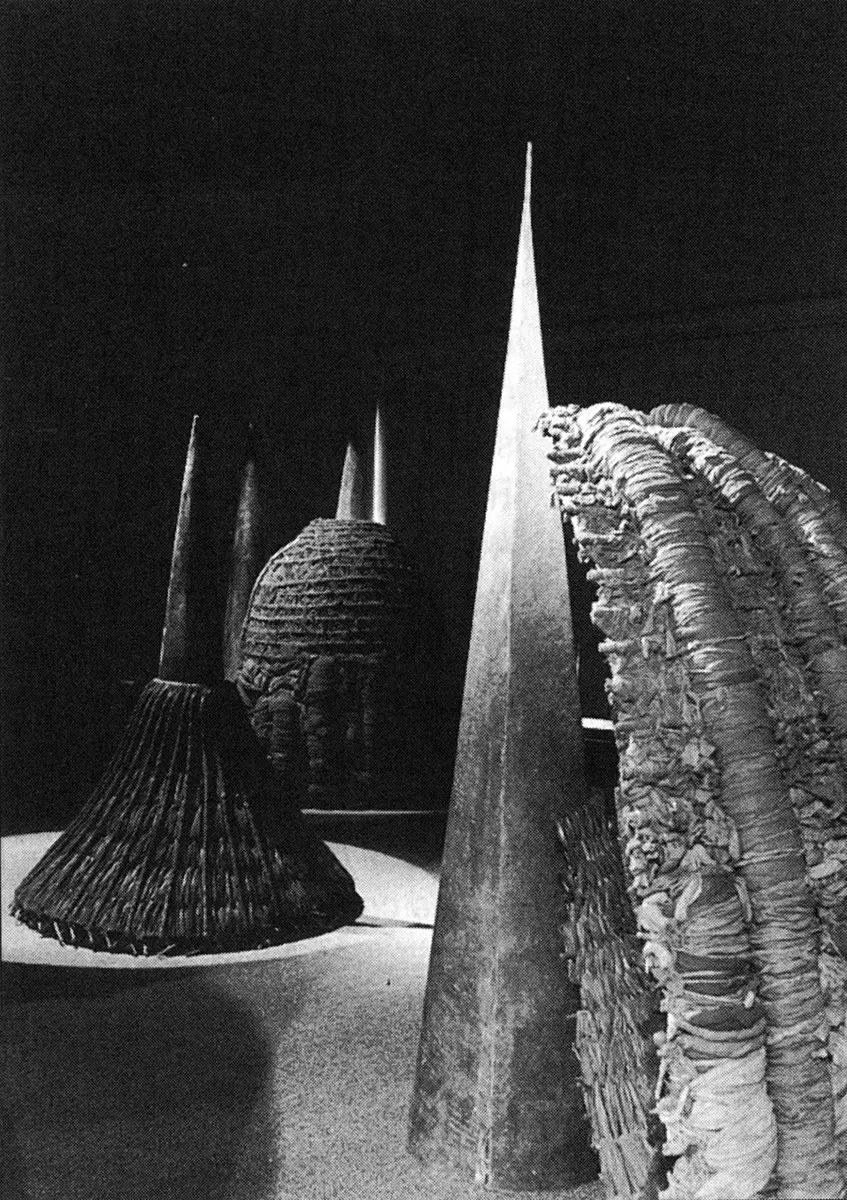
Nora Correas studied at the Higher School of Fine Arts at the National University of Cuyo and has been showing her work regularly since the second half of the 1960s. She made a name for herself in the seventies with, her work in the textile arts, a technique whose freedom allowed her to construct textile objects with almost sculptural qualities. It was therefore quite natural for her to move on to sculpture. These new works reflected the presence of her earlier textile techniques, with forms recalling wickerwork and the warp of the loom, in which she used various kinds of materials such as parchment, fabrics, paper, fiberglass, glass, wood, wicker, iron, wire, horsehair, ostrich eggs, plastic ants, resins, and pigments.
The five installations, from the oldest entitled Cara y Ceca (1989) to the most recent, The Rose (1996), was disturbing not only in their conceptual ideas but because of the different materials combined in closed or open forms. Perhaps it is here that we best see the artist's poetic and transcendental aspirations, inspired by the lines of the German poet Novalis: "Everything has to penetrate into everything, to flower and mature in everything." The blue rose is protected from the ants, symbolizing poetry and truth which we can accede to individually, and which must be protected from classification. Other notable works included Ora pro nobis (1992), created in connection with the Fifth Centenary. Here a comparison is established between Noah’s ark and cargo consisting of fifty hearts within an animal sanctuary in the continent — a homage to the man in the Americas from the origins down to the present day. This was an excellent exhibition that fully confirmed the maturity of this artist from Mendoza.
ALBERTO COLLAZO