
Olga de Amaral (Bogota, 1932) recently presented an exhibition of textile works entitled Stelae and Landscapes. Amaral’s career, which began in 1957, has been a long and intense process of enrichment in which textiles have been used as a symbolic and evocative means for creating suggestive forms whose arguments have been taken from the artist’s surroundings.
Her wide formal spectrum has led her to work with an infinite number of materials of animal origin, horsehair, and wools, as well as vegetable fibers and synthetic residues. In this materialization of textures, she has created a fiction about nature, ritual, and sacred elements through a powerful and instantly recognizable language.
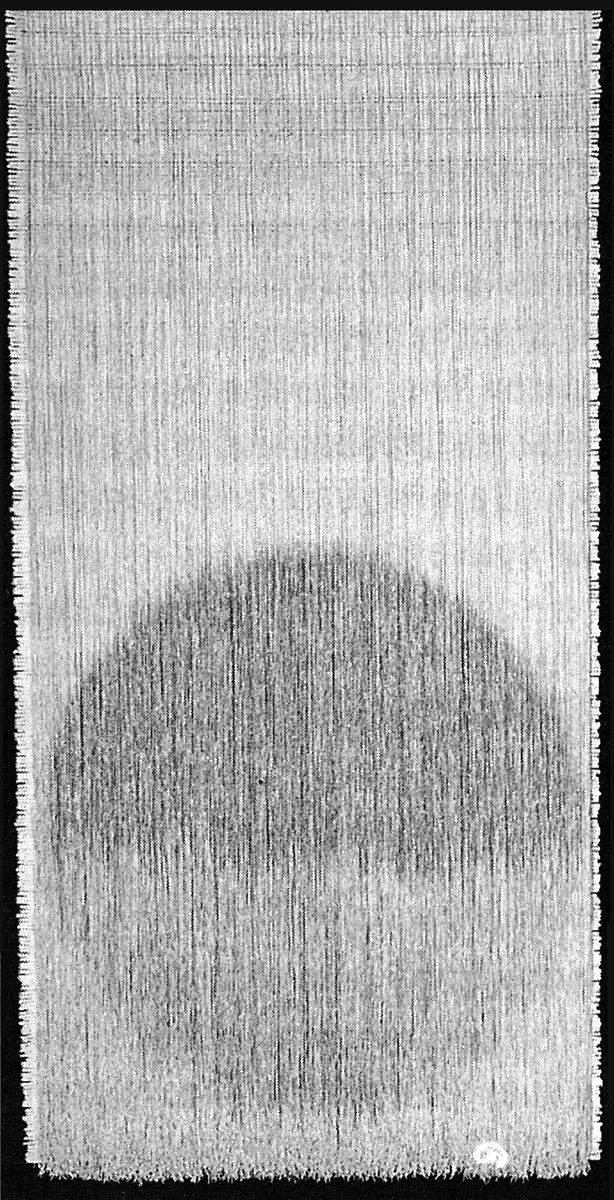
Textile art is a rich and varied practice dating back to the pre-Hispanic period that has enjoyed an uninterrupted tradition over the centuries. The great contemporary interpreter is undoubtedly Olga de Amaral, who has managed to set up a workshop that produces monumental works and carries out research into the use of color, form, and textures that have given dynamism and richness to her artistic and creative code. In recent decades Amaral's work began to reflect her interest in the use of gold and later, silver, as sumptuary and coloristic elements. This exhibition illustrated this element, with the presence of these metals creating images of splendor reflected in her explorations of tactile and ceremonial qualities.
Today her work utilizes a number of resources and procedures, including abstract forms and variations on the phases of the moon and the presence of the sun. She also produces pieces whose weight and texture are explored and developed in a way that takes a natural and logical account of the materials involved. In other instances, the material is hardened through the use of plaster, and rests against the wall or oscillates in space. A constant feature of her work has been the production of textured surfaces, along with the use of chromatic effects inspired by lichens, moss, thickets — elements that continue to enrich her work in various formats.
Although this exhibition was made up of individual pieces, the overall effect was one of continuity. A relationship was established between the different works, generating a logic that resulted in a setting of a unique kind, suggestive of temples or tombs, clearly rich in theatrical and dramatic effects. Since the 1960s Olga de Amaral has become an experienced and forceful artist who has won a wide international public with her textile works. In her career, she has explored a wide range of definitions of textile work and her aesthetics have become an indispensable component of contemporary art. She has managed through her art to retain her pioneering spirit and to continue to be at the forefront of contemporary projects.
MIGUEL GONZÁLEZ