"The deepest passion of the Western intellect is to establish unity with the roots of one's own being," wrote Richard Tarnas, quoted by Ilya Prigogine at The End of Certainties. To which the latter added: "This passion led to the Promethean affirmation of the power of reason, but also identified it with the drama of alienation, a negation of what gives meaning and value to life ... this same passion may lead today to a new kind of unity in our vision of the world, and science should play an important role in the construction of a new coherence." This reflection from the standpoint of a scientist who has studied both Einstein and Plato or Borges might well find a parallel in some of the new models for reading reality, the advent of which was heralded by the process of modernity.
In his exhibition Memoirs of an Outspoken Parrot, Sergio Vega seems to follow this line of reasoning, unwittingly re-writing Flaubert or invoking Dante to metamorphize this new coherence made possible by mixture. It is a mixture at the intersection of different strata of thought and the quicksilver of a mirror in which Vega recognizes himself and identifies the trappings of the Latin American being.
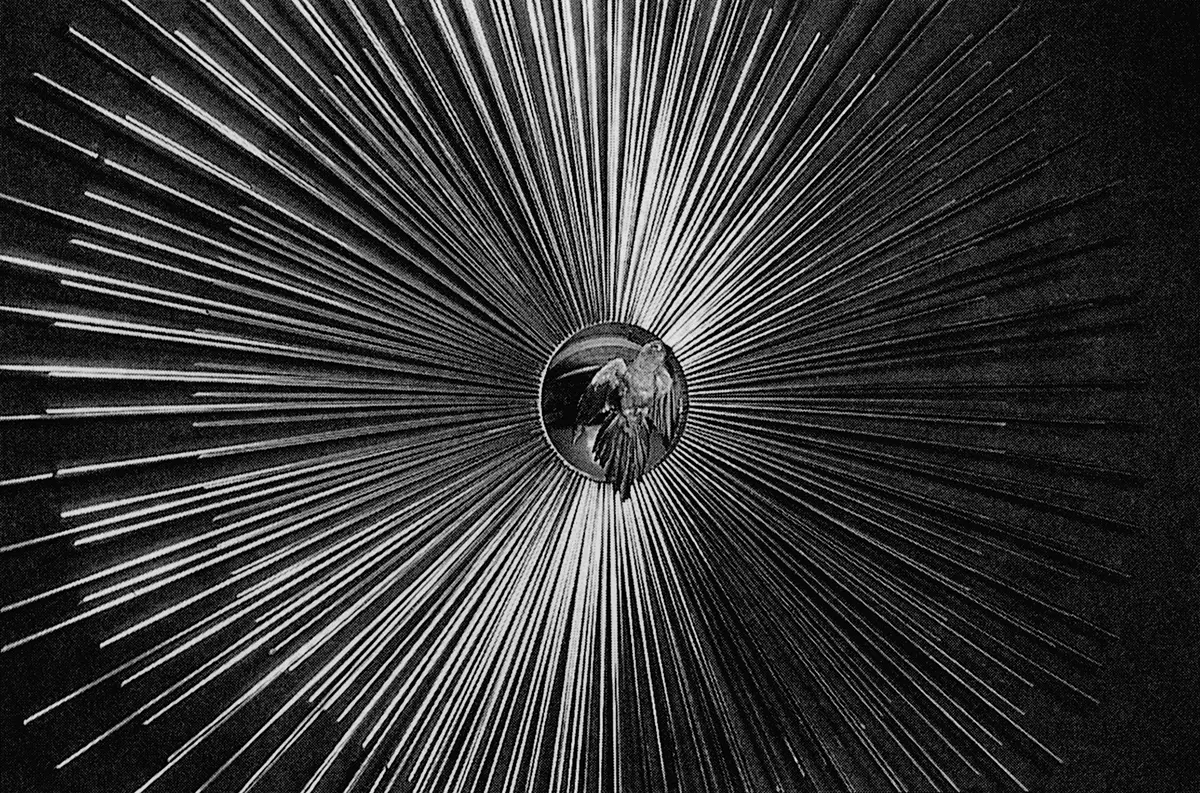
The Holy Parrot irradiates its divine light from a number of solid bronze bars which converge, like rays, on the body of the embalmed parrot, in the middle of the celestial blue plane which appears in the background. This Holy Spirit is the hybrid in which Vega emphasizes and combines souvenir, religion, politics, and language. It also demonstrates his controlled manner of articulating visual discourse with the rational rigor of someone who is looking for a new unity between form and content. In turn, it is an exercise in the conciliation of humor, with the mordacity implicit in this game in which the divine aspect of a form is made in the likeness of what is human, if not physically, then at least verbally, since mankind has condemned the parrot to the role of a mere repeater.
For some time now, in his attempts to chart this post-colonial socio-cultural geography, Vega has plunged himself into the construction of such parodies. Dante, to whom he ascribes the symbolic paternity of Latin America's affiliation to Western culture, is another of his main protagonists. But it is not only that Dante should explain or transform the West that has been filtered into the vernacular reality of Latin America, but the fact that the visual and conceptual processes used by Vega are also involved. On the one hand, he gives in to the fiction and lets himself be guided by it so that his objects and installations are visual continuations of the narratives. On the other hand, he inverts the roles and serves as a guide to Dante. He takes him by the hand so that he can revisit himself, not in fiction, but in reality, in a socio-cultural and political territory where the phenomenon is made in the likeness of literature. Vega displays these symmetries in Jungle-Beard, with a large rationally designed table, in the center of which a maquette of a generic forest — apparently Cuba — reveals the profile of the sierra merging with that of Dante, the whole surrounded by a sea camouflaged in war. The table has its counterpart in the photographs surrounding it that make up Within. These photographs are a response to Vega’s encounter with a book by Leon Pinelo written in the seventeenth century that describes the location of the Garden of Eden in South America and in the middle of the Forest. This served as a pretext for the over-printing of the opening paragraphs of the entry into hell in the Divine Comedy onto the dense foliage of the paradise-forest in the Amazon.
Paradise is on earth. But so is hell, and both are in the same place. The forest represents all forests, and we are as lost in it as we are in ourselves. This conviction of Vega’s, which is based on, among other things, his observation of magical realism, projects his work as a simultaneous reflection of different topics, ranging from the theme of revolutionary struggle (of which Cuba is the paradigm) to religious syncretism, from modernist illusions in agony to psycho-analytical interpretations of the Lacan used to explain the recurrent parody of hell being located in paradise.
ANA TISCORNIA