
The current work of Venancio Shinki can be seen as a synthesis of the most characteristic features of Peruvian art. The artist is a member of the generation that from the early 1960s opted for abstraction as a means of expressing common ideals. His was, and remains, a style of painting that gives special attention to space through a profound kind of lyricism, evident in his imagined atmospheres, the austerity of his resources, and his ability to create illusory depths in an interplay of seduction bordering on the dream.
The 1970s saw a return to figuration in Peru. Radical changes were underway in the country and our artists were looking for different ways of capturing their experiences. It may be that in those turbulent years surrealism was the prevailing trend in Peru. The painters who lived here, as well as those who returned from Europe, such as Tilsa Tsuchiya, another formidable artist of Asian origin, helped focus our collective aspirations on art as a fusion of east and west, as a subtle kind of eroticism and a magnificent expression of craft in works of art that captured some of the greatest virtues of Peruvian painting.
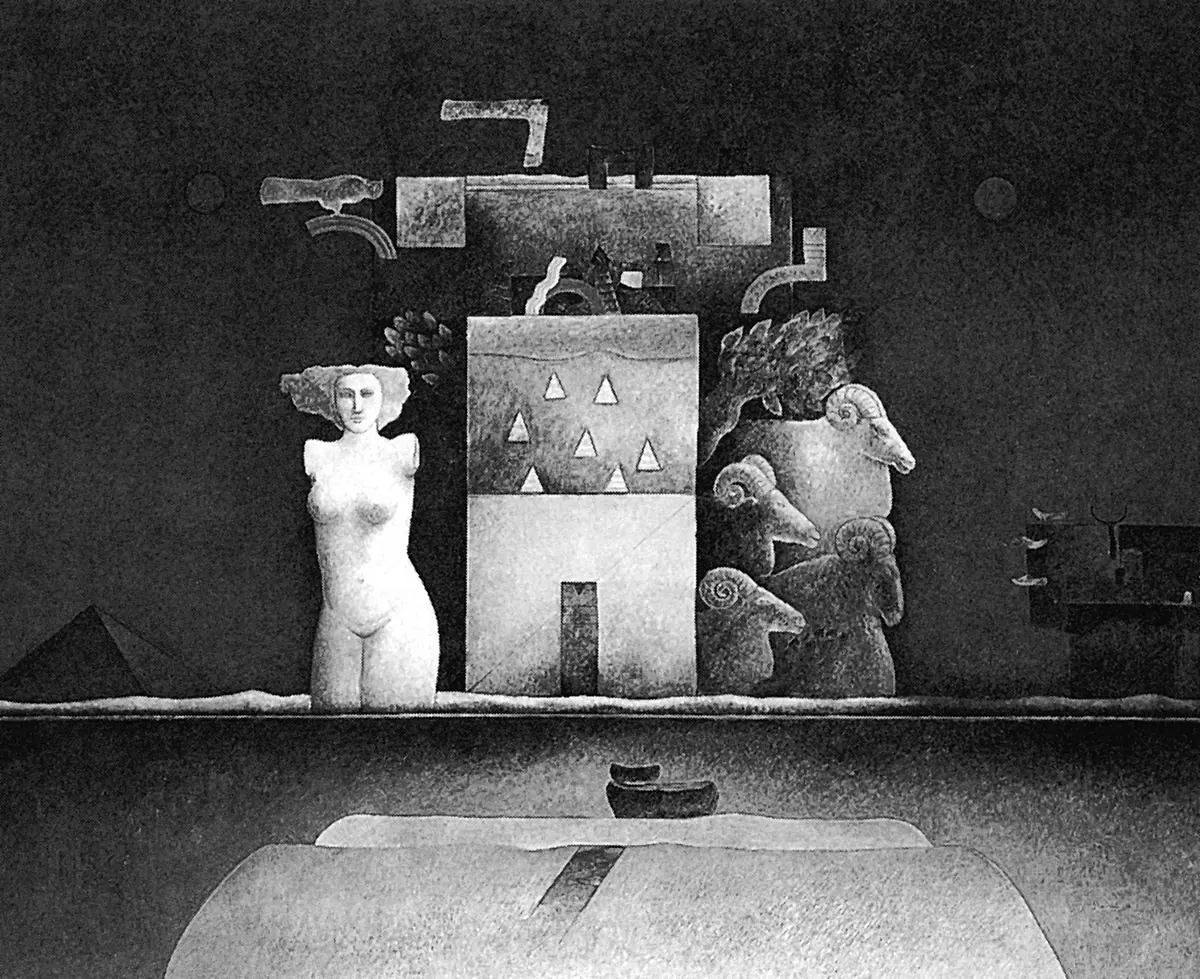
However, Venancio Shinki's work kept its distance from the surrealist trends of the period, adopting an approach which, although far from the excesses of Breton, directed itself toward the creation of worlds that are possible only as a parallel to reality itself. In the following decade, Shinki went deeper into the meticulous construction of a universe where life was reduced to its essence: the woman was represented as an emblem of fecundity and as the center of his thought. Other elements included the desert, mountains, and, perhaps, man whose sporadic presence could break the magic of a solidly constructed space.
In the 1990s Shinki’s work moved along metaphysical paths. His paintings from the last five years show the human body transformed into sculpture. The skin acquires a marbled appearance, with special attention given to reflection by placing the figures under fiery skies or in increasingly barren desert landscapes. In this way, the spectator can concentrate on the subtle confrontation between culture, nature, and humanity in these pictures, encounters which are often merely suggested through symbols integrated into the presentation of vast spaces. Shinki’s most recent works suggest in particular, a painting based on secrets. These are pictures that do not reveal themselves to the spectator, but, in addition to the visual pleasure they offer, require contemplation by the spectator. In these works, we can see how, over the artist’s long career, each stage has been a link in the consolidation of one of the most respectable achievements in Peruvian art of the second half of the century.
In this new work, Shinki concentrates on myths and traditions, fears and concerns, the human body and the artistic body into a kind of painted erotica evident in the smooth surface of the pictures and the signs which the artist leaves on the canvas is a reflection of his thoughts. This meticulous selection of pictures by Venancio Shinki from the 1990s was presented at the Habitante Gallery of Panama.
LUIS LAMA