
An exhibition of little-known works on paper by Victor Magrinos D. (1924-1993) at the Centro Cultural Borges paid homage to this Argentinian artist who had a great influence on the abstract movement in the 1950s and 1960s, and whose ideas and images, three years after his death, are generating considerable interest among the younger generation. For many decades, Magrinos did not hold any one-man shows. At the end of the 1960s, he left Buenos Aires in protest against consumer society and settled in a city along the Atlantic coast.
A graduate of the National School of Fine Arts, Magrinos organized along with other young artists the Young Group of Painters in 1946. He had very firm ideas and a strong personality and was a supporter of the non-objective movement. Although he participated in several national and international group shows, he had only a few solo exhibitions in 1951, 1982, and 1991. He won scholarships from the governments of France and the United States. He was a friend of Max Bill, Fernand Leger, and the Belgian Georges Vantongerloo, the creator of cosmological art, whom he considered as the great revolutionary of art. He participated in the São Paulo and Venice Biennials, and his works were shown in individual and group exhibitions in Europe and the United States.
This new show of just over 80 works, consisted primarily of works on paper, generally in small format, and also included three objects or structures from the 1960s. It offered a very complete overview of the artist’s 53 years of production, which began in 1946.
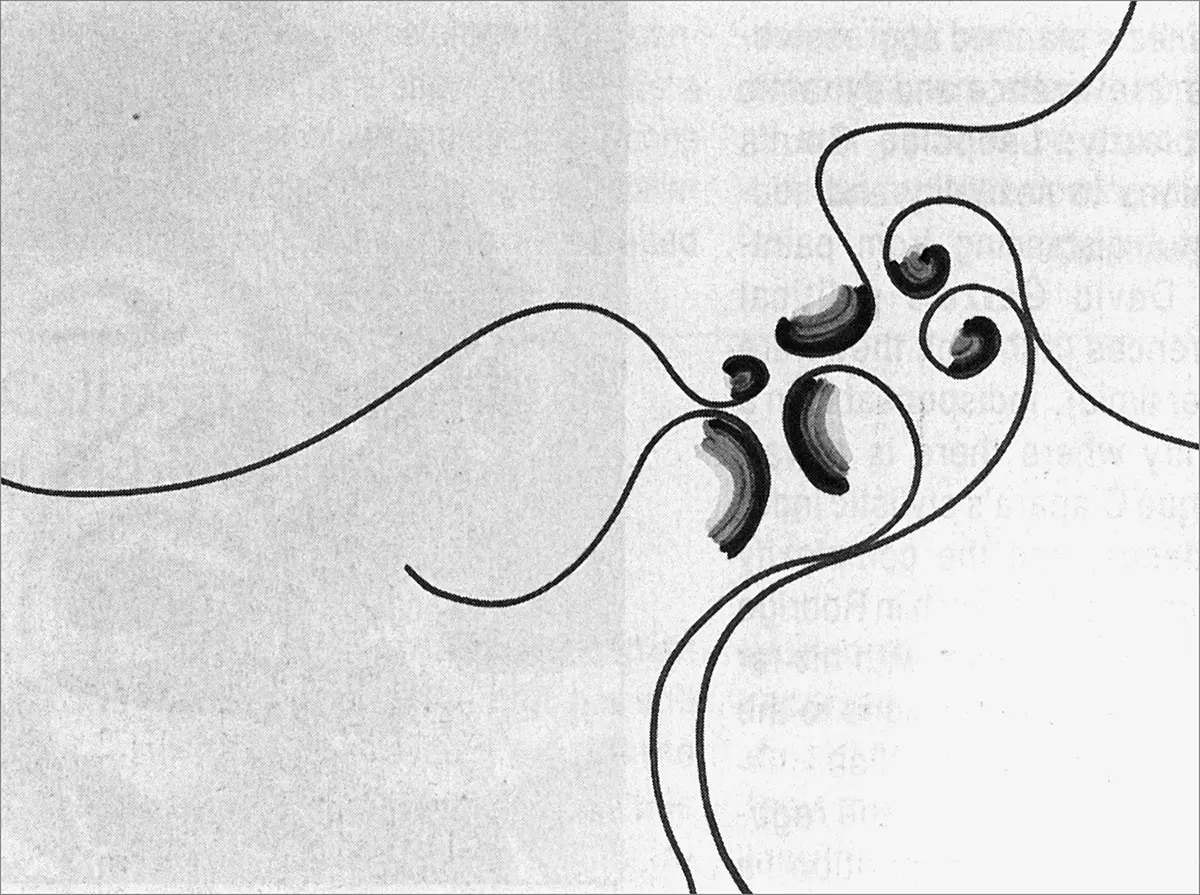
During his early period, up to his trip to France in 1951, synthetic figuration heralded a move towards geometrical proposals, as can be seen in his Still Life 1948. Vantongerloo’s influence took Magrinos towards an abstraction beyond concrete aesthetics. A small tempera work, Untitled, from 1951 showed him decidedly in the abstract sphere, with the color planes serving as a basis for the dynamic display of line work. Throughout his production two tendencies seem to be constant — on the one hand, the interplay with large flat spaces, and on the other, the great concentration of the images, which in some cases results in a certain kind of baroque effect, as in Untitled (1959), a mixed media work with collage. His move towards cosmological aesthetics resulted in the elimination of the horizon line, with the works suggesting a limitless kind of spatiality — just a few years before the first real space journeys.
ALBERTO COLLAZO