
It is rare for the title of an exhibition to describe what one actually sees. Here, however, the idea of texture appeared as a bold paradox. The canvases by Aixa Requena were on exhibit in Paris in the Salle des pas perdus of the UNESCO building, and are now at the Museum of Contemporary Art of San Juan, in Puerto Rico. Painted in large parallel bands, they consist of thick layers of paint which give the impression that we are looking at the superimposed planks of some colored huts. Here and there is a window or a wooden door that strengthens this impression of Caribbean architecture of humble origin.
The illusionistic nature of the representation, skillfully exploited by the artist, becomes accentuated when, like a spectacle glimpsed through a window, the spectator's gaze seems to plunge into these little wooden houses to discover some intimate scene. In fact, this image of intimacy appears on the surface of the pictures in the form of a black and white photograph, replacing the spectacle which might be visible through the half-open door or window. The fact that Aixa Requena pushes to the limit of the mixed media technique renders the illusion almost perfectly.
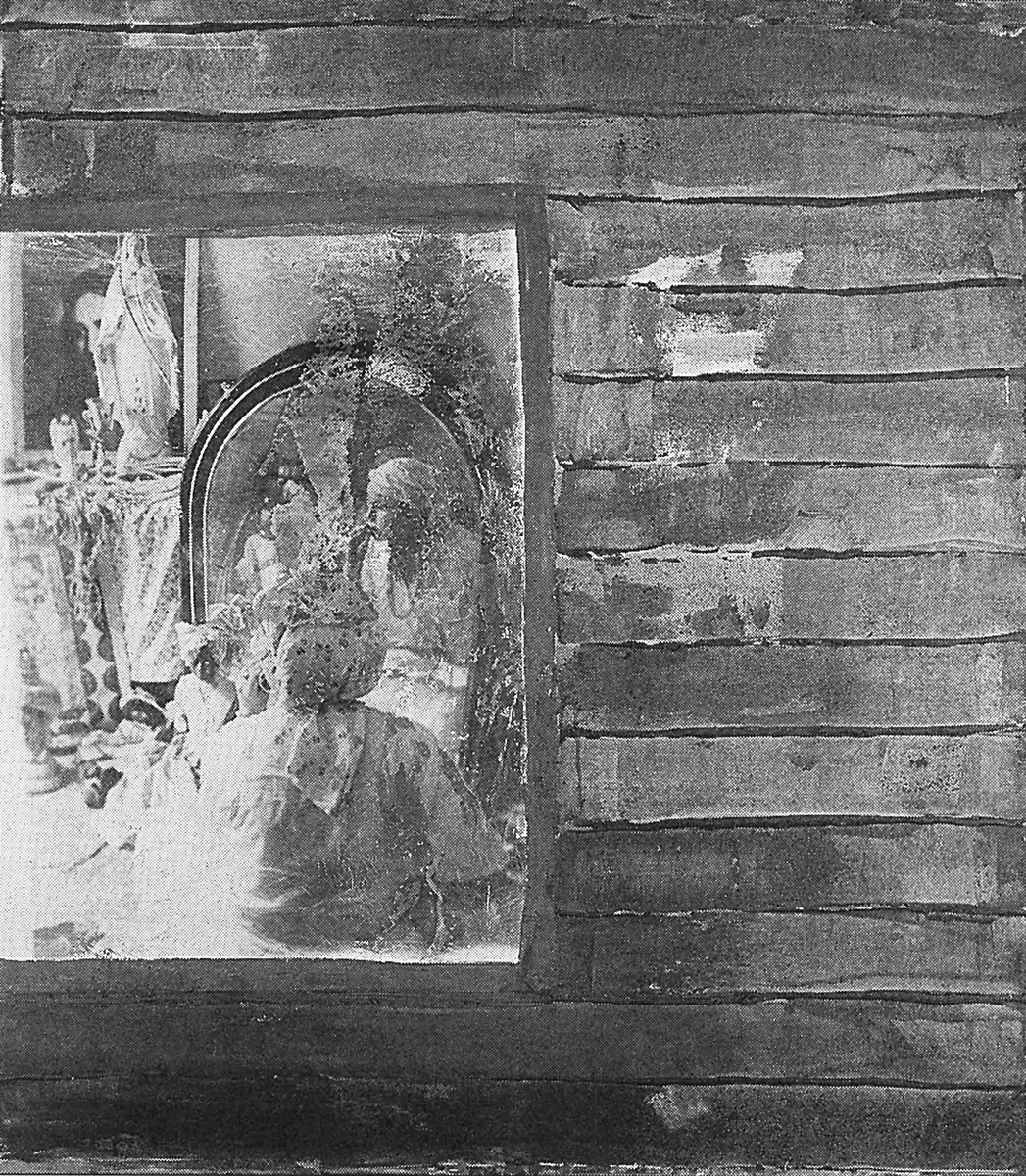
However, everything seems to shift in meaning when we realize that we are in front of a “theater of memory” and not some exotic reality. The “Caribbean textures-' thus become those of the histories which intermingle in the cultural sphere of the Caribbean— a multi-fiber blending of political and cultural histories, that includes, in particular, the history of women as a recurrent motif, providing a profile for the narratives of all the other actors. The work of Aixa Requena invites us to embark on an unusual adventure. For us, the spectators, she glances into the density of the layers making up the identity of each person, and through which each person tries to construct his or her own being.
The mirror is justifiably one of the constant themes of these works, reflecting the image we have of ourselves or of the other—an image which can unravel in the humidity of the afternoon, an image that fades when the sun has washed away its colors, images rescued from memory and restored by her selected medium, photography, to their radical reversibility.
The prints made on the canvas, which have been coated in places with a sensitive emulsion, evoke the fragility of memory. Pale and trembling, never really very clear, they show and at the same time hide, an everyday world made up of possible encounters and moments of solitude. The fact that some prints reappear, sometimes identical and sometimes different, heightens the impression that with these memories we are always playing and replaying the scene of our identity. And this scene is undoubtedly never really clear, never caught in a hypothetical moment of perfection, but always in the act of starting over again, interminable, as in the work of Pirandello.
Aixa Requena's use of the resources of various media is particularly important in this project, giving it an undeniable sense of narrativity. Each medium materializes, and thus the existence of a logical or temporal level makes it visible and intelligible. The scene the spectator discovers is thus never fixed within some static moment of time. It has begun before we have arrived in front of the picture, and will continue after we have left.
What is shown is only a moment in time, a fragment caught by the genius of photography. But the rest of the material and thus the conceptual framework of the work—the doors and windows, the painting representing the closely fitting boards—projects this instant towards longer and more diverse historicity. An entire drama emerges in front of us, of which only one image remains for us to look at briefly.
But everything was already underway. The story of this Crime and the collapse of these Fallen Virgins were set within a period of time, within a history which suddenly becomes palpable and opens up an imaginary dimension within the heart of the picture. I, this "I" of the spectator, which the latter always and rightly mistrusts, is invited to participate in the dance of meaning. It is this "I" that is called upon to write the story in all its length, which will set the image within this or that register. This “I” removes the ambiguities that lie hidden behind the images and replies, through its poetic capacity, to the uncertainties that are being proposed.
The word "textures" thus acquires an even stronger meaning. Everything, in these Caribbean stories, these little houses in the Antilles, is a tissue made up of the history of lives, the crystallization of a centuries-old, pluralistic experience, writing by many different hands extending over time. This is true, yet there is something else that concerns the spectator. The picture in front of us suddenly seems to address us, just as we thought we were only passing by—in a sublime moment of confrontation when the work invites us to look. At the very moment we thought we could escape, like a Peeping Tom, we hear the question being asked about our identity, we feel that what is moving on the canvas is fusing the fragile image we have of ourselves with the pale yet obsessive images which are already there on the canvas.
And so it is the spectator who becomes implicated in the story which Aixa Requena, like the age-old spider of the fables, has woven for him. Like all mirrors, it is a trap, an invitation to see by seeing himself. The spectator is caught up in the play of images to which the delicate eroticism of Alice through the looking glass adds an additional touch of seduction, setting the question of one’s image of oneself against the reflecting surface into which Narcissus gazes.
For what crime did Ophelia die? Did she, like Icarus (Metamorphosis) want to fly too close to the burning sun, in the belief that she could free herself of earthly laws? Did she fall back, like Ariadne, on the shores where she was thrown, in a quite different environment from that which she conquered in her ascent towards the sun? Without making any explicit references, Aixa Requena brings into play ancient mythology. But there are myths like mirrors, which always speak to us in a language that goes beyond us. The intelligence of the artist lies in the way she discovers in the contemporary resources of art, in the technical instruments of the modern world, a way of telling once again what lies in the deepest part of ourselves, the timeless fable which has been woven and unraveled throughout history. To be contemporary is to tell this story in our own language, because only in this way will we be caught in the nets of the story and the image—this is the fabric that makes us all both different and the same.
JACQUES LEENHARDT