
Alberto Castro Leñero recently presented his work for the first time in Canada at the Montcalm Gallery, in the city of Hull, Quebec. It is situated across the river from the city of Ottawa, and the entire area is considered part of the capital. The inhabitants of Hull, where the artistic life is characterized by French-dominated regionalism, rarely have an opportunity to see paintings by artists from other areas.
It is true that this gallery has also presented the work of the Peruvian artist, Pedro Caballero, last year, but it is unusual to find work by non-Canadian artists here, and particularly ones from outside the region. The reasons for this are too numerous to examine here. Suffice it to say that preference is given to local artists under Canadian artistic practice; although no major obstacles are placed in the way non-Canadians do, neither are any special opportunities provided.
Hence the two-fold importance of the work by Alberto Castro Leñero at this gallery. Although there are visual and thematic differences between the painters in the region, in one way or another, whether they realize it or not, they share certain common traits which identify them. The arrival of an artist with traits that are not only different but which seem to commit an act of violence against the predominating trends in the region might pose the risk of that work not being accepted in the interests of maintaining the artistic status quo. The Montcalm Gallery was willing to take a risk by presenting the work of one of the most important painters from Mexico, generating an unusual level of interest in the press, and among other artists established in the region. Interior Castle will subsequently travel to Washington, D.C., Toronto, and Montreal after its near two-month presentation in Hull.
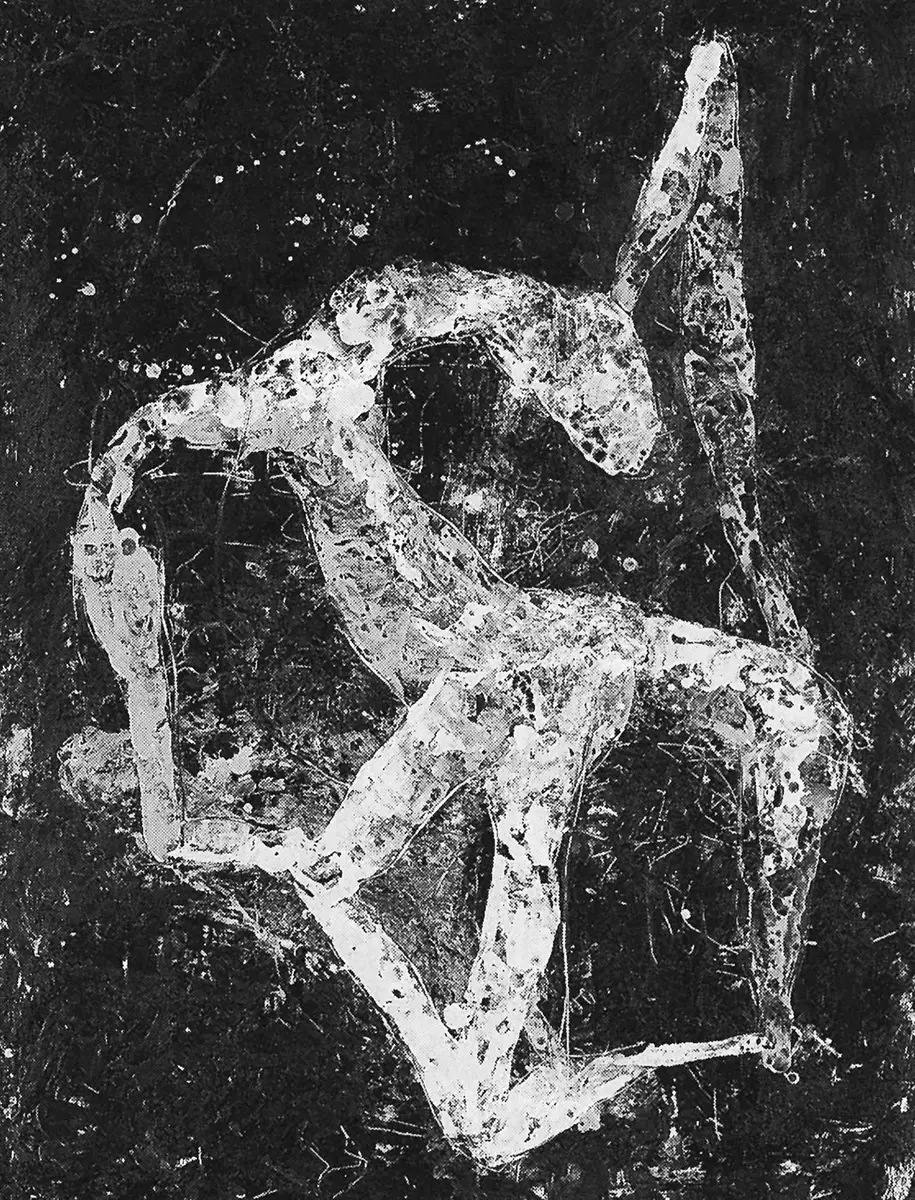
Interior Castle is made up of 19 works, most of which are in a cross or t-shape, that the artist has been using for a number of years. The Christian reference is inevitable. The title of the show, taken from St. Teresa of Jesus, evokes a mystical and interior atmosphere which, although it has also appeared in other periods in Castro Leñero’s work, now seems to be more clearly oriented towards a description of the deepest emotions to be experienced not only in religious belief but through suffering and its acceptance as a ritual of belief and purification. All the works are done in encaustic on wood. In the hands of Alberto Castro Leñero, this technique results in the creation of very impressive works full of texture. Powerful in their own right, the generous application of pigmented wax gives them an undeniable personality.
Castro Leñero has been working with the human figure for a number of years. However, this concern is not reflected in a narrative manner. There is no story being told here: the individual moments exist separate from any pre-established discourse. His painting neither narrates nor explains: it bestows. Interior Castle includes such works as Time, where Castro Leñero places on wood pieces of metal that remind us of heavy medieval swords. In this piece, which was of particular interest to the Canadian public, two large blades of a knife seemed to cut the space in which they were placed, leaving a semi-circle below that marked out their trajectory. Far from evoking only the obvious image of the hands of a clock, the corporeal nature and weight of these two metallic pieces made them paradoxically seem to be measuring the non-corporeal and ethereal with their heavy steel blades. The human obsession with measuring everything found a bloody and death-like response in works such as this. The hands/swords do not measure time: they behead it and show us the final path they followed without fear so that we in turn can follow. They are neither guilty nor persecuted. Without quantifying time, they annul it and make it their own: it becomes their condition.
Another work, a triptych titled Arch-like Composition, places the spectator before a series of curves which, although evident in the end panels are only evoked in the central panel: a woman with her back turned bends her body back to form a third curve that complements the composition. If we could "three-dimensionalize" this work, we would have a circle made up of the curved lines of the two end panels which function like enormous parentheses for the woman, who also forms a curved and moving line with her body.
Here we see another of the characteristics of Alberto Castro Leñero’s work: nothing is given definitive existence or status. Everything that we see in it exists in a changing and temporal manner—although the painting is finished, what it evokes seems to be in a constant state of transition.
Interior Castle also takes the spectator towards a world of erotic and sensual experimentation. This is not only a matter of the bodies (or fragments) of the women painted by the artist but concerns the sexual and amatory values implicit in the pictures. The eroticism begins with the texture itself as a sensitive awakening, a yearning for possession. The human forms created by the strong gesture of the artist reinforce the impression and make it necessary to adopt a certain kind of distance to gain a full appreciation of the works. Touch as something prohibited becomes evident when we realize that we can only love with our eyes, and from a certain distance, the body which is never close at hand.
The exhibition was curated by the artist himself, and included works from 1992 to 1996, all presented for the first time in Canada. Time will tell of the impact left by this show in this country. It will be seen in places where the works of foreign artists are rarely exhibited, artists with other ways of looking, other ways of telling another kind of history.
SANTIAGO ESPINOSA DE LOS MONTEROS