
The pictures recently presented in Paris by the young Mexican painter Alicia Paz reminded us that the pleasure of the artist also includes that of the spectator. The intelligent and mischievous vision which Alicia Paz has of the world around her, of the history of painting, her own creation, and the possible interaction between these elements, is fully at one with her times. Articulately, with references to the history of art and based on genuine technical knowledge, her work is contemporary, since it is placed within a context of mobility. Nothing is fixed, everything is living; art is not only a gesture to capture, interpret, and reflect, but it is also experience and reflection. The show was characterized by great freedom and coherence concerning the choice of formal vocabulary and the pictures as a whole acquired, as a result of these same qualities, a real force.
Quotation and parenthesis are resources that artists of the twentieth century have used simultaneously as a parodic and astute means of dealing with the weight of history, and as a metaphor of the fantastic or absurd dimension which can result from the coexistence of different times. But the sense of provocation has diminished with time and contemporary artists are surrounded by memories, images, technical resources, and theoretical postures which they must constantly cast off, exorcising them through an inevitable critical questioning.
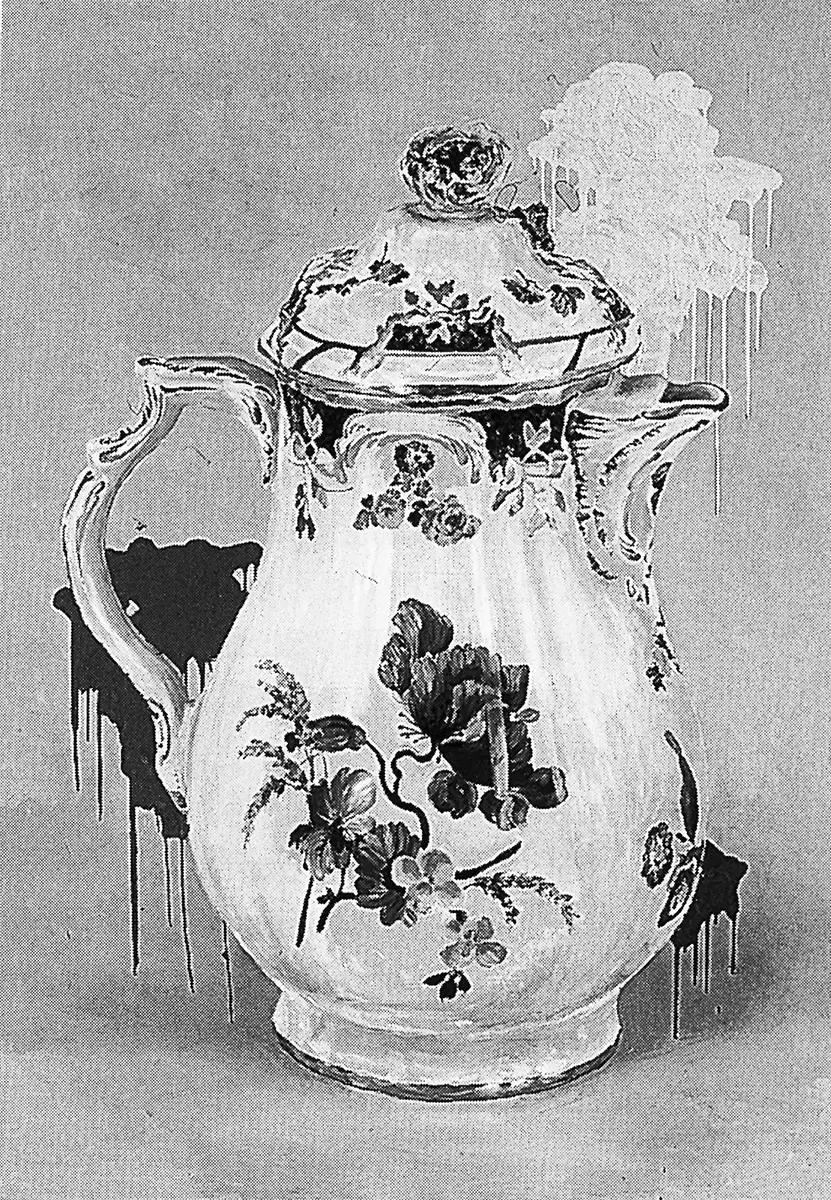
The originality and singularity of this young artist lies in the fact that her cannibalistic posture—with the purest tradition of her Latin American predecessors—is the result of a position that is both intellectual and sensitive. While being an artist/actor of both reality and fiction, of art and the world, she also questions herself about the separation of the spirit from the body, artifice, and illusion.
As the interpreter of her own fiction, she can imagine, enumerate, observe, quote, and betray, but what she sees above all is the creation of an atmosphere. Indeed, she refers to the theater when she discusses her painting. To be in control of a fruitful space which is in constant transformation coupled with her role as an artist between two worlds also allows her to place herself between the spectator and the painting, or rather to place mediators (a small fluffy rabbit, a clown, etc.) which are no more than the visual and conceptual pretexts of her artistic project whose role is to question the meaning of an impossible confrontation.
It is an art which places the artist in a broad parenthesis within the act itself of painting, through its interpreter-usurper, Goya, Velazquez, miniatures of European eighteenth century porcelain, and kitsch objects are the actors in the transmission of this time of the past and this interrogation of painting. Equipped with palettes, pencils, paints, and brushes, the protagonists are distanced from their own roles as artists, that Alicia Paz attributes to them with regard to the narrative on painting.
Alicia Paz, who was born in Mexico City in 1967, studied at the Academy des Beaux Arts in Paris, where she has lived and worked for a number of years. The interplay she creates with the dialectics between content and form emerges from her mastery of a conceptual and visual reasoning that undeniably links her to contemporary art. As she herself has said, “l want to do painting which describes the world but I want it to be seen as an integral part of that same world.” The inscription-confrontation which constitutes the basis of her project is expressed brilliantly through her pleasure in painting, with her work expressing a sense of joy shared by other Latin American artists in a spirit of generosity devoid of any complexes.
CHRISTINE FRÉROT