
On the revolutionary murals by José Clemente Orozco of the Antiguo Colegio de San Ildefonso, alongside what was the Great Temple of the great Tenochtitlan, now Mexico City, there falls, in a chaotic mixture, three soundtracks that disturb the tranquility of this site used for the most important official, national and international exhibitions, such as Mexico: Splendors of Thirty Centuries. Far from being objectionable, the havoc is a clear sign that something is changing in Mexico.
Chido, a popular word meaning something that is worth the effort, something that is impressive, critical, and rebellious, is a mode of challenging from the margins which, in this exhibition, managed to create a sense of opening up and tolerance rare in the cultural policies of Mexico vis-à-vis expressions of profanity, of demands for human brutality, and the ambushing of established values.
Passing by the retinue of plump and snobbish aristocrats that Orozco painted in the entrance corridor, the spectator enters through a black curtain on the second floor of this colonial monument to find a dramatic setting of red and black walls, where he becomes the target of a franc tireur as he passes in front of a video projection showing scenes of everyday violence— the work of Gustavo Vázquez. Transformed into the obese Orzoquian characters which occupy the place, visitors suffer a kind of evacuation of any moralizing or democratizing pretensions, through paintings, videos, installations, scenes, objects (the artifacts of fear), and sound environments which offer up slices of the exacerbating political, sexual, and cultural violence of recent years.
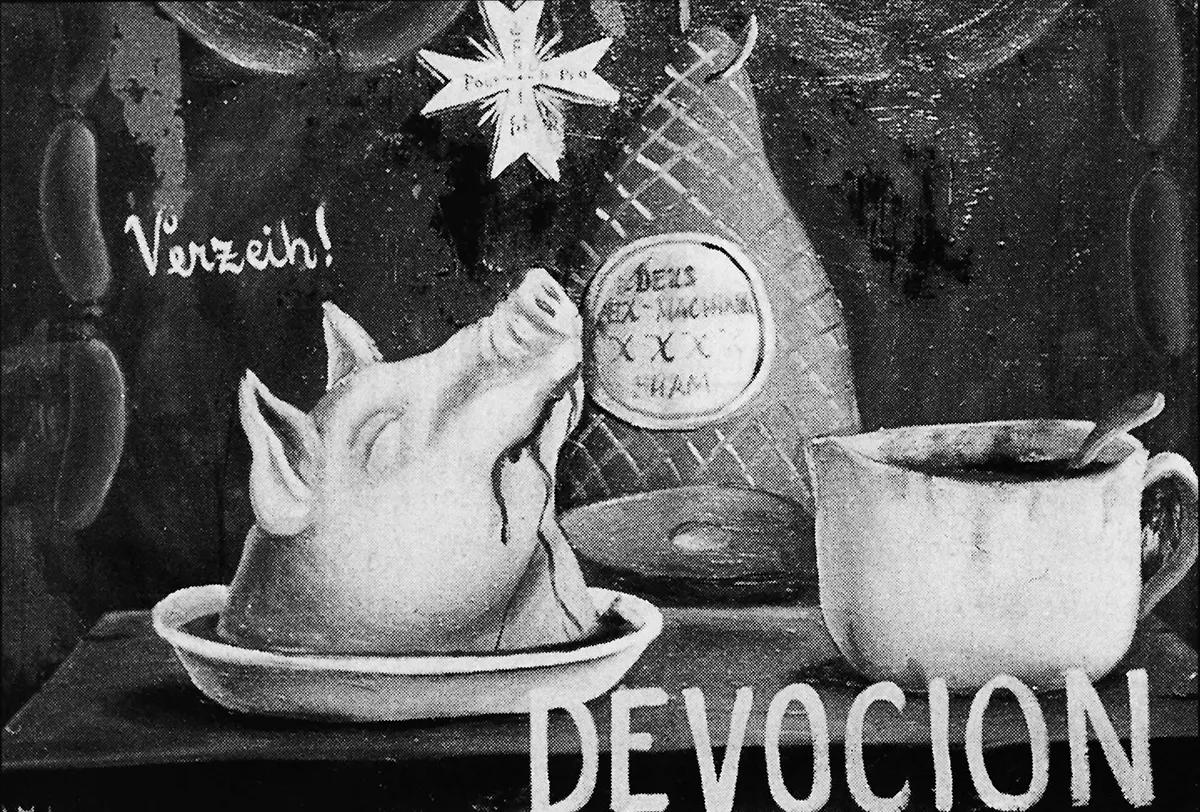
The brutality of man has always been present; sadism and masochism are the savage practices of inter-ethnic survival whose impulse permeates the structures of power and leaves little room for conciliation. But more than violence as a repressive social act, this exhibition showed that the body is its ultimate refuge. The primary territory of a society in which freedom has become the standard of slavery, the body is the most primitive and immediate field for non-conformity and self-sacrifice. To assault it is to retain the omnipotence of individual will, to take control of the life and death giving power, bringing perverse horror to the look of others (and obtaining pleasure in the process), denouncing, in the pain itself, the atrocities of society.
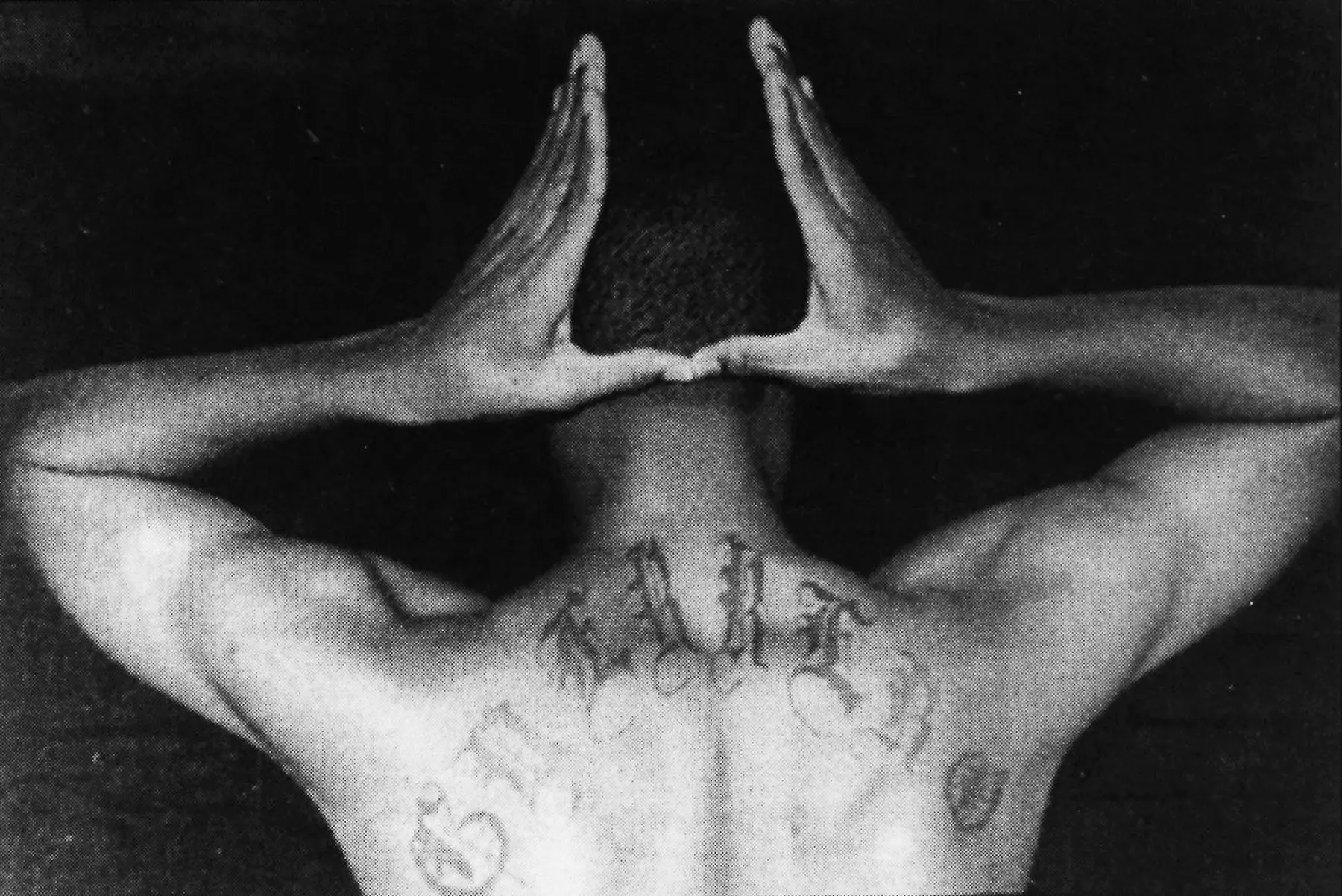
This is evident in the flesh of the prisoners who write their stories alongside the photograph of them taken by Dennis Callwood. Their bodies are covered with supplication. "Forgive me, my Jesus," "In Memory of Jasmine," "Bless me for my sins"—these are tattoos of the deep social and moral complicity between the authorities (the "friend”, partner, Providence?) and delinquency, between justice and corruption, between pacification and aggression, between democracy (we are all created equal, but some of us are more equal than others), and xenophobia.
The vaginal lips of Katia Tirado, pierced with rings, with a syringe hanging from them, a coin with the dismembered female body of the Aztec deity Coyolxauhqui, a pistol-key ring or a pair of scissors, are sources of provocation both for the chavo band and for the assiduous visitor. Photographs placed at the exit summarize and complement the meaning of the show, and are indispensable to the power of this discourse on violence against the body itself and its social content.
Installations such as an electric chair surrounded with photographs with time-cards by Carlos Aguirre, or a room ransacked by a thief in the work by Héctor Bialostozky are more effect-seeking. As the curators point out, the show “is a dis-narrative (i.e. more experiential) and fragmented (like reality itself) discourse on violence in different communities on both sides of the border."
However, it is this characteristic which is both its strength and weakness. The fact that it is a show by Chicanos, Mexicans, and United States artists with a strong dose of border themes, as seen in the photographs of Antonio Turok or the codices of Enrique Chagoya, gives it an air of extradition within the heart of Mexico City. But it also serves as a thorny and distant memory of the suffocation of indigenous realities under Spanish dominion (barely 476 years ago?).
Although the local nuance evident in the curatorial concept tends to reduce the show to one of graphic and journalistic testimony, this impression is transcended in some cases by a ludic touch, as with the clocks by César Martínez, where the national heroes on the Mexican banknotes, like the coins, are fragmented into rotating amounts. With great humor, the artist magnifies his 100 peso Netzahualcóyotl, 20 peso Benito, 50 peso Morelos, 10 peso Zapata.
The strength of the discourse, therefore, is that it allows the other, the abuser, the delinquent, the underdog, the racial, sexual, and social minorities to speak from within their own space, making the spectator a participant in the patent violence and intolerance. The rejection of the wretched and of those who are migrants, a characteristic, according to Georges Duby, of the end of the first millennium, is reappearing as we approach the year 2000. And it is the other who defines the territory to be defended. How far will man have to go before intolerance is defeated, or will violence remain as the sole means of cohabitation?
The spirit of denunciation in the show tried to hide behind the curtains at the entrance. As a reflection of a cautious institutional approach, this timid opening up was in fact a significant and hopeful event, reflecting a sense of tolerance to be found in the Mexican artistic environment which was not only a demand of the exhibition but of life itself. This was a show about the other, the territories of violence,
the futility of the local, and the transcendence of its racial, sexual, and political struggles. For this reason, the empty showcase with the words in black letters against a red background that read: "What was not shown," should have acquired a greater museographic weight and become integrated into the discourse, alluding not only to censorship and repression but above all to the intangible nature of the experience which each individual has about violence and its “aesthetics”.
ANA ISABEL PÉREZ GAVILÁN