
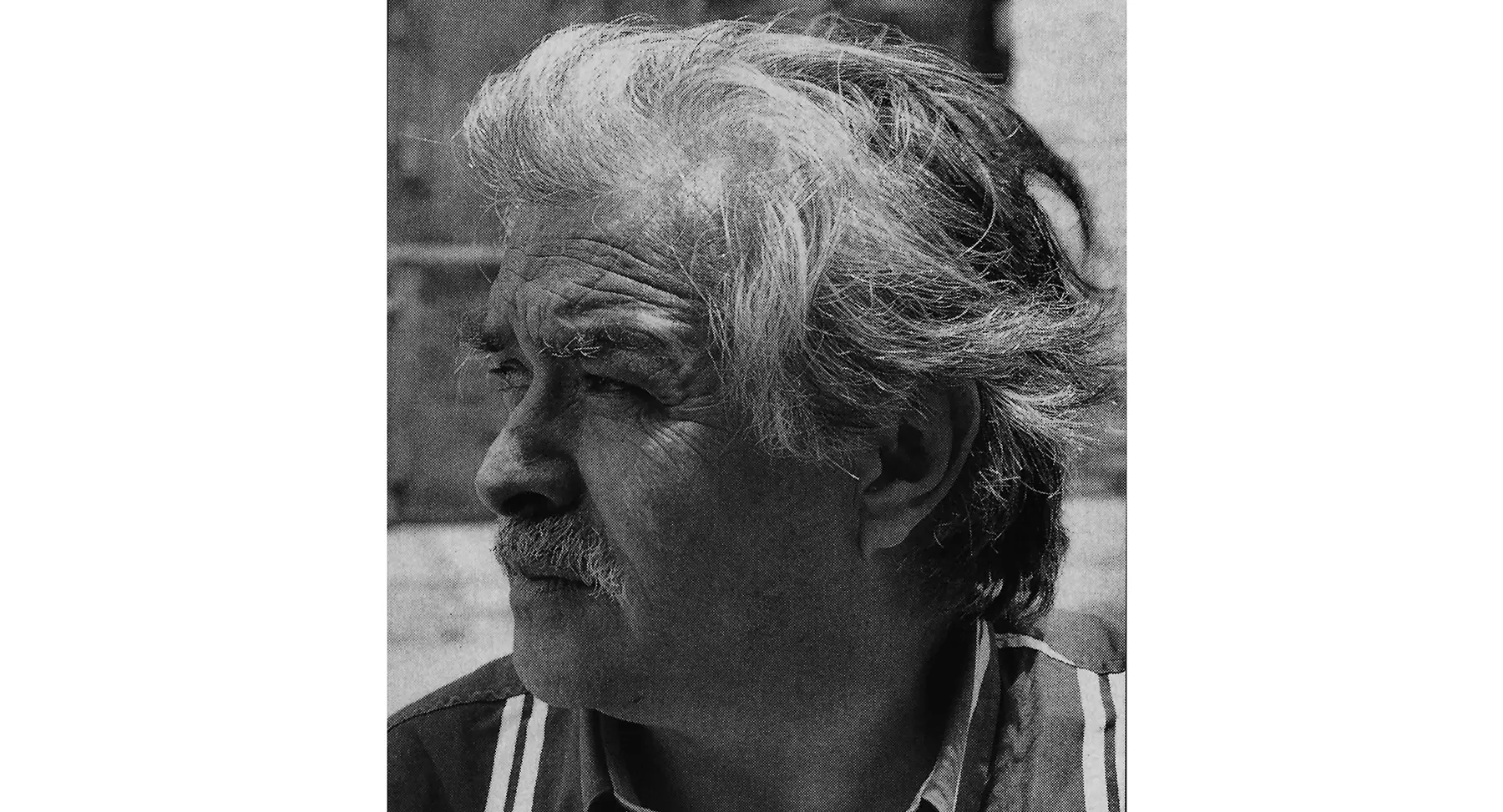
On the 3rd of May, Carlos Rojas died in Bogota at the age of 63. I met him at one of his subjects, "Art Composition", at the University of the Andes during my first semester as a student. A year after, he traveled to the United States, and upon his return, I again attended one of his courses. Carlos was demanding, passionate, and difficult, maybe because of his own capacity and virtuosity.
Sometimes a word, a suggestion, an idea, can be transformed into a project, and that was what happened with Carlos Rojas and Arte en Colombia.
When in 1975 he received an award at the São Paulo Biennial, I discussed with him my surprise for the little press recognition that he had received (about 10 lines in the most important newspaper) and how important it was to have in Colombia a magazine specializing in the fine arts in Colombia. He answered that there was no one to do it. At that time Carlos worked at Colcultura, the state institution in charge of the cultural affairs in Colombia. I commented to him that Colcultura should do it. He responded that there was no budget, and I immediately suggested that it could be financed with advertising. He maintained his position assuring me that nobody would place advertising in a magazine of Colcultura and proposed that I do it.
The idea disturbed me and became an obsession. I did research that encouraged me to make the decision, and I talk to him again. In support, he designed the first logo of Arte en Colombia and presented it as a gift. Today, 21 years later, all those memories are present. I have told this story many times, and I consider obliging to present an acknowledgment to Carlos because, in a way, it was him who started the spark of this project.
Now that Carlos Rojas is gone forever we remember the master, the talented artist of multiple facets, with a large artistic production. I have the memory of the teacher and the one that motivated this adventure called Arte en Colombia - ArtNexus.
CELIA SREDNI DE BIRBRAGHER
He was born in 1933 in Facatativa, a small town in the plains of Bogota. After studying architecture for several years, he dedicated himself to art, having his first show in 1957 in Bogota. Carlos Rojas was an artist because he had a unique and exact manner of seeing things. His art is the symbiosis of design, which he understood as the capacity to see the formal properties of objects, and life, which he understood as the material of freedom. His paintings allow our eyes to penetrate them guided by precise geometric principles, and once in them, we are invaded by the living pigments of color and matter. Also inhabiting the surface of his paintings are fragments of objects such as glass or wood, generally used in the construction of the world around us. He invited these materials to participate in his own constructions because Carlos Rojas was an artist not only because he saw the world with clarity, but because he never lost his capacity for wonder. The small details are treated with precision, in such a way as to become visual accidents, concrete facts that are really there, even though they seem imperceptible to the rest of the world.
During the sixties, he began his own journey in art history, with a series of studies of vegetables and synthetic cubist paintings. Later he made some references to the Pop and Dada movements with his own Women with Corset. In the seventies came the series Engineering of Vision, creating spaces with minimalist and analytic principles, not only in painting but also in the sculpture of barely recognizable cast-iron rods. From that era came the first logo design of Art in Colombia. During the eighties, spatial and design problems gave way to a different level of investigation, that is to say, the plane as support for more expressive problems such as color and pigmentation, wet or dry, that took on a life of their own. Clots, gouaches, scratches, and sparkles became concrete details. America, El Dorado, Mutantes, Mater Materia, and Por Pintar, are some of the series constructed by the subtraction of those parts of the world that interested him, that generally were the surface of things, with an element that the artist called “presence”. The surface, marked by the passing of time, adds its formal conditions in a natural manner to become an inseparable whole. These were his last artworks.
"Carlos Rojas influenced a new generation of Colombian artists. Here are two of their testimonies: The master Rojas’ mind sheltered the contradiction between intuition and reason, thereby opening new ground. He had integrative thoughts. He is, for me, a great influence." Luis Roldán.
"Rojas loved dirt. So much so, that he wished to lose himself in it: to be part of the wave of capricious movements that make it possible, and to accompany the time that accumulates and solidifies it. His method of working impressed me: Rojas bought his pigments in bags and spread it over the gasoline that soaked the canvas. Rojas used sponges to soak up the excess gasoline around the canvas, respecting the orography that had just formed. With a pointless pencil and an aluminum pole, Rojas opened grooves on the surface of the taut canvas. Then he would take a trash lid, squeezed it against the canvas, and turned it frantically about the almost dry material. Lastly, he sprinkled handfuls of silver or golden pigment into the air, which, like a delicate, slow mist, settled in the archaeology that emerged from the canvas, covered by time. Rojas is dangerous." Danilo Dueñas
NATALIA GUTIÉRREZ