
Eight years after his last exhibition in Buenos Aires, Cesar Paternosto just held a new show at the Galería Rubbers, with fifteen works that complement our knowledge of his activity during his absence. This Argentinean artist, who has lived in New York since 1967, was at that time doing abstract images in vibrant colors on stretchers in shaped canvas format. Toward the end of the 1960s, there appeared a disturbing monochrome surface in his work, with the color flowing at the edge of the stretchers, bringing about a displacement in the observer’s angle of vision. In the second half of the 1970s, his visits to the north of Argentina, Bolivia, and Peru led to the establishment of formal and thematic coincidences with pre-Columbian cultures.
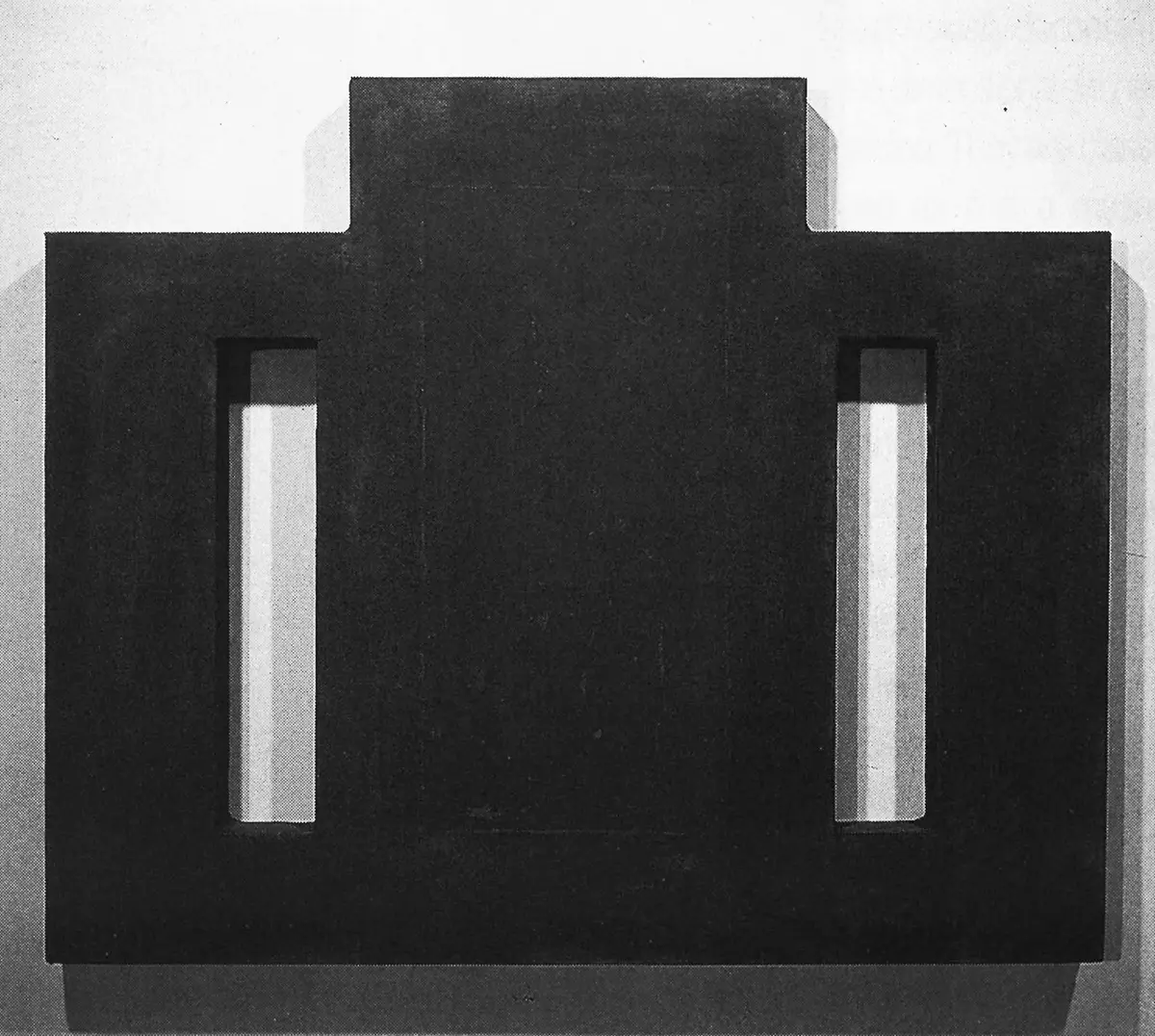
The expectation generated by the presence of Cesar Paternosto among the exponents of the different currents of abstractionism, as well as young students familiar with his classic study titled La Piedra Abstracta, or his articles on art, was enormous, The works presented in Buenos Aires revealed some differences with the earlier ones, with variations that, although they do not lead to changes in concept or structure, do introduce modifications which review the plastic language developed by Paternosto for use in his aesthetic projects. Today the emphasis in his works is light. At other times it had been lateral observation or the bare treatment of the surface. Perhaps all these works can be seen as a succinct synthesis of his earlier characteristics since in all cases, the observer is not passive but must establish a dialogue with the works.
The theme of light contributes to this objective: it penetrates through the openings in the pictures and generates different degrees and densities of luminosity. This creates a subtlety that catches the spectator’s interest, coupled with the treatment of the pictorial surface. The color is in general monochrome, with minor tonal variations accentuating specific areas. These are also emphasized by a discrete use of impasto, evoking an ascetic and harmonious range of tones.
The openings also create an ambiguous sense of volume, because although the view is frontal, the filtered light provides an impression of depth that fluctuates between specific and pure suggestions. A good example is Construction II, a mixed-media work from 1996, which combines acrylic and marble dust on wood. In this work, the opening is at two levels, and the interplay of light is reflected in the treatment of the chromatic plane. There is greater subtlety here than in Diptych IV (1992), where the openings are clearly defined.
In conclusion, the works presented by Cesar Paternosto show him in full maturity, not only in form but in the transcendental meaning given to his aesthetic undertakings.
ALBERTO COLLAZO