
One smells Ernesto Neto’s new exhibition before one even turns the hallway comer and enters the gallery. Arranged in the raw space is a group of sculptures that are, for those conversant with Neto, at once both familiar and very different. At first, his strategy appears deceptively simple: he has arranged throughout the gallery nylon stockings that have been filled and stretched so that they reach from the floor to the ceiling.
As with Neto’s previous work, these everyday materials take on a very different appearance. Our visual attention is split between examining each separate piece and looking at the work as an installation, with each object becoming an element of the whole. We have once again the play between the almost impossible elongation of the «leg» that is attached to the ceiling or wall, and the bulbous form of the «foot» that is grounded on the floor. We are constantly aware of the materials used, and the issues and implications raised when one considers these works as a sort of commentary on women's bodies and the abstracting tendency of fashion. At the same time, we lose sight of the nylon's original purpose and then see an object that deals in issues of precarious balance, weightless thinness, and solid mass. Previously, when Neto had filled these nylons with lead pellets, there was a further tension between the lightness of the nylon versus the unforgiving dense solidity of the lead, calm at rest in its sheath yet at the same time threatening to tear the fabric.
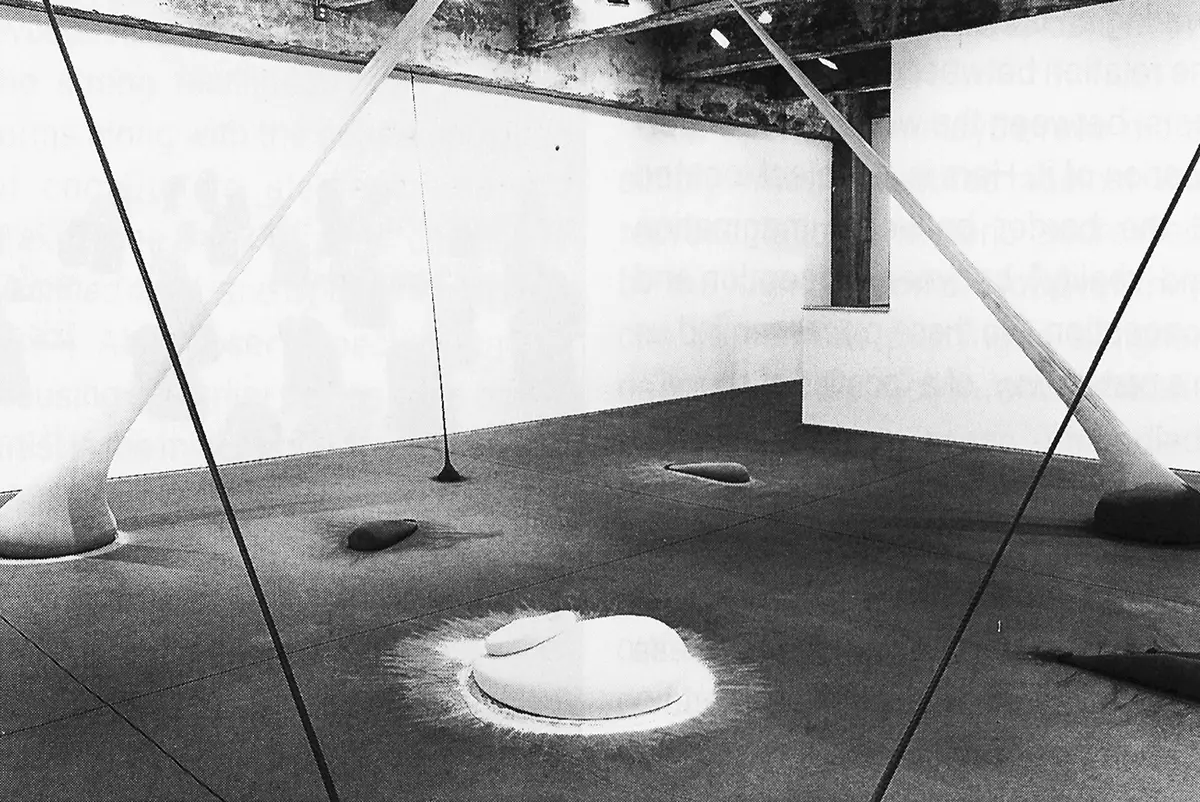
This time around Neto has made a subtle yet profound change. Rather than lead or concrete, he has uses spices like clove, cumin, and curry to fill and weigh down the nylon. After filling and stretching a stocking, he allows it to drop to the floor. The spice seeps through to make a powdery ring around the bottom of the sculpture and extends the object’s presence outside of the actual physical parameters of the stocking.
By using spices, Neto adds many new dimensions to what was a familiar project. The large accumulations of pure spices add a bold and colorful element to these works—something that was not a major factor in earlier pieces. Instead of seeing a room full of lines and curves playing off each other we also experience the relationships he has set up between the bold yellows, reds, and whites. The spilled spices paint the floor as well and add to the feeling that a room-size installation has been created, that Neto has constructed a three-dimensional abstract painting of intersecting lines and round pools of color. The employment of the spices adds another sensory response to these works as well; in fact, the smells, when combined, border on being displeasure and overwhelming, perhaps as a check against the enhanced visual pleasure that these works provide.
Perhaps most importantly, by employing these spices in works that stretch longingly upward and are grounded in a bulbous form, Neto has dramatically increased the organic sensibility of his sculptures. While the nylons filled with lead pellets could be seen as making some reference to the body, these take on an undeniably plant-like character, planted in their own ring of «soil.» It is possible that this shift toward the organic should be seen as a final act of liberation on Neto’s part, a resolute and final break from the concrete-and-steel sensibilities of the Brazilian Neo-Concrete movement that he has been a part of. It may also stand not as an act of closure but one of opening new possibilities. It will take future exhibitions to see which is actually the case.
JOHN ANGELINE