
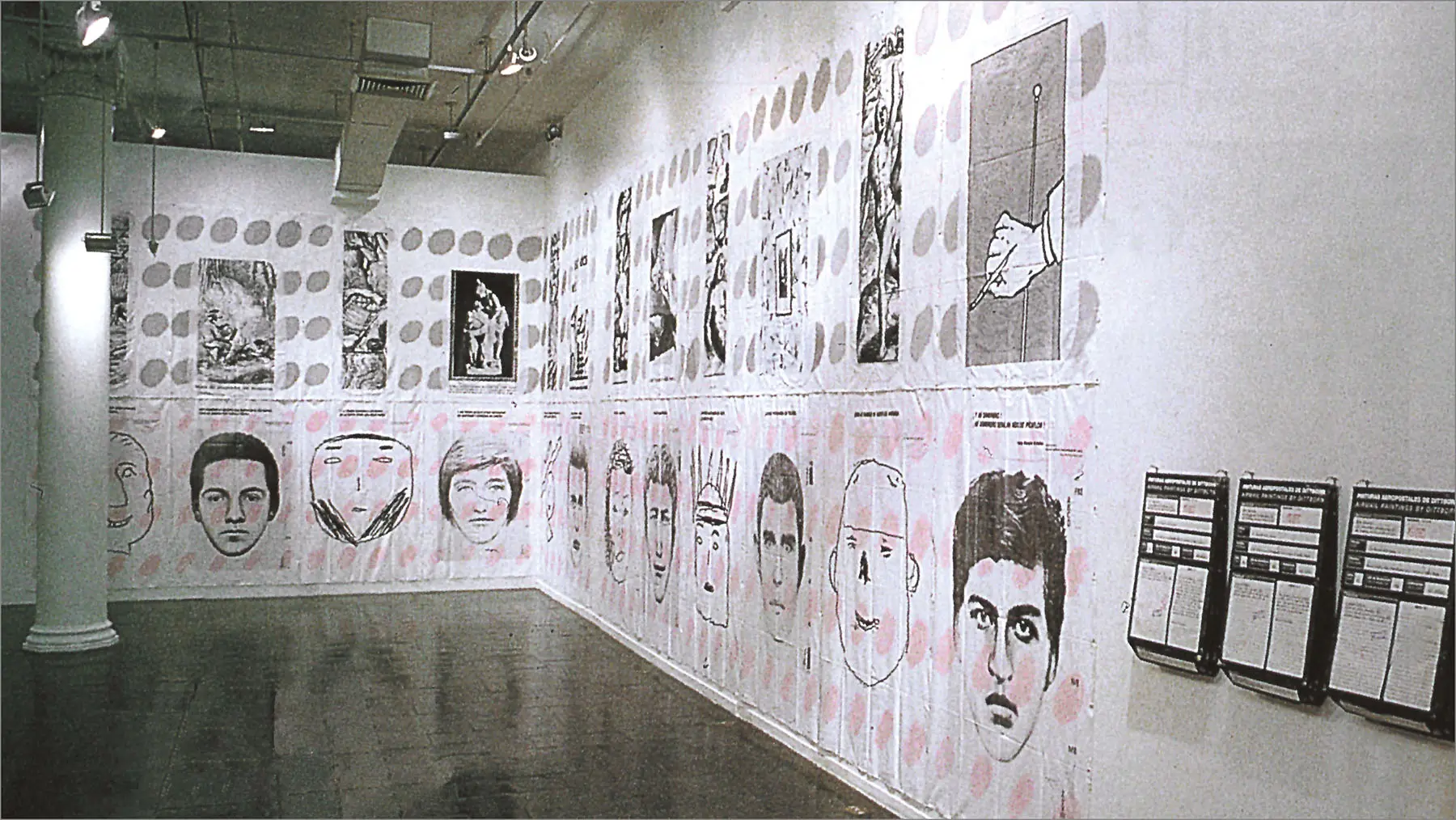
Remota: Airmail Paintings, is the first major exhibition of the work of Eugenio Dittborn in the United States. After numerous international group exhibitions and successful one-person shows, most recently, MAPA, a survey of works from 1984 to 1992 at the ICA (London) and Witte de With (Rotterdam), Remota: Airmail Paintings is one that was long overdue in New York. Curated by Dan Cameron and with an important catalog published on the occasion of the exhibition,1 Remota: Airmail Paintings is a joint project between The New Museum of Contemporary Art in New York and the Museo de Bellas Artes de Santiago in Chile—a collaboration that in itself is significant.
Seven Airmail Paintings made their way to a city that for too long had been considered the center of artistic activity. As with the few exhibitions that have begun to shatter the stereotype of art from the Americas,2 the reception of Remota: Airmail Paintings played on the old prejudices toward Latin American art as well as the new theoretical outlooks that are critical of the very notion of 'Latin American art' itself. Too political for some, and not enough for those who make activism a fetish, the reactions to Remota: Airmail Paintings ranged from cool to warm; from detached and dismissive to engaged and conflicted, and, from bewilderment to more serious entertaining of issues raised by the art and related to larger debates taking place in other cultural locations.3 Aided by curatorial endeavors, publications, lectures, and panel discussions that have introduced and reiterated other approaches and visions in the United States to art and visual culture from the Americas, Remota: Airmail Paintings is an anti-dote, a trigger, a jump start from which to address meta-artistic questions and problems resulting from close, multiple, contradictory readings of the works themselves.
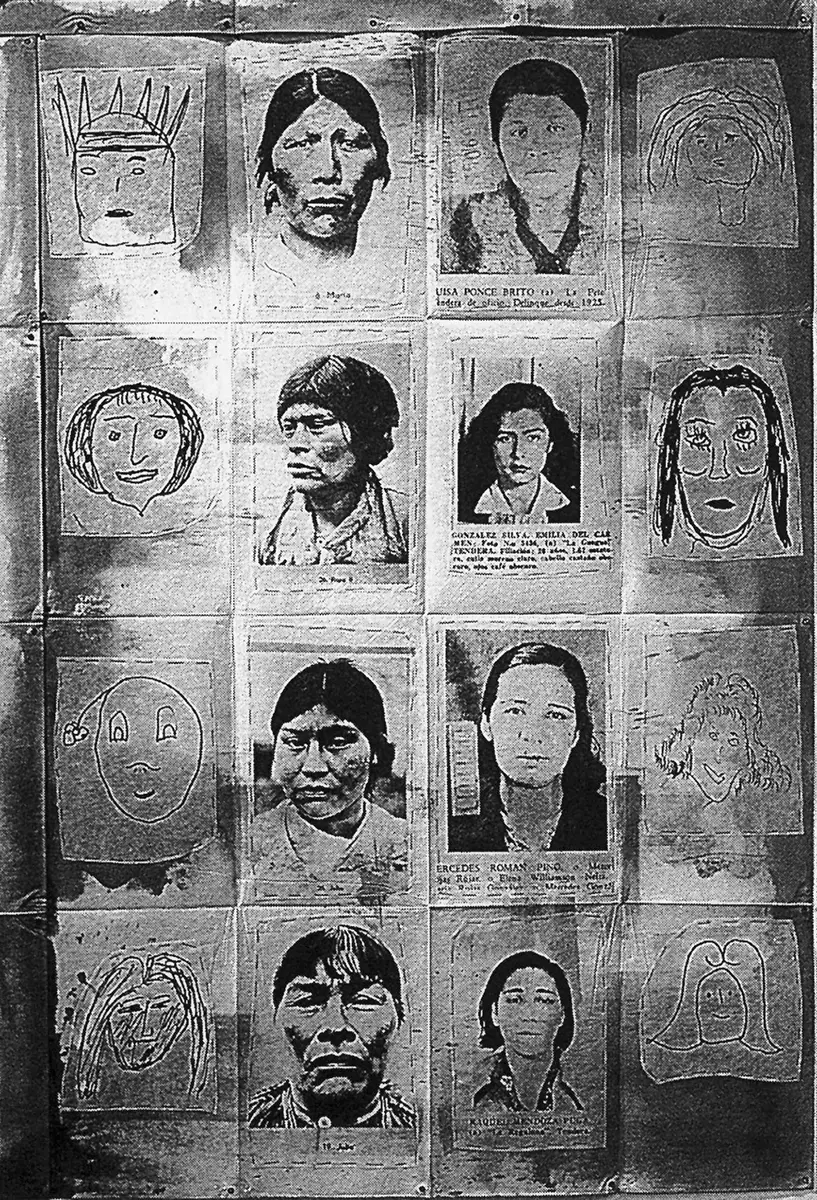
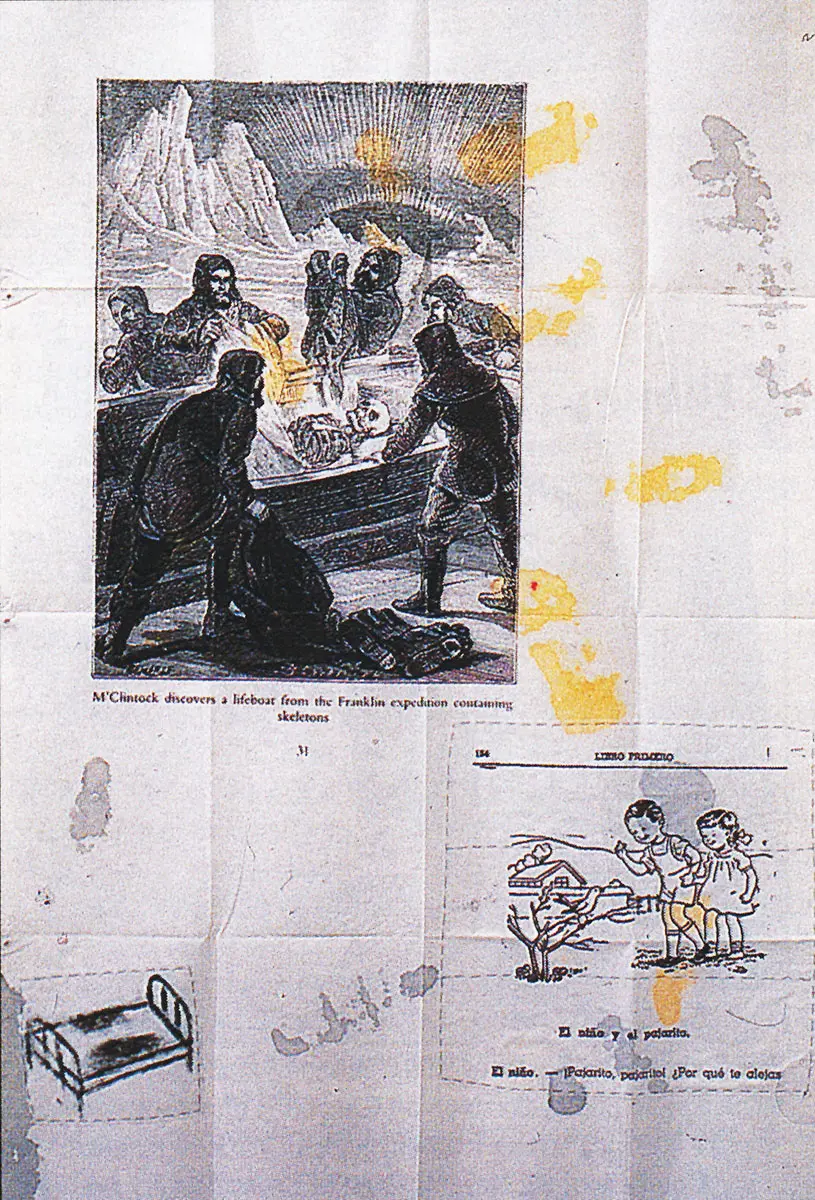
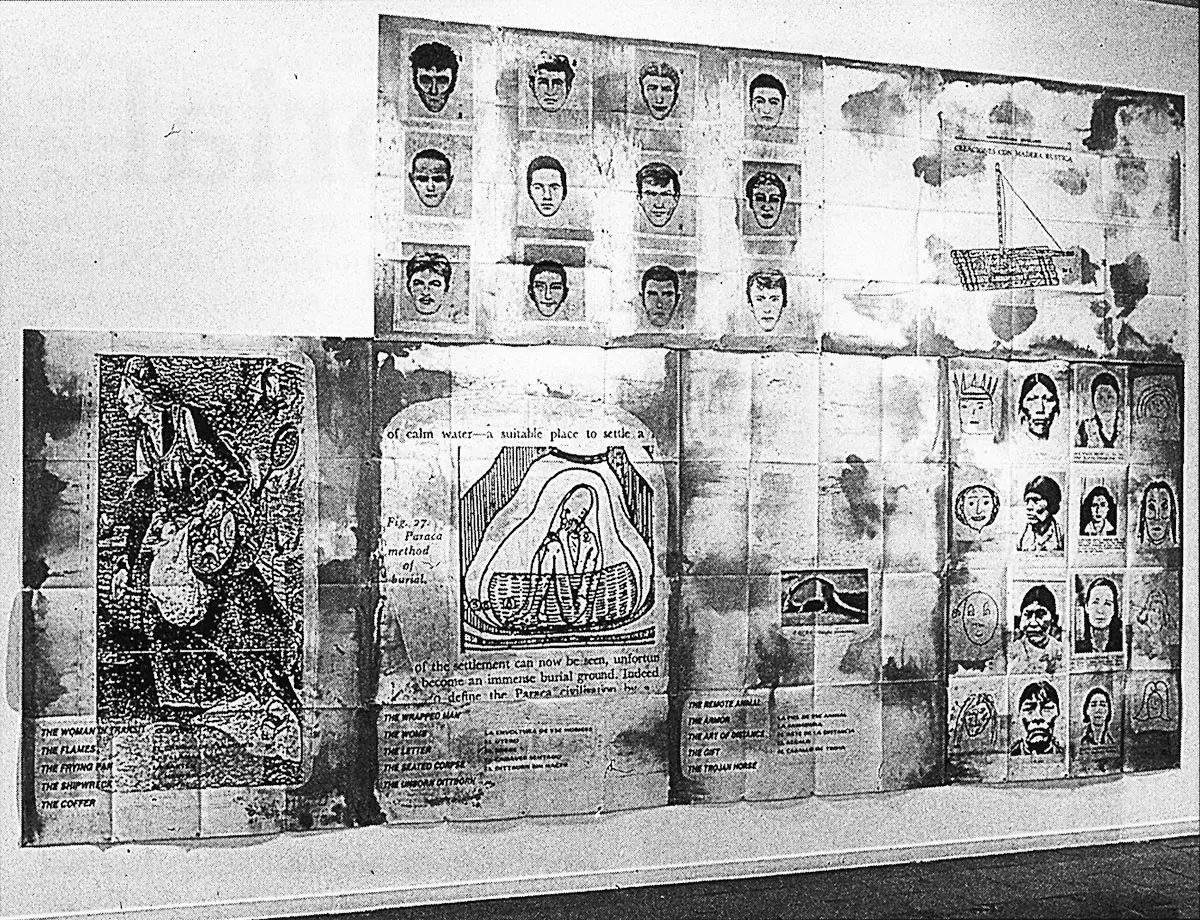
Like Cildo Meireles' Insertions into Ideological Circuits (1970), there is in the Airmail Paintings, for diverse reasons, a qualitative shift from production to the circulation of the object in the public sphere. Yet Dittborn is paradoxical; like a coyote trickster, he leads us to displace our involvement with the work to its very process of circulation. The Airmail Paintings—printed, stained, transferred, and sewn-on images of drawings, found photographs, heterogeneous texts, including newspaper clippings; and diverse media on a paper and/or felt support surface— are folded and placed in an envelope. Written on the envelope are the route, exhibition venue, and description of the airmail painting. Always placed next to its corresponding Airmail Painting, the envelope is meant to be read by the viewer, framing the work it contained. "In a sense, the important thing is not so much to read what is in the Airmail Paintings—basting stitches, silkscreen, embroidery, blotches of dripped paint, charcoal, feathers—as to read what the paintings are incessantly doing: traveling."4 Yet all these signs and activities are still facilitated by the auratic presence of the work in which space, scale, the material hybridity of the works, the envelope that serves, according to the artist, as its womb/skin on route, and the visual/textual narrative of the hanging/installation of the Airmail Paintings, come together to trigger other structures of knowledge and of the visual. In fact, according to Mari Carmen Ramírez, "There is a total inversion of the Eurocentric model in Latin American conceptual art. What is posited from the hegemonic centers of power as a total disappearance of art and the object, in Latin America, is re-posited by way of re-utilizing the object and inserting it into new semantic and social contexts, from where the object acquires new meanings. It does not solely concern a process of the recuperation of the object; what is important in our latitudes is its recuperation and reinvestment with new semantic charges that make it circulate in another manner."5
Neo-Expressionist painting in the 1970s and 1980s in Western Europe and the United States, while returning to the self and to history as a subject, as well as working with and around various degrees of differentiation, was not only culturally specific but intrinsically linked to a return to order in the economic-political complex.6 If painting and its return, could, as Thomas Lawson has argued, be qualitatively significant and different, given what he claims are its 'never-ending web of narrative possibilities,' in other cultural locations characterized by an economic-political complex, such as Chile, painting had fewer possibilities. Other forms were sought by artists, particularly from those who resisted political exile, to express narratives and stances of diverse sorts.7
The Airmail Paintings, created within one of the most brutal military dictatorships ever seen, challenge and circumvent political censorship. In overcoming established forms, they transgress and redefine fields of artistic action. Dittborn first began to develop and experiment with the photo-based mixed-media form in 1984. In the artist's words, "the Airmail Paintings are a pictorial subtraction: they extricate themselves from easel painting, then steal away to maneuver through the postal system with the barest minimum of paint. Next to nothing. Just what they need through it and out the other side, where they are exhibited as a display of numerous scarce resources..."8 These hybrid paintings not only call attention to the traditional form and its complicity with the academy and the market; they also signal its crisis and difficulties in coming to terms with realities not addressed historically in its gaze and visual scope. Discussing the historical trajectory of painting in Latin America as a practice linked to Eurocentric dominant cultural codes, Nelly Richard has noted that, "photography will remain, at least in its most subversive of its versions, an accomplice of everything rejected by painting, and will record the most rebellious and erratic drives of the rest of society, of that group which opposes and resists being sublimated by painting."9 During the dictatorship in the 1970s and 1980s, photo appropriation and deconstruction, particularly of those images published in the government censored mass media, were an aesthetic strategy by which the regime's discourses were undermined, contradicted, and indicted. Photo-based activities by artists such as Dittborn produced other modes of signification and challenged the discursive monopoly of the regime to define and frame the established reality. Further, as Richard has sharply observed, photographic activities and interventions, (temporally) rescue from oblivion what official operations sought to confiscate from collective memory. Richard's notion of 'temporal rescue' is framed by her dynamic concept of memory and its politicization:
"Dittborn’s work understands that memory is not the past reduced to the historical narrative in control of its own (single and definitive) meaning, but a temporality as yet unfinished; open to multiple rewritings of the past which base themselves on the fragment as isolated evidence of a half-truth that always confronts victor and vanquished. Dittborn's work employs a memory-subject that disassembles the past, hazarding unexpected connections between breaks and sequences."10
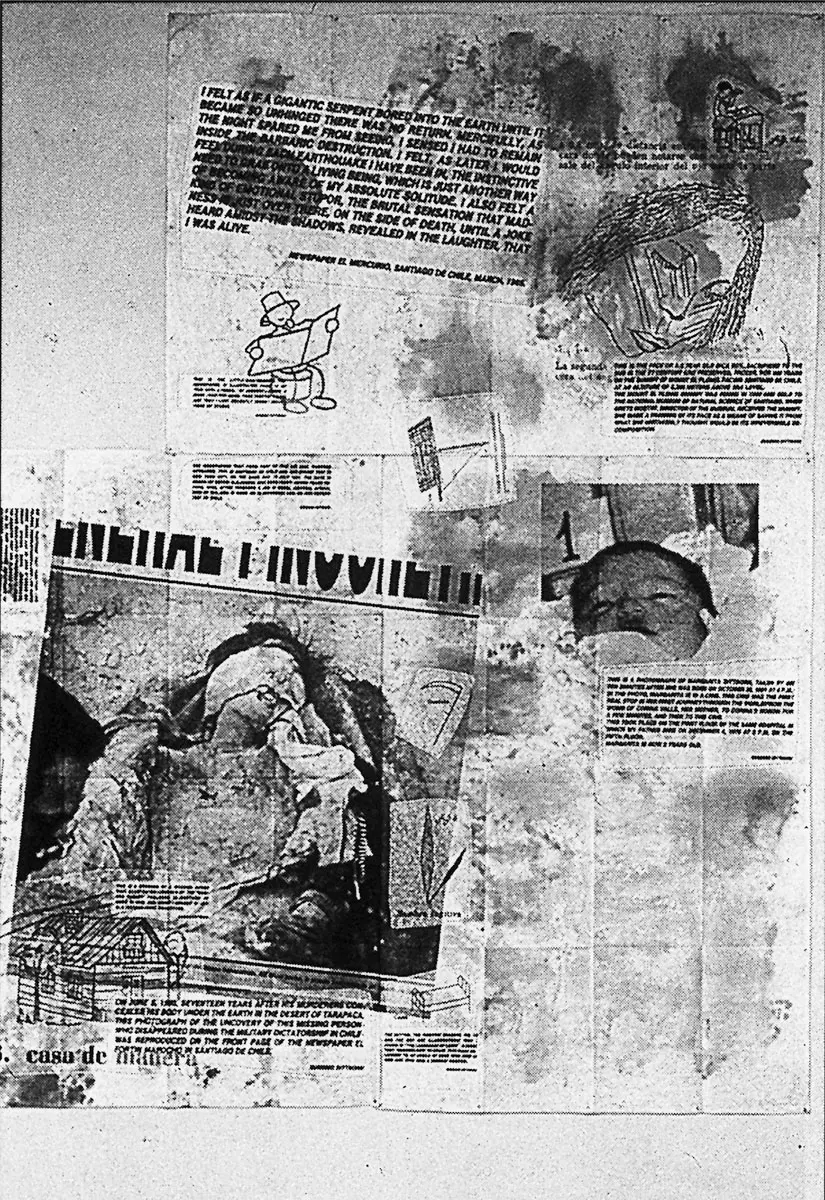
Operating dynamically not only against the amnesia propagated and institutionalized by the dictatorship but also against the recent negotiations by which the past is forgotten in the form of pardons in democracy's "return to business as usual", Dittborn's archive of memories have a redemptive character: they register the vertigo of reification, past and present. In Airmail Painting No. 90, The Corpse, The Treasure (1991), like a flash from the past interrupting the present, Dittborn's visual quotations and apostrophes from diverse media—including his own Airmail Paintings—denounce the living, redeem the dead, awaken one from the narcotic of an instrumentalist visuality. The fragmented gaze resuscitates aesthetics from the mere linguistic operation it has become for the most part; it brings to mind Peter Weiss' notion of aesthetics as a field of resistance, one which indicts the whole as untrue and its imposition and function as dogmatic if not tyrannical. In The Corpse, The Treasure, layers of memory registers around in the form of fragments: familial/ autobiographical (the image/text surrounding the birth of his daughter Margarita Dittborn, born in 1981 in the very same floor of the hospital where the artist's father passed away in 1979); familial/ anthropological/ pedagogical ('how to' draw snippets from The Language of Lines, a book that belonged to the artist's uncle); art historical/self-referential/intertextual (images and texts Dittborn has incorporated and deployed in the other Airmail Paintings); mass media/political/historical (a press photo reproduced in the Santiago newspaper, El Fortín Mapocho of the discovery of a cadaver of a disappeared citizen, dead for seventeen years, unearthed in the Tarapaca Desert). If photography is memory and the registering of absence, in the work of Dittborn, it acquires an interruptive and disruptive quality that engages the viewer. Simultaneously referring to itself, to one, to context(s) and to other(s), the Airmail Paintings, as hybrid materiality and activities, mix and match, through their registers, a heterogeneity of associations.
The Airmail Paintings travel, and often, depending on exhibition circuits, have many stops on their itinerary. "Are the paintings perhaps letters dispatched by the sender to the recipient to poison him in the ever-present to come?"11 But where is the poison? As stated in an interview with Sean Cubitt, Dittborn reiterates that meaning in his works, "depends on a supra-meaning, the circulation of the works through the international airmail network."12 The political impulse and dimension of the Airmail Paintings are not only in 'pre-established meanings' regarding Chile and the Americas, which Dittborn claims are never sufficient. The political aspects of his work, according to the artist, are to be found, "in the folds of the Airmail Paintings (like a poisonous powder) hidden there." Referring to a discussion that took place in Canada on mail art, Dittborn claims that, "these words brought about, provocatively, an edging-away from the immaterial and abstract notion of the political to a precise and particular notion of the political in my work: the air mailness or airmail strategy, as a material option and artistic cunning to disguise a painting as a letter, to infallibly reach places that are far from the starting point, to break through the isolation, separation and international confinement. All of this is possible because of, and from within, the folds. Traveling is, thus, the political element of my paintings. And the folds, the unfolding of that politics."13
Circuits of circulation, art included, are mapped by relations of power within globalization. Dittborn's strategies focus on and utilize circuits of power in our globalizing impulses and contexts. In more ways than one, the visual and textual strategies of the Airmail Paintings are declarations, metaphors, and allegories of the dynamic between art and power, its myths, deconstruction, and critique as well as its circuits. Dittborn's work calls attention to art as cultural capital; it underlines that as a practice, even in its self-critique and the manners it devises to circumvent the mainstream. Art is still connected to the market, to practices of collection and exhibition, and to regional, national and global narratives and their networks. After having viewed Remota: Airmail Paintings, one is apt to agree with Gerardo Mosquera's assessment of Dittborn, "His work is at the same time a symptom of discourse on globalization, dealings between the center and the periphery, physical journeys and intercrossing and imaginary and representational ones, border crossings..."14
NOTES
1. Eugenio Dittborn, Remota: Pinturas Aeropostales/Airmail Paintings, exh. cat. (Santiago de Chile: Publica Editora in collaboration with Museo de Bellas Artes. Santiago de Chile and New York: The New Museum of Contemporary Art, 1997) Includes interviews and essays by Guy Brett, Dan Cameron, Sean Cubitt, Eugenio Dittborn, Gerardo Mosquera. and Adriana Valdés.
2. Examples of these are Ante America/Regarding America (1992); About Place: Recent Art of the Americas (1994); Re-Aligning Vision: Alternative Currents in South American Drawing (1997).
3. These debates that took place in journals, on the internet, in exhibition programs and biennials, art fairs like FARCO (Guadalajara) and ARCO (Madrid), public programs in museums and cultural spaces, and, universities, include but are not limited to technology and media; critique of hegemonic art histories; curatorial practices; collecting and the market; art as cultural capital and its relation to discourses on the nation; historical and political identities; and, globalization.
4. Eugenio Dittborn, Remota: Pinturas Aeropostales/Airmail Paintings, op. cit. p.56.
5. Víctor Zamudio-Taylor: “An interview with Mari Carmen Ramírez," ARCO Journal, No. 1 (Madrid, 1997)
6. See Benjamin H.D. Buchloh, “Figures of Authority, Ciphers of Regression," and Thomas Lawson, “Last Exit: Painting,” in Brian Wallis (ed.), Art After Modernism: Rethinking Representation, (Boston: David R. Godine, Publisher Inc., and New York: The New Museum of Contemporary Art, 1984)
7. See Julia Herzberg, Historias Recuperadas: Aspectos del Arte Contemporáneo en Chile Desde 1982 (Recovering Histories: Aspects of Contemporary Art in Chile Since 1982) , exh. cat. (New Brunswick: State University of New Jersey, 1993)
8. Eugenio Dittborn, Remota: Pinturas Aeropostales/Airmail Paintings, op. cit. p.106.
9. Nelly Richard, “Metaphors of the Photographic Negative" in A Marginal Body: Contemporary Latin American Photography, expo. cat. (Sydney: Center for Photography, 1988)
10. Nelly Richard, "Nosotros/The Others," MAPA, exh. cat. (London: ICA and Rotterdam: Witte de With, 1992) p. 50.
11. Dittborn, Remota: Pinturas Aeropostales/ Airmail Paintings, op. cit. p.193.
12. Interview with Eugenio Dittborn by Sean Cubitt in Guy Brett, Sean Cubitt, Eugenio Dittborn, Camino Way (Santiago de Chile, 1991) p.28.
13. Camino Way, op. cit. p. 193.
14. Gerardo Mosquera, Remota: Pinturas Aeropostales/Airmail Paintings, op. cit. pp.157-158.
VÍCTOR ZAMUDIO-TAYLOR