
Ohuw-hni is the "anti-word" which Félix Lazo chose as a title for this impeccable exhibition held in three galleries simultaneously in Santiago. A pure signifier, this combination of letters, does not, in itself, represent anything else than its actual sound when pronounced. “Ohuw-hni, ohuw- hni" would be the translation to the verbal code of the sound produced by the repeated blows of a piece of wood against metal. But in the context of the strategy mounted by Lazo in this show, the title functions olympically as a key to meaning. The artist is not attempting to use an explanatory concept as a title for his work but is "inventing" a kind of independent sound object which, within its own structure, can encompass the whole. This kind of naming is the minimal yet sufficient gesture for enunciating the operational logic of his work.
Félix Lazo’s work is devised, articulated, and functions in a way similar to sound. Sounds are always present in space as autonomous and current events. This status of their presence which is offered up directly to perception is what characterizes his work. Although Lazo included installations, objects, paintings, and prints in his show, strictly speaking, all his production can be defined as objects. Even when they are paintings or prints, the framework is never used as a surface for representation, but as a presence in itself. Lazo does not illustrate or depict but rather translates. And translation means betrayal (in Italian the two words are often coupled together). The model, when it appears as a referent, is not subjected to a faithful copy, but is used as a citation from which an unfaithful and disobedient substitute is invented. Because the work has to function in itself in order to become a body that can relate to the body of each observer and must be recreated in each of these contacts.
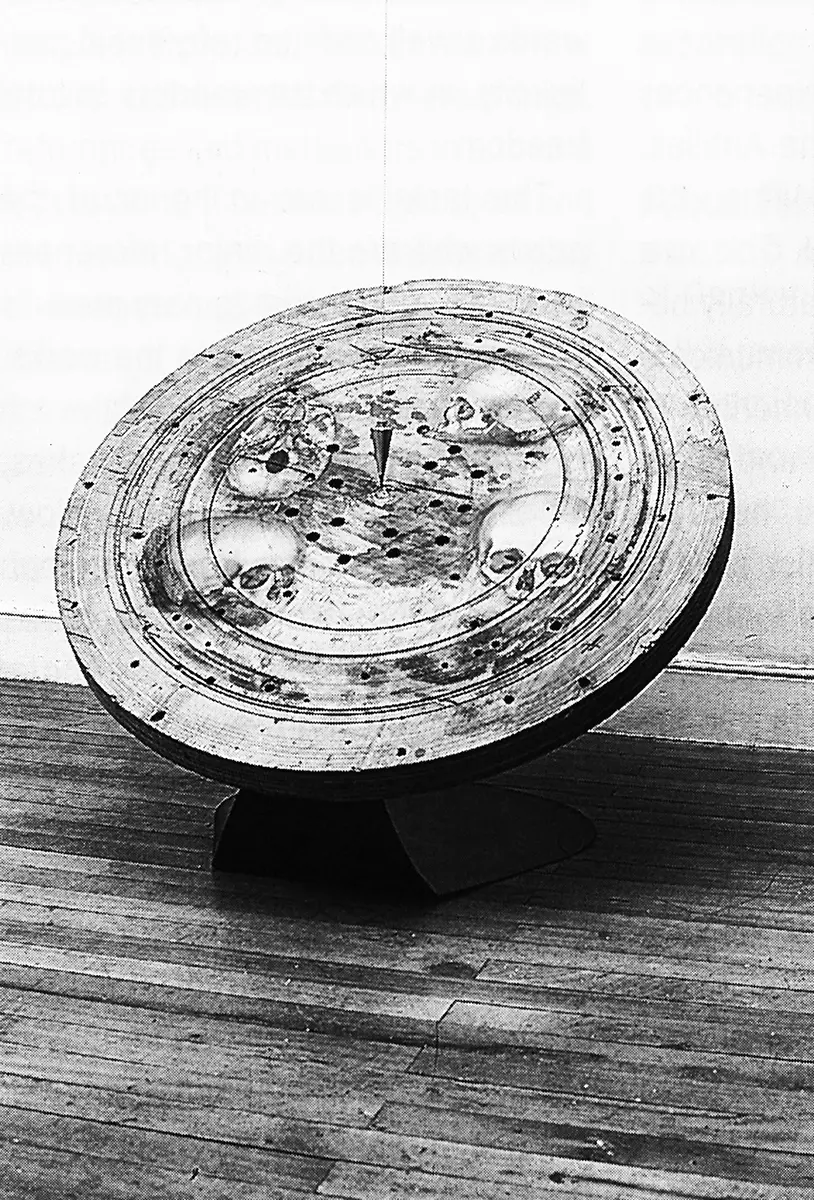
It might be that in the perceptive act of Lazo’s work, ideas fuse together from the cultural unconscious. In this case, the observer would be tempted towards metaphorical thought, that is, to believe that the work is trying to say something through the quotation and that this message needs to be deciphered. Indeed, the artist uses elements from the external world (a potato, a spoon, condoms) which undoubtedly evoke their own range of connotations and experiences. However, this journey towards external meaning is sabotaged by a kind of gravitational force that the work exercises against its own center. The elements behave in a very different way from the Duchamp “found object.” Rather than decontextualizing cultural meanings and problematizing them (something which happens in any case), here the potato, spoon, and condom lose their original meanings and function as part of a mechanism that has meaning in its total corporeality.
Lazo is not interested in metaphorical speculations or deciphering, but in the act of perception itself, because only at that moment of seduction will the work exist in a unique and unrepeatable way—something which will occur with each new gaze. The act of perception is taken to its point of maximum intensity so that the subject not only perceives the object but also perceives itself in the act of perception. Lazo obliges the spectator to have contact with the work, which inevitably takes him back into his own inner world.
The artist introduces us to a kind of “hyper consciousness of space” through a mise en question of bodies. This affects, at the most basic level, the relationship between the work, spectator, and exhibition space. However, within each work, Lazo also recreates real fields of forces in which the elements become strategically taut and relaxed. In turn, the selection and arrangement of the elements often refer to the physical sciences, their laws, and measuring instruments. In this way, the works become like experimental models for a study of scientific problems from the vantage point of art. It is as if Lazo wants to tell us that physical space can be examined through mental space or, even more radically, that the observable world is nothing more than a fiction shaped by thought mechanisms.
This calling into question of bodies evoked by Lazo’s work is achieved in Ohuw-hni with a maximum economy of resources. A rigorous aesthetic of poverty runs through the show. The artist uses tree trunks, sticks, and pieces of thin rope; the elements are always of a minimal kind. Color is used as a background that refuses to partake in any kind of expressive merriment, enabling the spectator’s gaze to deepen.
Austerity and precision are the hallmarks of this artist’s work, the sensibility of which is far from any kind of baroque effect-seeking and vociferous discourse.
CATALINA MENA