
The Galería Luigi Marrozzini recently presented in the West Room of the Arsenal de la Puntilla in old San Juan an exhibition entitled Navigare necesse by the Brazilian painter Fernando Paes.
At present, Paes is a teacher at the School of Plastic Arts of San Juan. Most of Paes’ pictures are mixed media works in which a variety of graphic media alternate with painting, reflecting a yearning for integration and a technical and cognitive synthesis. His work is emblematic of how atypical our times have become, immersed as it is in the constantly pendular aesthetic movement which has characterized the twentieth century and increased during the recent period. Probably, the postulates of postmodernism currently in vogue have to some extent played a role similar to that of romanticism at the end of the last century. Romanticism plunged into the past in an attempt to re-evaluate the greatness of the medieval period and primitive arts and contemporary developments can be seen as a veritable archeological attempt to give simultaneous currency to images culled from the most remote suburbs of history. This is precisely what happens in Paes’ work, where the globalizing attitude is of such scope that it surprises us with shocking elements whose use may lead to genuine trouvailles.
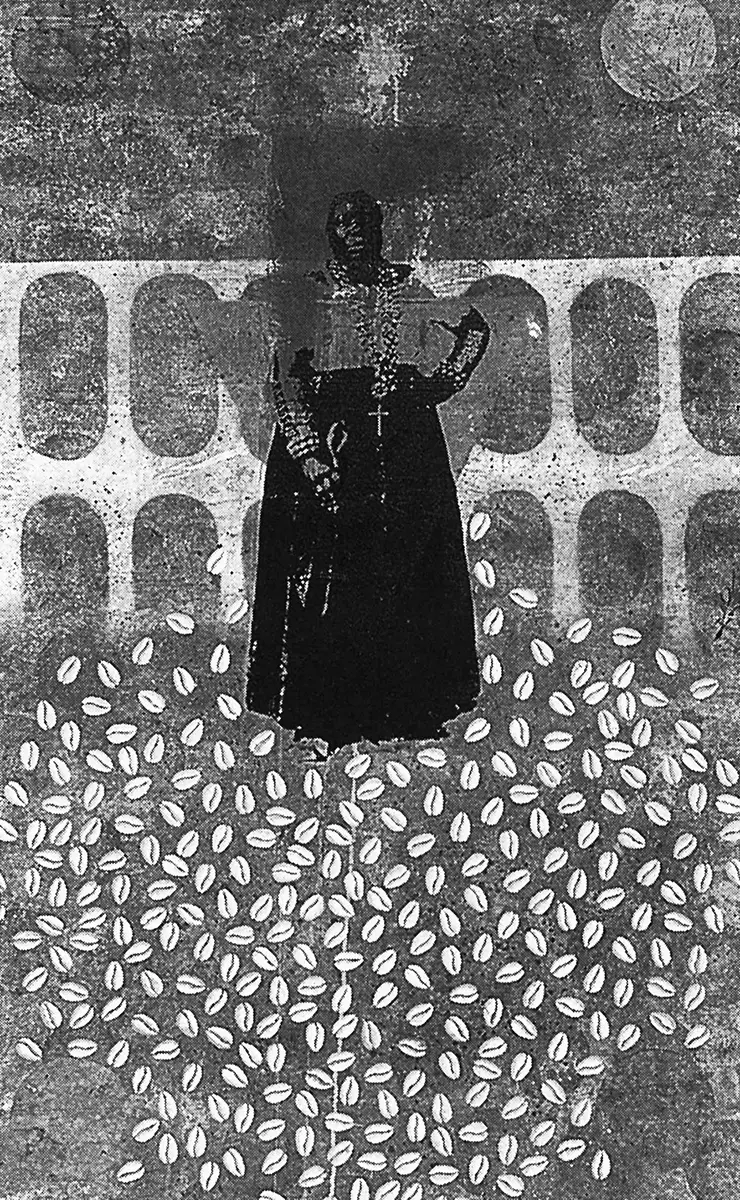
Paes explores all these imaginable dimensions of existence, directing his eye to the most immediate and intimate realities, as well as to those which are the most distant, perhaps in an attempt to compress time, to encapsulate experience in order to perpetuate it.
This kind of production becomes a kind of vital record of something caught between greatness and misery, pleasure and pain, freedom and slavery, civilization and barbarianism, anguish and hope, heroism and the basest forms of treachery. Mention must also be made of the way in which the artist creates special kinds of situations on his canvases, giving at it were a hearing to the events depicted, following the order or disorder in which the concepts appear in memory.
For Paes, art is a means of expressing what he sees and feels, to which he adds a number of very personal touches. In general, his use of the brush is very limited, and he applies to his canvases printed elements of his own or which have been taken from other contexts. He clearly sees himself as a descendant of the pop art generation and is very conscious of how that movement influenced the future. The main theme of pop art was the identity crisis produced by the consumer society, a feature which is reflected in Paes’ use of experimental techniques and exploitation of such common media as photo-serigraphy, collage, modules, and other forms of print-making. The superimposition of elements used in a personal manner is one of his objectives in the creation of pure images. All his current production is dominated by earth colors, where the intention is to emphasize the mysterious elements latent in his work. The persistent use of ropes, shells, and spirals in strategic parts of the canvas encourages the spectator to reflect on situations beyond the visual dimension.
Another characteristic feature of his work is the presence of a wide variety of animals. Baes has systematically consulted a number of specialized books on the subject, exploring the accounts compiled during the period of the Conquest and colonization of the continent and, in particular, the fantastic and imaginary creatures of the medieval period which overflowed into the New World. Paes has used the European art of the period when Europe first reached the western hemisphere; he is an admirer of Giotto and is fascinated by the way time has taken hold of his pictures - something which Paes believes has actually enriched the works. For this reason, he has tried to give a patina of age to his own pictures, in a kind of parody of the effects of time on the artist’s support.
The mixed-media works of Fernando Paes conjure up eclectic situations which include boats such as that which Jason used in his quest for the Golden Fleece. There are also references to Afro-Cuban cults, from a reading of the future through the use of shells to the angel figures of the Brazilian baroque. In conclusion, it is a work that encompasses the breadth and depth of our mestizo race and culture.
JOSÉ ANTONIO PÉREZ RUIZ